
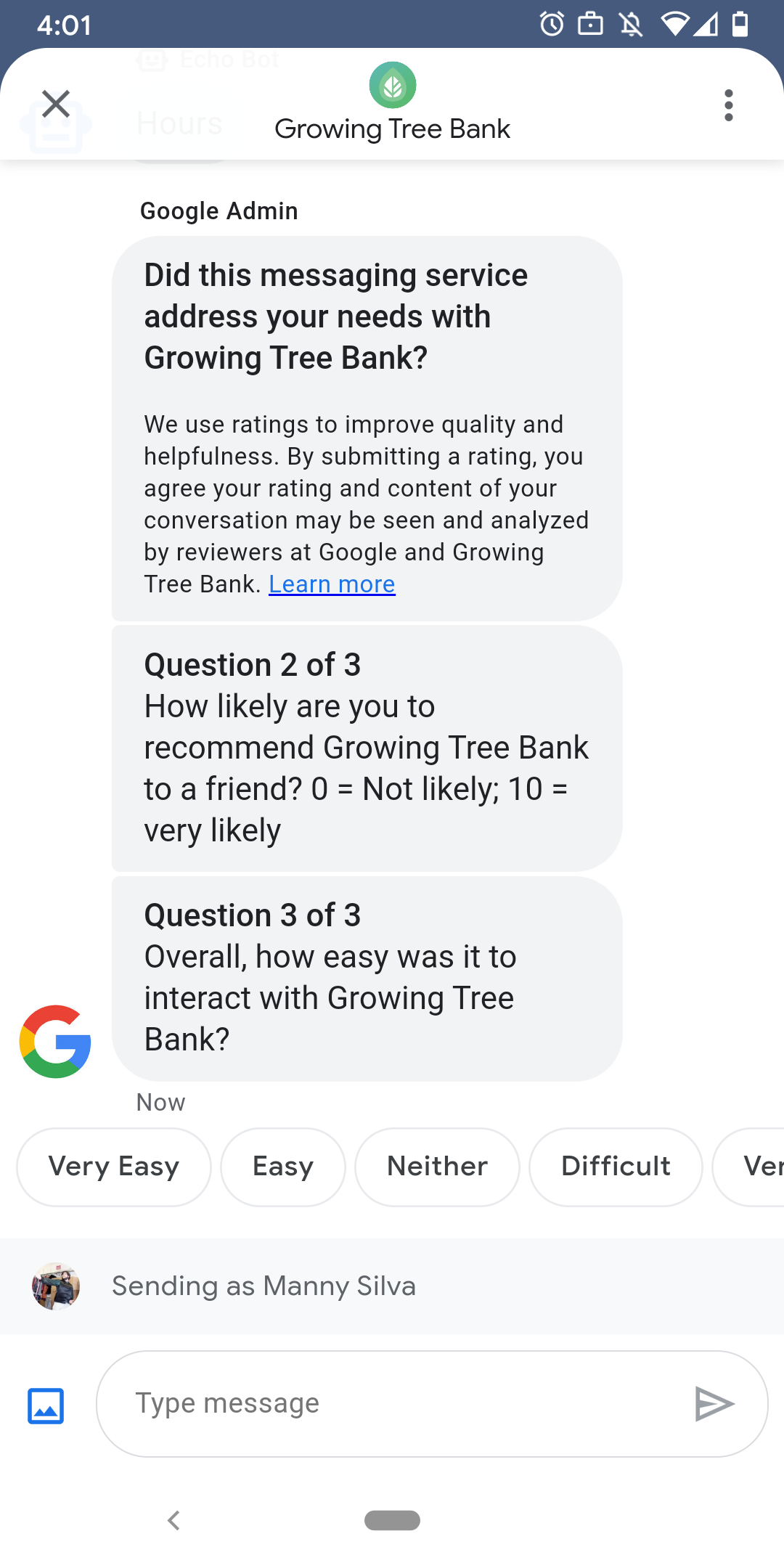
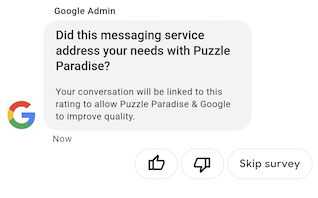
Google จะส่งแบบสำรวจให้ผู้ใช้หลังจากที่สนทนากับตัวแทนของคุณเสร็จสิ้น เพื่อให้มั่นใจว่าผู้ใช้จะได้รับประสบการณ์การโต้ตอบที่น่าพึงพอใจกับตัวแทนของคุณ หากต้องการรวบรวมข้อมูลในช่วงเวลาที่ต่างกัน เช่น เมื่อสิ้นสุดการสนทนา คุณสามารถส่งแบบสำรวจภายในบริบทของการสนทนาได้ แบบสำรวจจะแสดงในการสนทนาและช่วยให้ผู้ใช้แสดงความคิดเห็นได้ด้วยตัวเลือกต่างๆ โดยขึ้นอยู่กับคำถาม
ช่วงเวลาที่ Google ทริกเกอร์แบบสำรวจจะขึ้นอยู่กับความพร้อมในการรับส่งข้อความของตัวแทน
| ความพร้อมใช้งาน | เวลาในการทำแบบสำรวจ |
|---|---|
| บ็อตเท่านั้น | 30 นาทีหลังจากข้อความสุดท้าย |
| เฉพาะมนุษย์ | 24 ชั่วโมงทำการหลังจากข้อความสุดท้าย |
| บ็อตและมนุษย์ | 24 ชั่วโมงทำการหลังจากข้อความสุดท้าย |
หากมีเวลาทำการน้อยกว่า 24 ชั่วโมงในอีก 7 วันข้างหน้า เราจะใช้ 24 ชั่วโมงแทน
คุณส่งแบบสำรวจได้ 1 รายการต่อการสนทนาทุก 24 ชั่วโมง หากคุณส่งแบบสำรวจใน การสนทนาก่อน Google ระบบจะไม่ส่งแบบสำรวจไปยังการสนทนานั้น หากตัวแทนส่งแบบสำรวจหลายรายการในการสนทนาเดียวกันภายใน 24 ชั่วโมง Business Messages จะพยายามส่งแบบสำรวจแรกให้ผู้ใช้เท่านั้น
ครั้งถัดไปที่ผู้ใช้เริ่มการสนทนากับตัวแทนหลังจากทำแบบสำรวจเสร็จ ตัวแทนจะแสดงคำทักทาย หากผู้ใช้ไม่ตอบแบบสำรวจ แบบสำรวจจะหมดอายุหลังจากผ่านไป 7 วัน และ ผู้ใช้จะเห็นคำทักทายในการสนทนาครั้งถัดไปหลังจากที่แบบสำรวจหมดอายุ
หากผู้ใช้ส่งข้อความที่ไม่เกี่ยวข้องกับแบบสำรวจขณะที่แบบสำรวจใช้งานอยู่ใน การสนทนา ข้อความธุรกิจจะยกเลิกแบบสำรวจและส่งข้อความของผู้ใช้ ไปยัง Webhook ของตัวแทน
หากคุณไม่ได้ส่งแบบสำรวจให้ผู้ใช้ แต่เอเจนต์จะยังได้รับผลลัพธ์ของแบบสำรวจของ Google ที่เว็บบุ๊กของคุณ และควรยอมรับและประมวลผลผลลัพธ์เหล่านั้นตามความเหมาะสม
คำถาม
แบบสำรวจมีคำถามได้สูงสุด 5 ข้อ โดยแบ่งออกเป็น 3 หมวดหมู่ ได้แก่ ต้องระบุ เทมเพลต และกำหนดเอง แบบสำรวจ จะมีคำถามที่จำเป็นเสมอ จากนั้นจะแสดงคำถามจากเทมเพลต สูงสุด 2 ข้อ แล้วจึงแสดงคำถามที่กำหนดเองสูงสุด 2 ข้อ
คำถามที่ต้องตอบ
คำถามที่จำเป็นต้องตอบจะได้รับการแปลเป็นภาษาท้องถิ่นในทุกภาษาที่ Business Messages รองรับ ผู้ใช้สามารถตอบกลับได้โดยใช้ไอคอนชอบหรือไม่ชอบ
คำถามที่จำเป็น: "บริการรับส่งข้อความนี้ช่วยแก้ไขปัญหาความต้องการเกี่ยวกับ AGENT_NAME ของคุณได้หรือไม่"
คำถามเกี่ยวกับเทมเพลต
คำถามในเทมเพลตเป็นคำถามที่ไม่บังคับซึ่ง Google กำหนดไว้และแปลเป็นภาษาท้องถิ่น ในทุกภาษาที่ Business Messages รองรับ แบบสำรวจมีคำถามจากเทมเพลตได้สูงสุด 2 ข้อ รูปแบบคำตอบของผู้ใช้จะแตกต่างกันไปตามคำถาม
คำถามในเทมเพลต ได้แก่
- ประสบการณ์เกี่ยวกับการรับส่งข้อความกับ AGENT_NAME เป็นอย่างไรบ้าง
- คุณมีแนวโน้มมากน้อยเพียงใดที่จะแนะนำ AGENT_NAME ให้กับเพื่อน
- ครั้งต่อไปที่คุณติดต่อ AGENT_NAME คุณมีแนวโน้มมากน้อยเพียงใดที่จะเลือกการส่งข้อความ
- โดยรวมแล้ว การโต้ตอบกับ AGENT_NAME มีความยากง่ายมากน้อยเพียงใด
- คุณเห็นด้วยหรือไม่เห็นด้วยกับข้อความต่อไปนี้มากน้อยเพียงใด AGENT_NAME ช่วยให้ฉันจัดการปัญหาได้ง่ายขึ้น
- โปรดให้คะแนนความพึงพอใจโดยรวมของคุณที่มีต่อพนักงานฝ่ายช่วยเหลือ
- เซสชันการแชทนี้ช่วยทำให้คุณไม่จำเป็นต้องโทรหา AGENT_NAME หรือไม่
หากต้องการดูรายการคำถามในเทมเพลตทั้งหมดที่ใช้ได้และรับรหัสเทมเพลต ให้ทำดังนี้
- เปิดคอนโซลนักพัฒนาแอปการสื่อสารทางธุรกิจ แล้วลงชื่อเข้าใช้ด้วยบัญชี Google ของ Business Messages
- เลือกตัวแทน
- คลิกแบบสำรวจในการนำทางด้านซ้าย
คำถามที่กำหนดเอง
แบบสำรวจมีคำถามที่กำหนดเองได้สูงสุด 2 ข้อ หากคุณระบุคำถามที่กำหนดเอง ให้ระบุคำถามเวอร์ชันต่างๆ สำหรับแต่ละภาษา ที่ตัวแทนของคุณรองรับ คุณต้องระบุเวอร์ชันของคำถามแต่ละข้อสำหรับภาษาเริ่มต้น หากผู้ใช้ได้รับแบบสำรวจแต่ใช้ภาษาที่ไม่มีคำถามที่กำหนดเองเวอร์ชันที่ระบุ คำถามจะแสดงตามที่กำหนดไว้ในภาษาเริ่มต้นของตัวแทน
คำตอบสำหรับคำถามที่กำหนดเองรองรับข้อความและข้อมูลระบบรายงานผล Conversion แยกกัน ซึ่งคล้ายกับคำตอบที่แนะนำ
ปรับแต่งแบบสำรวจ
หากต้องการปรับแต่งแบบสำรวจสำหรับตัวแทน ให้ทำดังนี้
- เปิดคอนโซลนักพัฒนาแอปการสื่อสารทางธุรกิจ แล้วลงชื่อเข้าใช้ด้วยบัญชี Google ของ Business Messages
- เลือกตัวแทน
- คลิกแบบสำรวจในการนำทางด้านซ้าย
- เพิ่มคำถามจากเทมเพลตที่มีอยู่ลงในแบบสำรวจได้สูงสุด 2 ข้อ
- คลิกสร้างคำถามที่กำหนดเองเพื่อเพิ่มคำถามที่กำหนดเองลงในแบบสำรวจ
ดูตัวเลือกการจัดรูปแบบและค่าได้ที่
surveyConfig
ส่งแบบสำรวจ
หากต้องการส่งแบบสำรวจ ให้เรียกใช้คำสั่งต่อไปนี้ แทนที่ CONVERSATION_ID ด้วยตัวระบุของการสนทนาที่คุณต้องการส่งแบบสำรวจ และ SURVEY_ID ด้วยตัวระบุที่ไม่ซ้ำกันสำหรับแบบสำรวจ
cURL
# Copyright 2021 Google LLC # # Licensed under the Apache License, Version 2.0 (the "License"); # you may not use this file except in compliance with the License. # You may obtain a copy of the License at # https://www.apache.org/licenses/LICENSE-2.0 # Unless required by applicable law or agreed to in writing, software # distributed under the License is distributed on an "AS IS" BASIS, # WITHOUT WARRANTIES OR CONDITIONS OF ANY KIND, either express or implied. # See the License for the specific language governing permissions and # limitations under the License. # This code sends a survey to the user: # Read more: https://developers.google.com/business-communications/business-messages/guides/how-to/message/surveys?hl=en # Replace the __CONVERSATION_ID__ with a conversation id that you can send messages to # Make sure a service account key file exists at ./service_account_key.json curl -X POST "https://businessmessages.googleapis.com/v1/conversations/__CONVERSATION_ID__/surveys?surveyId=f4bd7576-6c2e-4674-9db4-d697166f63ce" \ -H "Content-Type: application/json" \ -H "User-Agent: curl/business-messages" \ -H "$(oauth2l header --json ./service_account_key.json businessmessages)"
Node.js
/** * This code sends a survey to the user: * Read more: https://developers.google.com/business-communications/business-messages/guides/how-to/message/surveys?hl=en * * This code is based on the https://github.com/google-business-communications/nodejs-businessmessages Node.js * Business Messages client library. */ /** * Edit the values below: */ const PATH_TO_SERVICE_ACCOUNT_KEY = './service_account_key.json'; const CONVERSATION_ID = 'EDIT_HERE'; const businessmessages = require('businessmessages'); const uuidv4 = require('uuid').v4; const {google} = require('googleapis'); // Initialize the Business Messages API const bmApi = new businessmessages.businessmessages_v1.Businessmessages({}); // Set the scope that we need for the Business Messages API const scopes = [ 'https://www.googleapis.com/auth/businessmessages', ]; // Set the private key to the service account file const privatekey = require(PATH_TO_SERVICE_ACCOUNT_KEY); /** * Posts a survey to the Business Messages API. * * @param {string} conversationId The unique id for this user and agent. */ async function sendSurvey(conversationId) { const authClient = await initCredentials(); // Create the payload for creating a new survey const apiParams = { auth: authClient, parent: 'conversations/' + conversationId, surveyId: uuidv4(), resource: {} }; // Call the message create function using the // Business Messages client library bmApi.conversations.surveys.create(apiParams, {auth: authClient}, (err, response) => { console.log(err); console.log(response); }); } /** * Initializes the Google credentials for calling the * Business Messages API. */ async function initCredentials() { // configure a JWT auth client const authClient = new google.auth.JWT( privatekey.client_email, null, privatekey.private_key, scopes, ); return new Promise(function(resolve, reject) { // authenticate request authClient.authorize(function(err, tokens) { if (err) { reject(false); } else { resolve(authClient); } }); }); } sendSurvey(CONVERSATION_ID);
Java
import com.google.api.client.googleapis.services.AbstractGoogleClientRequest; import com.google.api.client.http.HttpBackOffUnsuccessfulResponseHandler; import com.google.api.client.http.HttpRequest; import com.google.api.client.googleapis.auth.oauth2.GoogleCredential; import com.google.api.client.googleapis.javanet.GoogleNetHttpTransport; import com.google.api.client.http.HttpTransport; import com.google.api.client.json.jackson2.JacksonFactory; import com.google.api.client.util.ExponentialBackOff; import com.google.api.services.businessmessages.v1.Businessmessages; import com.google.api.services.businessmessages.v1.model.*; import java.io.FileInputStream; import java.util.Arrays; import java.util.UUID; class SendSurveySnippet { /** * Initializes credentials used by the Business Messages API. */ private static Businessmessages.Builder getBusinessMessagesBuilder() { Businessmessages.Builder builder = null; try { GoogleCredential credential = GoogleCredential .fromStream(new FileInputStream("PATH_TO_SERVICE_ACCOUNT_KEY")); credential = credential.createScoped(Arrays.asList( "https://www.googleapis.com/auth/businessmessages")); credential.refreshToken(); HttpTransport httpTransport = GoogleNetHttpTransport.newTrustedTransport(); JacksonFactory jsonFactory = JacksonFactory.getDefaultInstance(); // Create instance of the Business Messages API builder = new Businessmessages .Builder(httpTransport, jsonFactory, null) .setApplicationName("Sample Application"); // Set the API credentials and endpoint builder.setHttpRequestInitializer(credential); } catch (Exception e) { e.printStackTrace(); } return builder; } public static void main(String args[]) { try { String conversationId = "CONVERSATION_ID"; // Create client library reference Businessmessages.Builder builder = getBusinessMessagesBuilder(); // Create a new survey to send to the user associated with the conversationId Businessmessages.Conversations.Surveys.Create request = bmBuilder.build().conversations().surveys() .create("conversations/" + conversationId, new BusinessMessagesSurvey()); request.setSurveyId(UUID.randomUUID().toString()); // Setup retries with exponential backoff HttpRequest httpRequest = ((AbstractGoogleClientRequest) request).buildHttpRequest(); httpRequest.setUnsuccessfulResponseHandler(new HttpBackOffUnsuccessfulResponseHandler( new ExponentialBackOff())); // Execute request httpRequest.execute(); } catch (Exception e) { e.printStackTrace(); } } }
Python
"""This code sends a survey to the user. Read more: https://developers.google.com/business-communications/business-messages/guides/how-to/message/surveys?hl=en This code is based on the https://github.com/google-business-communications/python-businessmessages Python Business Messages client library. """ import uuid from businessmessages import businessmessages_v1_client as bm_client from businessmessages.businessmessages_v1_messages import BusinessmessagesConversationsSurveysCreateRequest from businessmessages.businessmessages_v1_messages import BusinessMessagesSurvey from oauth2client.service_account import ServiceAccountCredentials # Edit the values below: path_to_service_account_key = './service_account_key.json' conversation_id = 'EDIT_HERE' credentials = ServiceAccountCredentials.from_json_keyfile_name( path_to_service_account_key, scopes=['https://www.googleapis.com/auth/businessmessages']) client = bm_client.BusinessmessagesV1(credentials=credentials) # Create the survey request survey_request = BusinessmessagesConversationsSurveysCreateRequest( surveyId=str(uuid.uuid4().int), parent='conversations/' + conversation_id, businessMessagesSurvey=BusinessMessagesSurvey()) # Send the survey bm_client.BusinessmessagesV1.ConversationsSurveysService( client=client).Create(request=survey_request)
ดูตัวเลือกการจัดรูปแบบและค่าได้ที่
conversations.surveys
รับคำตอบแบบสำรวจ
เมื่อผู้ใช้ตอบคำถามในแบบสำรวจ เอเจนต์จะได้รับการตอบกลับ ที่ Webhook รับและประมวลผลคำตอบของแบบสำรวจในลักษณะเดียวกับที่รับ ข้อความ
คำถามทั้งหมดในแบบสำรวจมีค่า surveyResponse.survey เหมือนกัน หากแบบสำรวจมีคำถามหลายข้อ โปรดตรวจสอบว่าโครงสร้างพื้นฐานยอมรับคำตอบหลายรายการที่มีค่า surveyResponse.survey เดียวกัน และระบุคำถามแต่ละข้อตามฟิลด์ surveyResponse.surveyQuestionId
ค่าข้อความสำหรับคำตอบของแบบสำรวจจะปรากฏใน
surveyResponse.questionResponseText สำหรับคำถามที่ต้องตอบและคำถามในเทมเพลต
Business Messages จะแสดงคำตอบเป็นกดชอบเป็น VERY_SATISFIED และคำตอบเป็นไม่ชอบเป็น VERY_DISSATISFIED หากคำตอบของคำถามที่กำหนดเองมีอีโมจิ แนวทางปฏิบัติแนะนำคือการใช้surveyResponse.questionResponsePostbackDataแทนที่จะพยายามแยกวิเคราะห์ค่า Unicode
คำตอบของแบบสำรวจมีรูปแบบดังนี้
{
  "agent": "brands/BRAND_ID/agents/AGENT_ID",
  "sendTime": "SEND_TIME",
  "conversationId": "CONVERSATION_ID",
  "requestId": "REQUEST_ID",
  "surveyResponse": {
    "survey": "conversations/CONVERSATION_ID/surveys/SURVEY_ID",
    "rating": "SURVEY_RATING",
    "createTime": "CREATE_TIME",
    "surveyQuestionId": "QUESTION_ID",
    "questionResponseText": "RESPONSE_TEXT",
    "questionResponsePostbackData": "RESPONSE_POSTBACK_DATA",
    "questionType": "QUESTION_TYPE",
    "questionIndex": QUESTION_INDEX,
    "totalQuestionCount": TOTAL_QUESTION_COUNT,
    "surveyTriggerSource": "TRIGGER_SOURCE"
  }
}
ดูตัวเลือกการจัดรูปแบบและค่าได้ที่
UserMessage
และ
SurveyResponse