Platform roadmap
Stay organized with collections
Save and categorize content based on your preferences.
Our goal is to provide the industry with an NPU reference
implementation, based on RISC-V standards, that is easy to adopt and
integrate.
The initial Coral NPU release included our RISC-V compliant scalar core and
the vector execution unit. A future release will introduce the RISC-V matrix
execution unit that will provide a complete, end-to-end, open-source stack
for a fully RISC-V compliant NPU. Below is a high-level roadmap for planned
feature additions and enhancements to the platform.
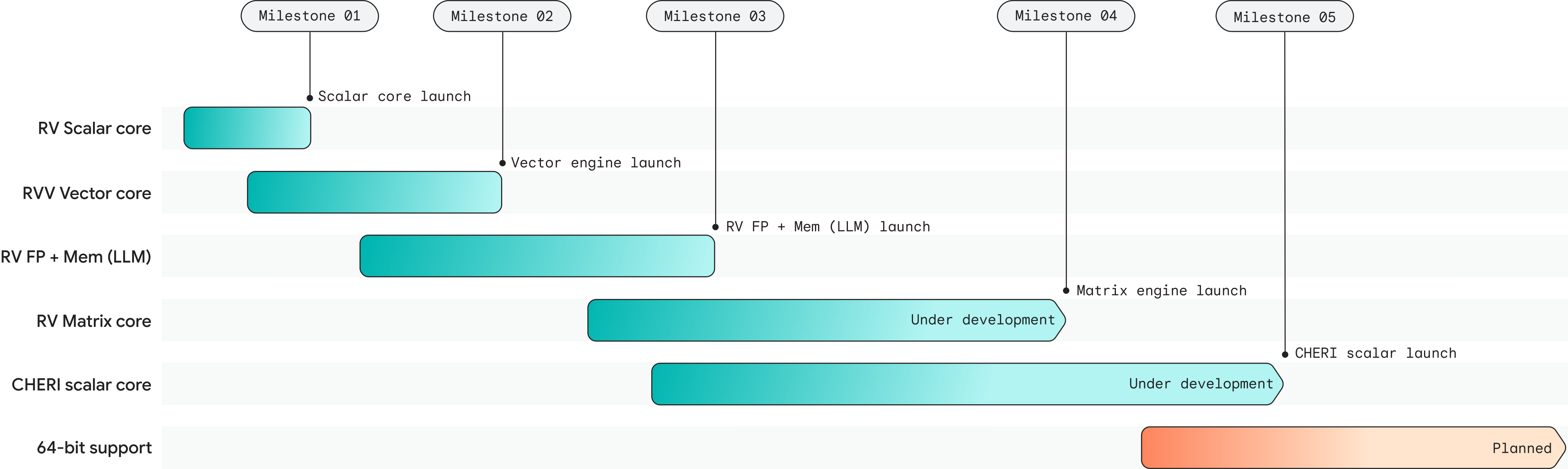
Note that this roadmap is a tentative plan and is subject to change.
|
Milestone 3
Released: Q2 2026 |
Milestone 4
Released: Q4 2026 |
| Focus |
Premier reference accelerator for Gemma |
RISC-V VME Matrix execution engine launch
Google Coral MLIR compiler release |
| Highlights |
- For low-power wearable devices, adding always-on ambient
sensing.
- Neural encoding of sensor data, acts as a trigger for high-power
domain or tethered device.
- Scalar core achieves open standards ISA compliance.
- Improves the RVV vector execution unit to support larger models and transformer architectures.
|
- For low-power wearable devices, adding always-on ambient sensing.
- Neural encoding of sensor data, acts as a trigger for high-power domain
or tethered device.
- Scalar core achieves open standards ISA compliance.
- RISC-V vector execution unit for RVV specification-compliant SIMD.
- Dedicated quantized outer-product multiply-accumulators (MAC)
- RISC-V VME ISA extensions for matrix multiplication
- Open-source Coral MLIR compiler v1.0 on GitHub
- End-to-end compiler and simulation stack that takes JAX, PyTorch, and LiteRT models straight to the Coral NPU hardware simulator
|
| Specifications |
- RISC-V 32-bit ISA 4-stage CPU
- RISC-V RVV vector unit with VLEN = 128, 256, or 512
- Supports larger memory capacity, up to 4 GB maximum
- Supported numerics: int8, int16, FP32 (FP16, BF16)
- Area = approx. 0.2 mm2 in TSMC 12nm (N12)
- Performance = 800 MHz clock x 16 MACs per cycle
|
- RISC-V 32-bit ISA 4-stage CPU
- RISC-V RVV vector unit with VLEN = 128, 256, or 512
- RISC-V VME matrix unit, configurable for up to 1 TOPS and targeting 10mW average power for inference
- Supports larger memory capacity, up to 4 GB maximum
- Supported numerics: int8, int16, FP32 (FP16, BF16)
- Area = approx. 0.2 mm2 in TSMC 12nm (N12)
- Performance = 800 MHz clock x 256 MACs per cycle
|
| Reference architectures |
|
|
| Target model size |
Less than 1 GB |
Less than 1 GB |
| Example use cases |
- Is someone talking
- Keyword detection
- Person or object detection
- Who is the person?
- What is the object?
- LLM transcription/translation
- Token encoding for tethered device
|
- Is someone talking?
- Keyword detection
- Person or object detection
- Who is the person?
- What is the object?
- LLM transcription/translation
- Token encoding for tethered device
|
Except as otherwise noted, the content of this page is licensed under the Creative Commons Attribution 4.0 License, and code samples are licensed under the Apache 2.0 License. For details, see the Google Developers Site Policies. Java is a registered trademark of Oracle and/or its affiliates.
Last updated 2026-10-19 UTC.
[[["Easy to understand","easyToUnderstand","thumb-up"],["Solved my problem","solvedMyProblem","thumb-up"],["Other","otherUp","thumb-up"]],[["Missing the information I need","missingTheInformationINeed","thumb-down"],["Too complicated / too many steps","tooComplicatedTooManySteps","thumb-down"],["Out of date","outOfDate","thumb-down"],["Samples / code issue","samplesCodeIssue","thumb-down"],["Other","otherDown","thumb-down"]],["Last updated 2026-10-19 UTC."],[],[]]