
Locator Tags
This section specifies the Locator Tag device behavior for FastPair and Find My Device Network capabilities and includes the mandatory and optional features required to certify such devices.
Dependency
To be certified, the device must support the relevant sections from GFPS v2.0 specification, as well as the Find Hub Network specification, as listed in the Features List section. This includes the relevant Unwanted Tracking Prevention specification, which provides a cross-platform security mechanism.
Features List
| Requirement | Feature |
|---|---|
| Mandatory |
|
| Optional |
|
| Not Supported |
|
Device Console Configuration - Locator Tags
Some features must also be configured in the Device Console to work. This table describes the options a partner must select to enable those features.
| Feature Type | Feature Name | Device Console Option Name | Example |
|---|---|---|---|
| Mandatory |
Find Hub Network |
Find Hub |
 |
| Optional |
BLE spec support (including LE audio) |
LE Audio |
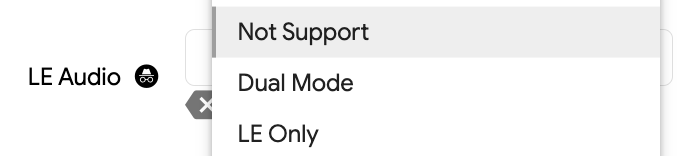 |
Certification (early access)
All supported features must meet the Find Hub network certification criteria.
FH Automated tests results should be uploaded using the FastPair validator App.
FH Manual tests results should be provided using the template available in the linked web page.
Certified Chipsets
The following chipsets are already certified for FHN.
| Vendor | Model |
|---|---|
| Airoha | AB1611M |
| Atmosic | ATM34 |
| Bluetrum | AB202x |
| Goodix | GR5331 |
| InPlay | IN610 |
| Jahport | JC511 |
| Lenzetech |
|
| Nordic |
|
| OnMicro | OM6626B |
| Realtek | RTL8762EMF |
| Renesas | DA14592 |
| Telink | AP2T21F40 |
Hardware requirements for Precision Finding
This section is intended for hardware developers who are considering or are in the process of designing a device that will be capable of Precision Finding using Google's Find Hub app. It contains hardware requirements for achieving optimal ranging measurement results.
Ranging Technology consideration
While there are many different ranging technologies, Precision Finding works best when Ultra-wideband is supported. Technologies such as Channel Sounding are supported, but the user might see less accurate distance measurements. Also, direction finding is only supported with UWB, while other technologies only provide distance guidance.
Hardware requirements for Ultra-wideband Precision Finding
The choice of the UWB chip and the antenna design are the two most important factors to consider when designing an UWB enabled device.
UWB Chip
The UWB chip must be FiRa compatible. The chip must support these parameters:
- Ranging Interval: 96ms is recommended for optimal precision finding experience, maximum allowed ranging interval is 240ms
- Ranging Slot Duration: 1ms for optimal battery performance, maximum allowed 2ms
- Slots Per Ranging Round: 6
- Initiation Time: 0ms
- Hopping: Hopping enabled
- Security: P-STS
- Support high pulse repetition frequency
Looking ahead, if the device is planned for a release after the 802.15.4ab standard becomes available, then a UWB chip that implements that standard will be highly recommended.
Definitions
- TX: transmit
- RX: receive
- Reference device: Pixel 9 Pro or Pixel 10 Pro
- Receive chain: A device's RX antenna gain + RX antenna efficiency + RX line losses + the chip's receive sensitivity on the device. Its performance is given in the same units as the receive sensitivity (dB, or dBm)
- Antenna efficiency: The antenna's performance versus the ideal Friis aperture (λ^2 / 4π). It should be a number between 0 and 1, then converted into decibels.
- Group delay: the timing delay introduced by the physical properties of the antenna. Since distance = c τ, where τ is the delay, c is the speed of light, group delay can result in a range bias. If group delay is a function of antenna orientation, then a change in device orientation can cause a change in the measured range.
- Initiator / responder: https://www.firaconsortium.org/resource-hub/blog/uwb-terminology
Measurements Introduction
- The FiRa convention used for precision finding is that the phone is the responder, and that the peripheral is the initiator.
- Getting UWB range involves a two-way link from the phone to the peripheral device, e.g. phone TX → peripheral RX, peripheral TX → phone RX.
- The links are not symmetric due to
- The device that is the responder will have an approximately 6dB RX sensitivity drop due to receiving SP0 packets as defined in the FiRa standard.
- The peripheral device may have different receiver sensitivity than the phone, or may not transmit at the maximum allowed EIRP.
- The antenna gain of the peripheral is a function of the orientation of the peripheral with respect to the phone, and the impact of a peripheral's antenna gain for a single antenna is symmetric in both receive and transmit.
- Whichever of the two links has the lowest signal to noise ratio (SNR) will be the link that determines ranging performance.
- Performance relative to a reference device for both TX and RX can be determined by testing in an anechoic chamber by purposely attenuating the signal between two devices. See below for more information.
- In marginal SNR conditions, packet loss occurs probabilistically, transitioning from 0% packet loss to 100% packet loss as SNR decreases.
Required Test Equipment
- 1x anechoic chamber
- at least 1 meter in length
- with an internal antenna that is externally accessible using connector (BNC, SMA, etc.) on one side
- with a rotating, RF absorbing platform inside, located at the opposite from the internal antenna
- with external access to the chamber's internal antenna allows RF attenuators to be placed inline.
- 1x peripheral device, which will be one of the devices under test (DUT)
- implements the FiRa protocol
- can successfully get range with the external UWB test device.
- 1x reference device (Pixel 9 or 10 Pro), which will also be a device
under test
- with an app (example) that leverages the Ranging Module such that it will act as a FiRa initiator
- 1x external UWB test device, separate from the reference device and
peripheral. For example, another Android phone with UWB, or an EVK that
- is capable of changing its TX power in a range of 10 dB
- connects to the chamber's internal antenna using appropriate bandwidth coaxial cable, i.e. has a SMA connector
- acts as a FiRa responder
- is capable of reporting
- % packet loss over a 10 second period
- UWB range
- RSSI in dB
- Multiple RF attenuators, or an adjustable RF attenuator that can be coupled in series with the anechoic chamber's internal antenna line, such that attenuation ranging from 6 dB to 40 dB attenuation in increments no larger than 2 dB can be applied.
- 1x test fixture for the peripheral that allows it to stand orthogonal to its nominal resting position, assuming the industrial design is to have a 'flat' device. This fixture shouldn't interfere with the RF signal. For example, a device that normally lies flat can be propped standing up on its side.
- 1x test fixture for the reference device that holds it up so the phone's back faces the internal antenna

Peripheral RX / TX Testing Relative to a Reference Device
At the end of this testing you should have the following values
- Maximum and minimum RSSI measured at the external UWB device from the peripheral device and the orientation of your peripheral device at the maximum RSSI
- Maximum and minimum range over orientation (i.e. range of group delay)
- Attenuation required to break DUT TX → external UWB RX link for reference phone and peripheral device in the maximum RSSI direction
- Attenuation required to break external UWB TX → DUT RX link for the reference phone and peripheral device in the maximum RSSI direction
Test 1: Maximum / Minimum Gain Directions and Group Delay of the Peripheral
Remember: Both DUTs should be acting as FiRa initiators.
Find maximum gain direction of the peripheral device
- Make sure that there is no attenuator in line with the internal antenna and the external UWB device.
- Rotate the peripheral in 15 degrees increments, and record at each
orientation
- the RSSI as seen at the external UWB device
- the UWB range measurement
- Flip the device 90 degrees on its side and repeat step 2.
- If you already know the gain pattern of your device from simulation or other testing, make sure the RSSI variation matches your expectations.
At the end of this test you should roughly know
- The maximum RSSI, and its direction of your peripheral device
- The minimum RSSI of your peripheral device
- The group delay variation (max range - min range) of your peripheral device
Test 2: DUT TX
Remember: Both DUTs (peripheral + reference phone) should be acting as FiRa initiators.
Test goal: Find the maximum attenuation of peripheral and reference devices in the DUT TX → external RX direction
For this test you must guarantee that the weak link direction is DUT TX → external UWB device RX. You can do this by increasing the external UWB device TX power to its maximum.
For both the peripheral and the reference device (i.e. do this test twice)
- Point maximum gain direction of DUT towards internal antenna. If it's the reference device, just point its back (phone -Z direction, i.e. the camera bar direction) to the internal antenna.
- Add attenuation until roughly 20% packet loss is seen on the external UWB device. Record this amount of attenuation.
At the end of this test you should know two values:
- How much attenuation the peripheral TX → External UWB device RX can handle
- The same as above, but for the reference phone device.
Test 3: DUT RX
Remember: Both DUTs (peripheral + reference phone) should be acting as FiRa initiators.
Test goal: Find the maximum attenuation of peripheral and reference devices to the external UWB → DUT RX direction.
*For this test you must guarantee that the weak link direction is the external UWB device TX → DUT RX (opposite of the previous test). You can do this by decreasing the external UWB device TX power to its minimum.*
For both the peripheral and the reference device (i.e. do this test twice)
- Point maximum gain direction of DUT towards internal antenna. If it's the reference device, just point its back (phone -Z direction, i.e. the camera bar direction) to the internal antenna.
- Add attenuation until roughly 20% packet loss is seen on the external UWB device. Record this amount of attenuation.
At the end of this test you should know an additional two values:
- How much attenuation the external UWB device TX → peripheral device RX can handle
- The same as above, but for the reference device.
Overall Performance Targets
The overall goal is to quantify TX and RX performance relative to the reference device, and understand gain and group delay variation.
Absolute Transmit Performance Target
Test methodology for measuring EIRP is beyond the scope of this document.
The average device-to-device maximum EIRP MUST be no less than 3 dB of the specified maximum.
- At the time of writing this document the FCC limit is -41.3 dBm / Mhz
averaged over a 1 millisecond time window
- Applies to 3.1-10.6 GHz
- The same limit exists from ETSI
- Applies to the 6 - 8.5 GHz band
- This typically results in an EIRP of -7 dBm (200 µs pulse, 500 Mhz bandwidth)
Peripheral Device Antenna Performance
- RSSI variation over orientation (Test 1)
- SHOULD not fall below -6 dB versus maximum RSSI and not have a null (i.e use multiple antennas)
- MUST not fall below -8 dB versus the maximum RSSI at any orientation, with the exception of one allowed directional null, defined as a region on the unit sphere with a 20° cone radius where the gain is less than -8dB from the maximum RSSI
- Group delay variation (Test 1)
- SHOULD be less than 20 cm over all orientations
- MUST be less than 60 cm over all orientations
Peripheral Device Performance Targets versus Reference Device in the Maximum Gain Direction
- The peripheral device's TX attenuation tolerance (Test 2)
- MUST be better than or equal to -2 dB of the reference device's TX attenuation tolerance.
- The peripheral device's RX attenuation tolerance (Test 3)
- SHOULD be better than -2 dB of the reference device's RX attenuation tolerance
- MUST be better than -6 dB of the reference device's RX attenuation tolerance
Hardware requirements for Bluetooth Channel Sounding
We are working on drafting BLE CS hardware requirements. ETA: Q1, 2026.
Peripheral Battery
- The device MUST be capable of ranging continuously for at least 5 minutes at 4Hz.
- For non-rechargeable batteries, the battery life MUST be able to handle at least a year of 1 minute daily use of Precision Finding at 4Hz
- The device SHOULD be capable of ranging continuously for 5 minutes at 10 Hz.
- Measurements should be done using the battery provided with the peripheral at purchase as performance of replacement batteries can vary widely with manufacturer.
Additional Sensors
To support detecting if the peripheral device is moving it's recommended to have an accelerometer built in, otherwise the distance and the direction values shown to the user might be wrong if the peripheral moved since the beginning of the precision finding session.
Phone devices must have an IMU sensor + ArCore enabled camera. Also, place the camera and the antennas in such a way that they're not blocked by the user when holding the device while using the Precision Finding feature.