
Meridian GeoX supports various geo testing options tailored to your specific marketing objectives.
Experiment designs
Refer to the following sections for details on the experiment designs supported by GeoX.
Single-cell design
Single-cell design compares a single treatment group against a control group. The single-cell design is recommended for standard incrementality testing as it's more statistically robust. It concentrates all statistical power on a single comparison, requiring fewer geos and lower overall budget to achieve a low minimum detectable effect (MDE).
Use this experiment design when you only need to evaluate a single tactic or channel, such as a YouTube go-dark experiment.
Multi-cell design
Multi-cell design compares multiple treatment groups with different interventions or budget levels against a common control group. Multi-cell designs facilitate measuring impact of multiple marketing interventions simultaneously within a single study, saving time and letting you to generate more insights.
Use this experiment design when there's a clear, specific requirement for simultaneous comparison in the same market conditions. Sample use cases include:
- Budget level tests:
- Combining heavy-up and go-dark experiments in a single test to understand the baseline and new budget level lift.
- Testing two new budget levels, such as increasing the budget of treatment 1 by 20% and treatment 2 by 50%.
- Cross-publisher comparison: Measuring and comparing the incrementality of multiple media platforms in one flight.
- Optimization experiments: Comparing different tactics and measuring their respective incrementality, similar to an A/B experiment.
Intervention types
Select the intervention type that aligns with what you want to measure:
| Intervention type | Description | Treatment versus control setup | When to use |
|---|---|---|---|
| Holdback | Deals with the measurement of brand new ad strategies, such as new channels and new campaigns in new accounts. This intervention type may be useful to prove incremental returns of new strategies to advertisers. 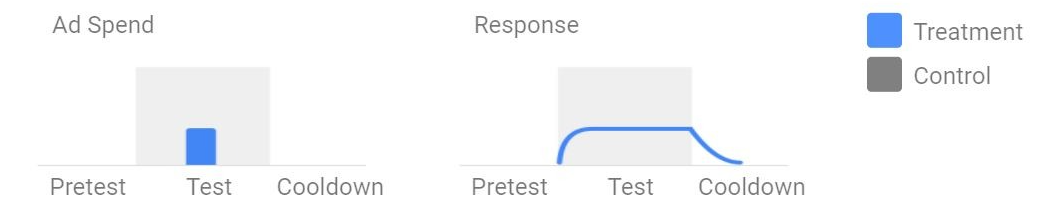
|
Treatment: Gets new spend Control: Held back or zero spend |
Launching net-new channels, tactics, or formats—such as testing Demand Gen for the first time—to validate incremental return before scaling. |
| Go-dark | Measures the incrementality of existing, live campaigns. Examples include measuring the incrementality of brand paid search campaigns. In this intervention type, existing ad spend is completely shut off in the test geos. This strategy may be useful to prove incremental returns of an existing channel for defense purposes. 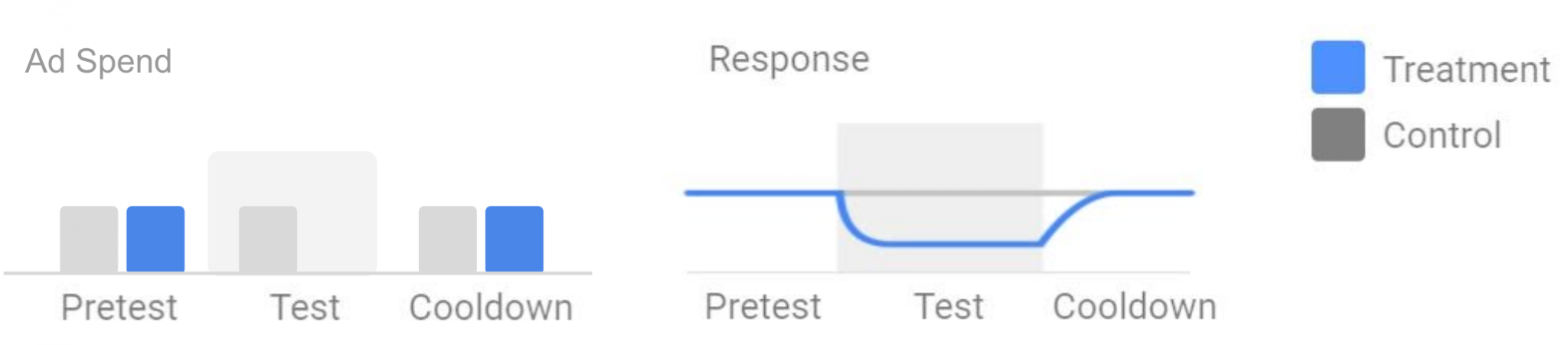
|
Treatment: Spend ablated or zero spend Control: Business-as-usual (BAU) spend |
Defending your media budgets by proving the baseline value that would be lost if ads were turned off. |
| Heavy-up | Tests increasing budgets for existing campaigns and measures the incremental response for expansion strategies, such as adding new search campaigns to an existing search account. In this intervention type, incremental ad spend is added to existing ad spend in the test geos and existing ad spend is held BAU in the control geos. 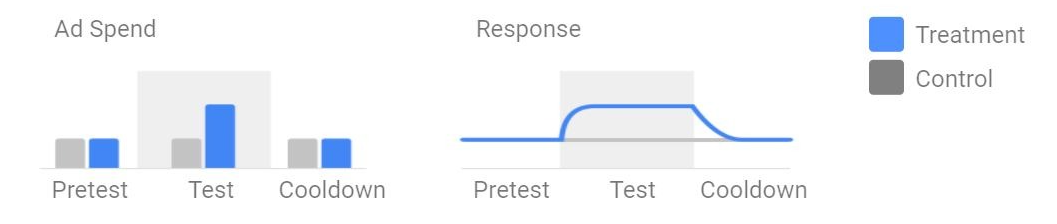
|
Treatment: Increased spend (+X%) Control: BAU spend |
|