
As part of the Meridian GeoX user journey, in-platform implementation serves as the critical step bridging the gap between designing an experiment and analyzing its results. This step requires executing your design directly within your media platforms, such as Google Ads or other publisher platforms.
Expected experiment timeline
Before configuring the exact details of the experiment, first revisit the expected timeline of executing a GeoX study. About 7–14 weeks is typically needed from pretest planning to completion of actual analysis.
- Pretest planning and study design (up to 2 weeks): Notable steps include, defining geographic units, preparing pretest data required by design, establishing geo assignment, determining necessary budget changes for the experiment, and pre-configuring campaign-level geo targeting across all participating buying platforms.
- Active test period (3–10 weeks): Execute the live marketing strategy strictly across designated treatment geos while maintaining BAU in control geos. The first few weeks of the test period might be reserved for your campaign warm-up.
- Cool-down and analysis (2+ weeks): Although cool-down period isn't mandatory, it is highly recommended if the incremental effect of your campaigns could be delayed to after the test period due to the conversion lag. Note that during the cool-down period, all geos—treatment and control—should stay at existing BAU—for example, go-dark geos regain ads exposure.
Key implementation specifications
To ensure a rigorous and scientifically sound geo experiment, advertisers should carefully define the following technical parameters within their chosen ads platforms:
- Measurement level: Configured directly at the campaign or ad account level within the platform's experimentation UI. To utilize this GeoX study to calibrate your MMM model, we recommended that you select your campaigns to align with the channels that you want to calibrate, to achieve the best channel representation possible. For example, if you want to calibrate a Search Shopping channel in Meridian, you should select Product Listings, Local Inventory, or Hotel Ad campaign types for your GeoX experiment. You can find more details in the Meridian guide for Google Ads taxonomy.
- KPI definition: GeoX supports experimenting with one primary KPI variable, such as transaction, sales or revenue. It is critical to decide the KPI for Geo testing beforehand. In most scenarios, the KPI should be based on raw unfiltered conversion events, and you shouldn't use attributed conversion events, as the choice of attribution model may bias the causal estimate in GeoX measurement.
- Geographic unit definition: Similar to any other experiment, it's important to carefully decide the experimental unit for measurement. Selecting the right geographic unit for your experiment requires a bias-variance tradeoff before running the GeoX design algorithm. You can design your experiment using administrative geo units—such as states, provinces, cities, marketing-driven geo areas—such as Nielsen DMA, or even algorithmic geo regions—such as mutually exclusive clusters of postal codes. Typically, having more granular or smaller geo units can improve statistical power and lead to lower budgets. However, more granular geo units and regions are not always more optimal, given that people may naturally travel across geo regions, causing contamination bias effect to the incrementality metric. On the other hand, picking very high-level geos, such as countries, would cause low statistical power and bring expensive experiment budget as a consequence.
- Test duration: To achieve optimal statistical power and account for consumer behavior, the test window should cover at least one purchase cycle. Under certain verticals, this may take weeks or even months. If your test campaign has automated bidding, you might also need to add more time in the test duration to account for campaign learning period.
Beyond the fundamental parameters, the physical execution of GeoX relies heavily on precise geo targeting logic in ads platforms:
- Geo targeting configurations: After the GeoX design is complete, you will typically have defined groups for treatment and control geographies. At this stage, you must configure ad targeting for the study. Implementing geo targeting correctly is essential for study success: start with removing all broad national targets, such as "United Kingdom" or "United States" from every campaign involved in the experiment. Following this, apply positive targeting by adding only the specific geos that are supposed to expose to your selected marketing campaigns. Depending on your testing strategies, you will see more targeting details in the next section.
- (Multi-cell) cross-platforms compatibility: In addition, it is recommended to verify the feasibility of ads targeting your selected geo units on each ads platform. It is recommended to use cross platform compatible geo units for such a study. Note that some platforms may not be able to support targeting at very granular geo level such as postal codes.
- For detailed instructions on how to execute your experiment in Google, refer to the step-by-step campaign implementation guide in the Google Ads Help Center.
Core testing strategies and targeting objectives
When configuring campaigns for a geo experiment across any ad platform, select the experimental design that matches your strategic learning objective and the detailed targeting approach can be decided accordingly.
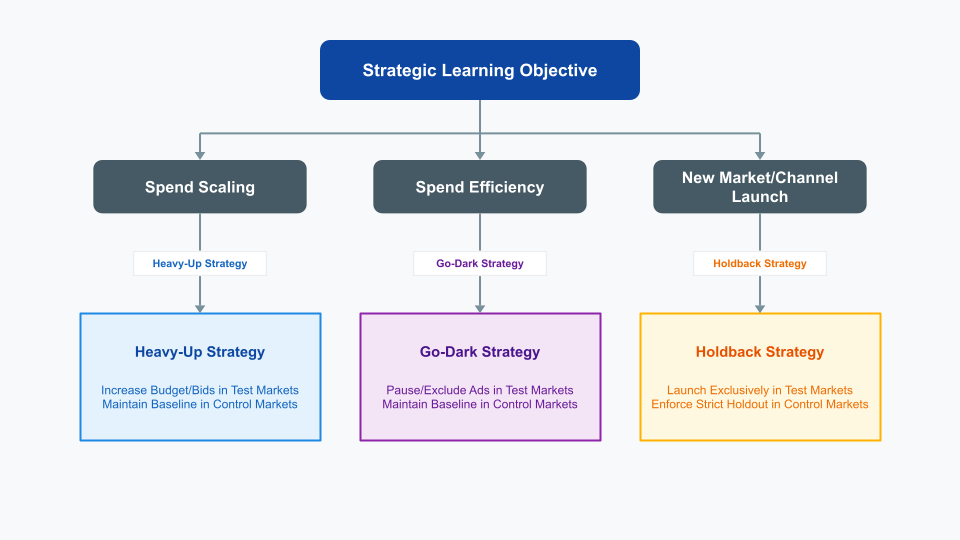
A. Testing increased ad spend (Heavy-up strategy)
- Objective: Measure the incremental return of scaling budget within an existing channel or campaign.
- Implementation: Apply positive bid multipliers or increased budget allocations to your designated treatment geos (for example, administrative geographic regions, DMAs, or postal clusters) while maintaining baseline spending and bidding configurations in control geos.
B. Testing current spend efficiency (Go-dark strategy)
- Objective: Quantify the baseline contribution and cost-efficiency of your existing marketing spend by measuring the impact of halting ad delivery.
- Implementation: Remove broad national targeting across your ad platforms and explicitly positively target only your control geos, leaving treatment geos entirely go-dark.
C. Testing new campaign launches (Holdback strategy)
- Objective: Evaluate the net-new incremental value of introducing a new product line, creative concept, or marketing channel.
- Implementation: Configure positive targeting to deliver exclusively to designated treatment geos while enforcing a strict geographic holdout across all control geos.
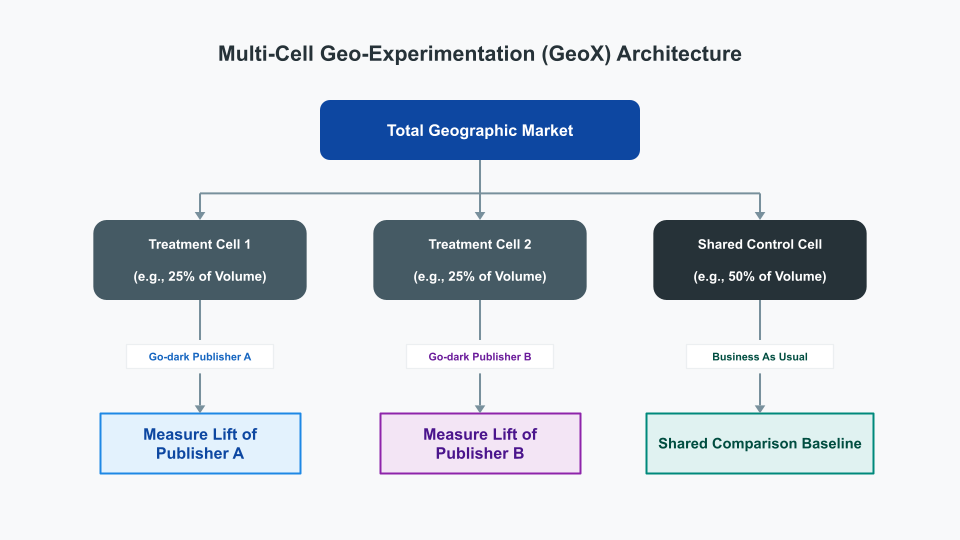
Finally, if you plan to run a multi-cell GeoX, the targeting setups would be per-cell specific: each cell will require their own targeting setups depending on the testing goal of the cell. The following example shows the 2 treatment cells GeoX that aims to measure incrementality of campaigns in Publisher A and campaigns in Publisher B simultaneously.
| Campaign Group | Geographic Targeting Setups | Applied Marketing Interventions |
|---|---|---|
| Campaigns in Publisher A | Configures in Publisher A: Removes national targeting. Only Geos in Treatment Cell 2 and Control Cell are positively targeted | While Treatment Cell 2 and Control Cell remains exposed to ads from Publisher A, Cell 1 goes dark completely |
| Campaigns in Publisher B | Configures in Publisher B: Removes national targeting. Only Geos in Treatment Cell 1 and Control Cell are positively targeted | While Treatment Cell 1 and Control Cell remains exposed to ads from Publisher B, Cell 2 goes dark completely |
Best practices and operational guidelines
Following these structural configurations, maintaining the cleanliness of the experimental environment is paramount. These operational guidelines help prevent data contamination and ensure reliable results:
- Geographic allocation: All regional level geo targeting must be locked in
at the campaign level prior to launching the experiment to prevent mid-test
population shifts.
- Don't add a new geo to the treatment group because you want to spend more budget, or for something else.
- Don't remove a low-performing geo from either group to "improve efficiency" mid-test.
- Don't swap a control region into the treatment group during the test.
- Experimental isolation: To ensure clean, unpolluted measurement, your GeoX participating campaigns must be completely isolated from other experiments. Verify that the campaign is not concurrently enrolled in overlapping brand lift, conversion lift, or holdout studies. Otherwise, it may compromise the validity of your GeoX results.
- Local marketing efforts: Local marketing activities should be balanced to prevent external confounding. We recommend that you match local and regional media efforts, such as local TV and offline campaigns, between the treatment and control groups. Furthermore, if it is expected that specific geo regions' local marketing activities will deviate significantly from the rest and can't be balanced, it is recommended to exclude those geos from the study design entirely to avoid skewing results.
- Cross-platform synchronization: Ensure campaign start and end timestamps are flawlessly synchronized across every participating ad platform, aligning perfectly with your pretest, test, and cool-down measurement phases.
In addition, the specific geo targeting settings play a critical role in ensuring study success:
- Strict physical presence targeting: Across all ad platform configurations, explicitly select "Physical Presence: People located within your targeted locations". Avoid the default settings and "Presence or Interest," as interest-based targeting will serve ad impressions to users outside your preferred geo boundaries, contaminating your incrementality measurement.
- Positive instead of negative targeting: Instead of broad national targeting plus negative targeting of excluded geo locations, explicitly positively target geo locations (for example, exact list of states, provinces, DMAs, or postal codes) to be exposed to ads. This can provide ad delivery to users with precise locations. Broad targeting can include users with less precise locations than the targeting resolution requires. Possibly biasing and contaminating the incrementality measurement.