
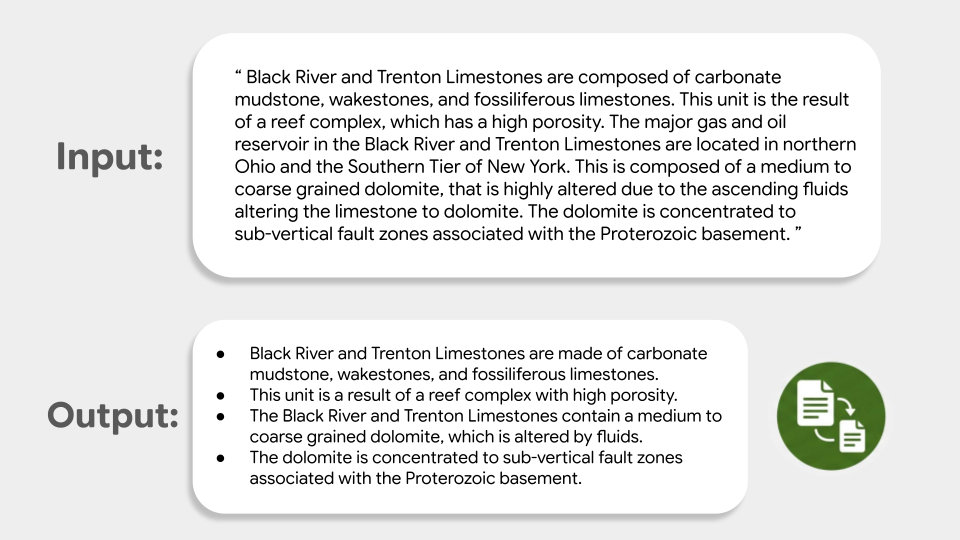
The MediaPipe Text Summarizer task lets you identify the most important information in a text and generate a shorter version while maintaining the original context meaning. This task operates on text data with a machine learning (ML) model and outputs a summary string.
This task supports two modes:
- TLDR: Generates a short paragraph of 1–2 sentences.
- Keypoints: Generates a bulleted list of 3–5 key points.
Get Started
Start using this task by following one of these implementation guides for your target platform. These platform-specific guides walk you through a basic implementation of this task, including a recommended model, and code example with recommended configuration options:
| Platform | Code Example | Guide |
|---|---|---|
| Android | Code example | Guide |
| iOS | Code example | Guide |
| Python | Colab | Guide |
Task details
This section describes the capabilities, inputs, outputs, and configuration options of this task.
Features
- Input text processing - Supports out-of-graph tokenization for models without in-graph tokenization.
| Task inputs | Task outputs |
|---|---|
Text Summarizer accepts the following input data type:
|
Text Summarizer outputs the following results:
|
Configuration options
This task has the following configuration options:
| Option Name | Description | Value Range | Default Value |
|---|---|---|---|
mode |
The summarization mode of the text summarizer task. Can be a short summary paragraph or bulleted list of key points. |
TextSummarizerMode.TLDR, TextSummarizerMode.KEYPOINTS
|
TextSummarizerMode.KEYPOINTS
|
max_num_tokens |
The maximum number of tokens for summarization tasks. If set, the summarization will be truncated if the input and output exceed this value. If not set, then the default limit is decided by the model capacity. | Integer |
None (model capacity 8k)
|
Models
We offer a default, recommended model when you start developing with this task.
Summarization 200M model (recommended)
A lightweight, 200M-parameter model fine-tuned to generate two types of summaries in real time: TLDR and Keypoints. This model is subject to the Gemma Terms of Use.
| Model name | Input | Quantization type | Terms of use | Versions |
|---|---|---|---|---|
| Summarization 200M | string | Mixed Precision (Int4 + Int8) | Gemma | Latest |
Task benchmarks
Here are the task benchmarks for the whole pipeline on a Pixel 10 Pro CPU, presenting the average latency across both Keypoints and TLDR modes. Peak memory usage for on-device model inference varies from approximately 200MB to 350MB depending on the input length (100 to 2000 words).
MediaPipe E2E Benchmark
| Device | Input Words (tokens) | Prefill (tokens/s) | Decode (tokens/s) | E2E Latency (ms) |
|---|---|---|---|---|
| Pixel 10 Pro CPU | 100 (~200 tokens) | 980 | 133 | 900 |
| 500 (~900 tokens) | 950 | 130 | 1790 | |
| 1000 (~1900 tokens) | 690 | 100 | 5,000 | |
| 2000 (~3600 tokens) | 470 | 55 | 12,000-17,000 |