This guide shows you how to use Google Mobile Ads SDK (Legacy) to load and display ads from BIGO Ads SDK using AdMob Mediation, covering bidding integrations. It covers how to add BIGO Ads SDK to an ad unit's mediation configuration, and how to integrate the BIGO Ads SDK and adapter into an Android app.
Supported integrations and ad formats
The mediation adapter for BIGO Ads SDK has the following capabilities:
| Integration | |
|---|---|
| Bidding | |
| Waterfall | |
| Formats | |
| App open | |
| Banner | |
| Interstitial | |
| Rewarded | |
| Rewarded Interstitial | |
| Native | |
Prerequisites
Before you continue, verify the following:
- Android API level 24 or later.
Latest Google Mobile Ads SDK (Legacy) version.
Step 1: Set up configurations in BIGO Ads SDK UI
Log in to your BIGO Ads dashboard.
Create an app
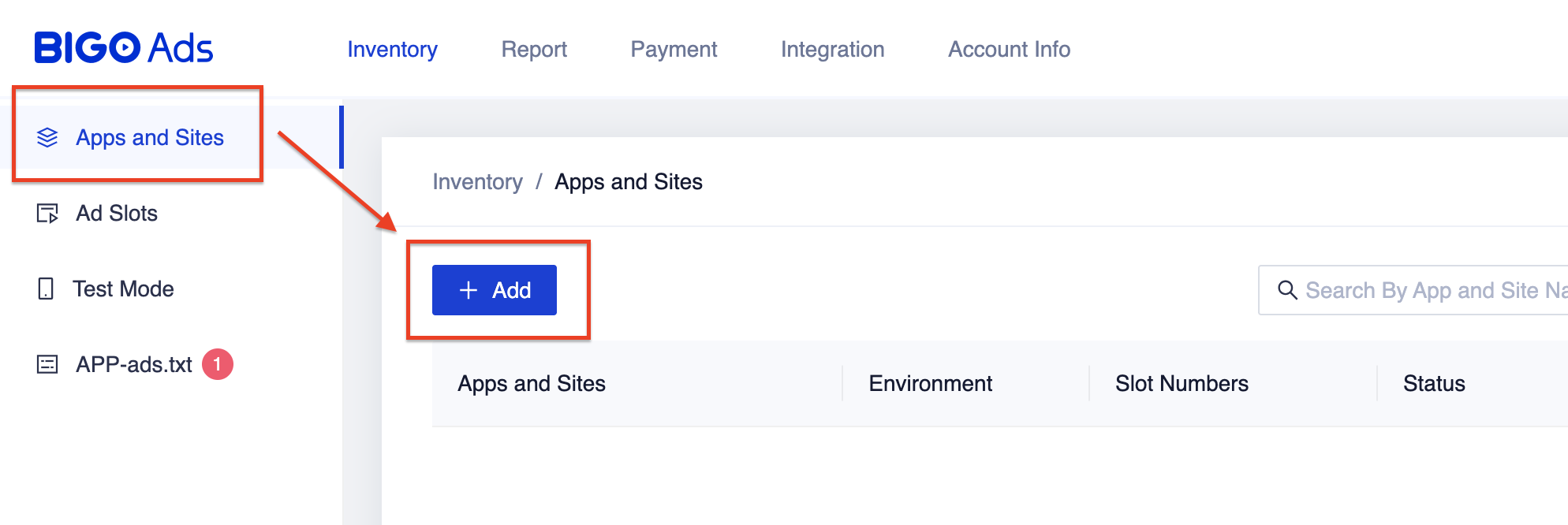
Navigate to the Inventory tab and under the Apps and Sites table, select the + Add button.
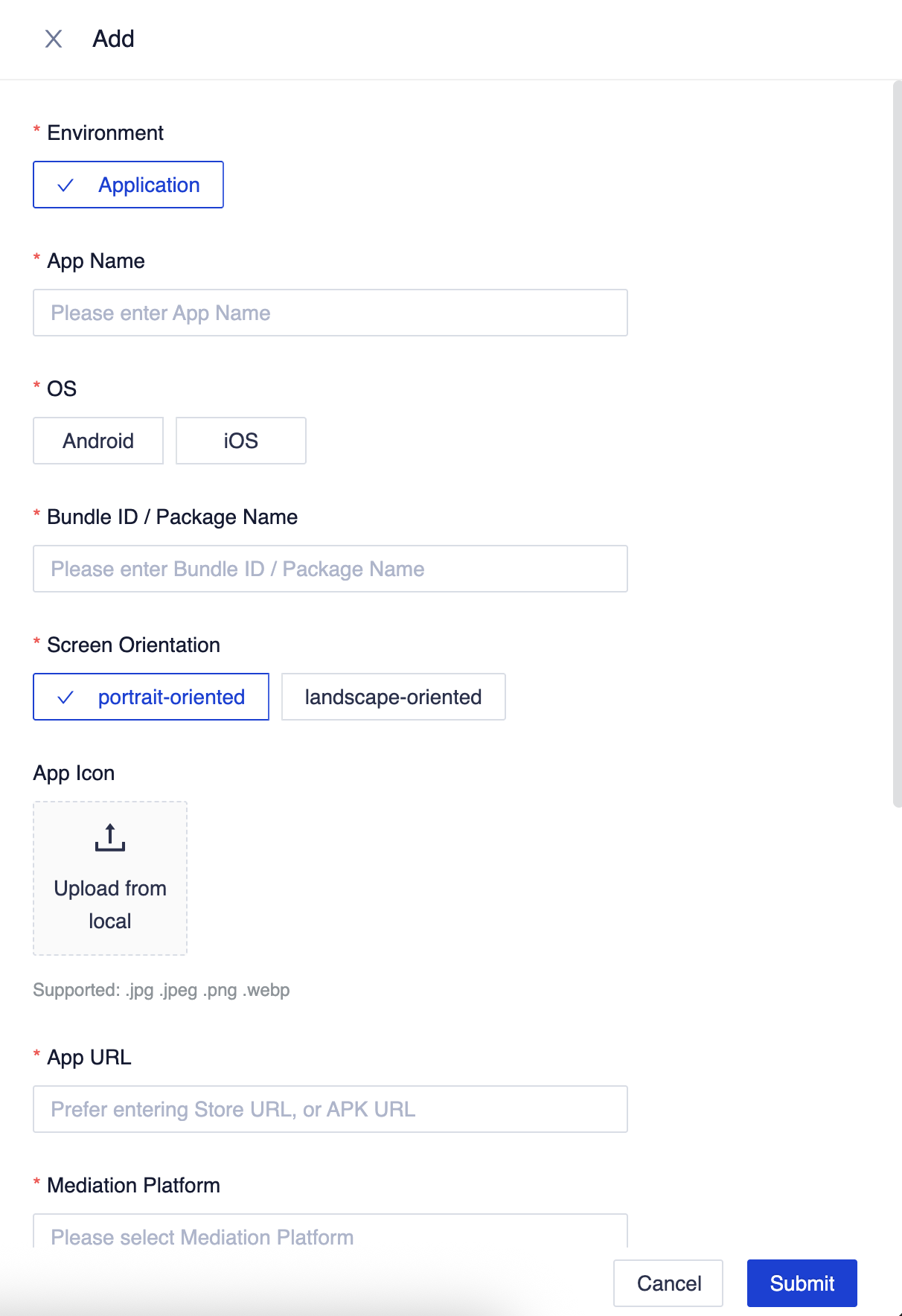
Fill out the rest of the form and click Submit.
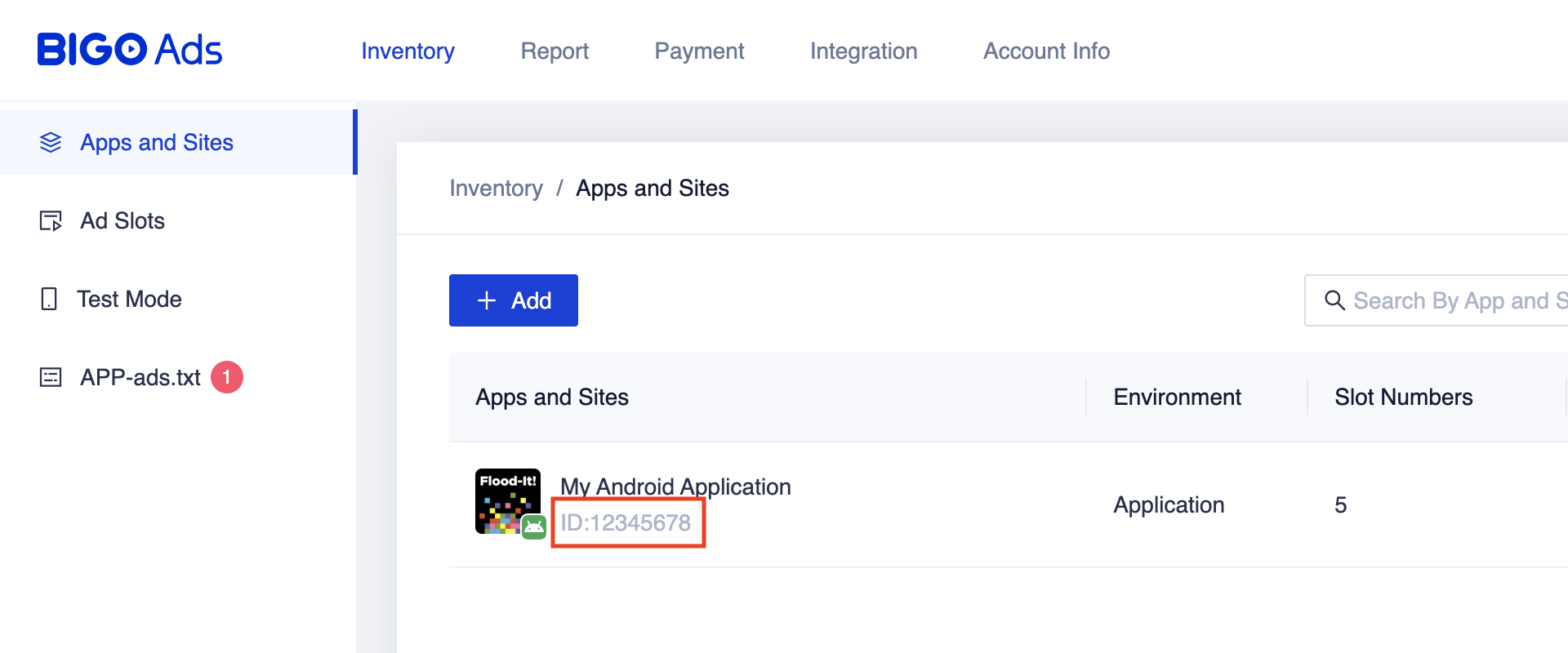
Take note of your Application ID.
Create an ad slot
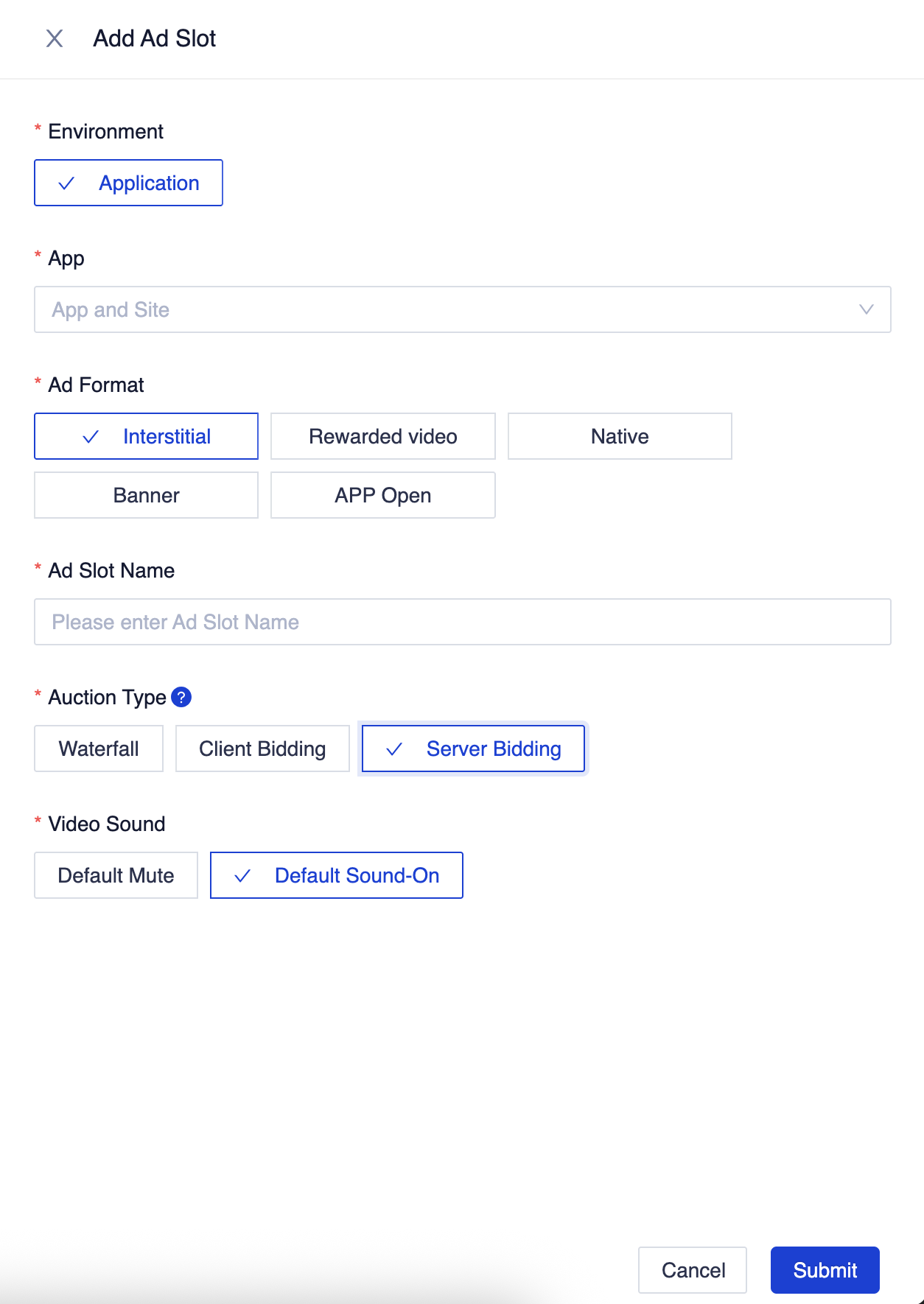
Once your application has been reviewed, navigate to the Ad Slots table and select the + Add button.
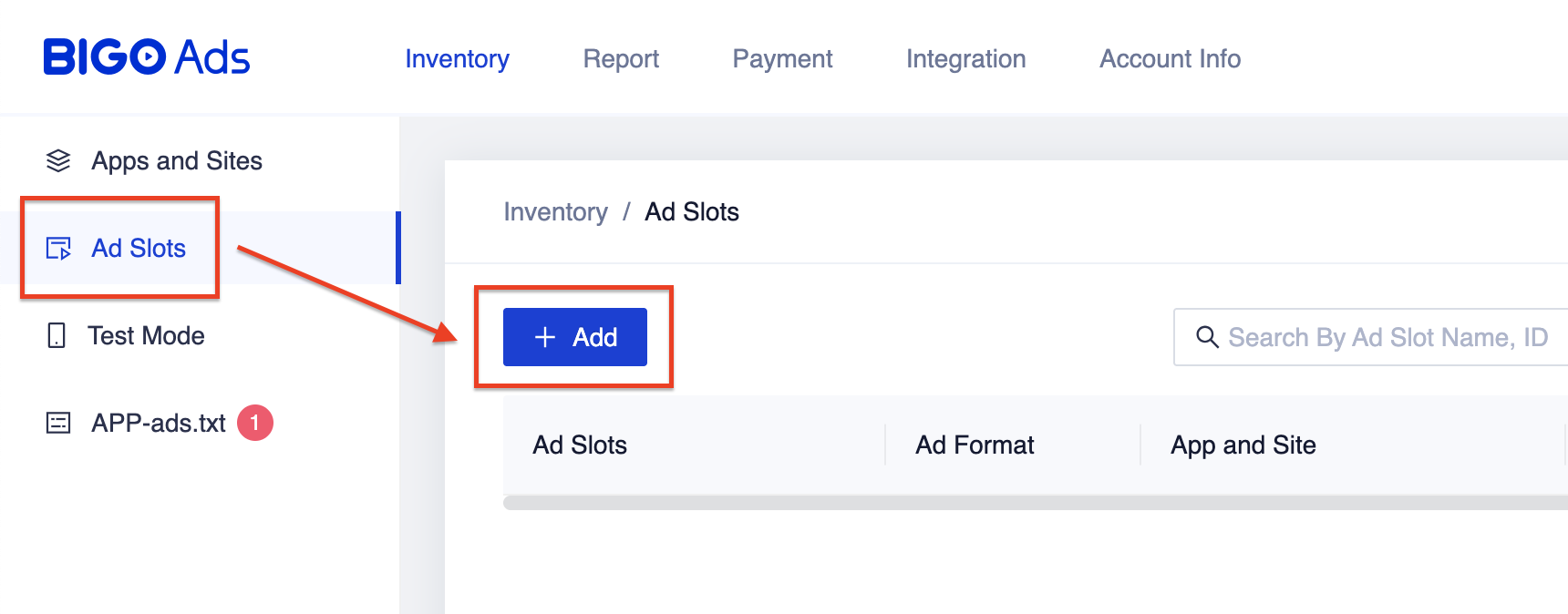
Select Server Bidding for the Auction Type, fill out the rest of the form and click Submit.
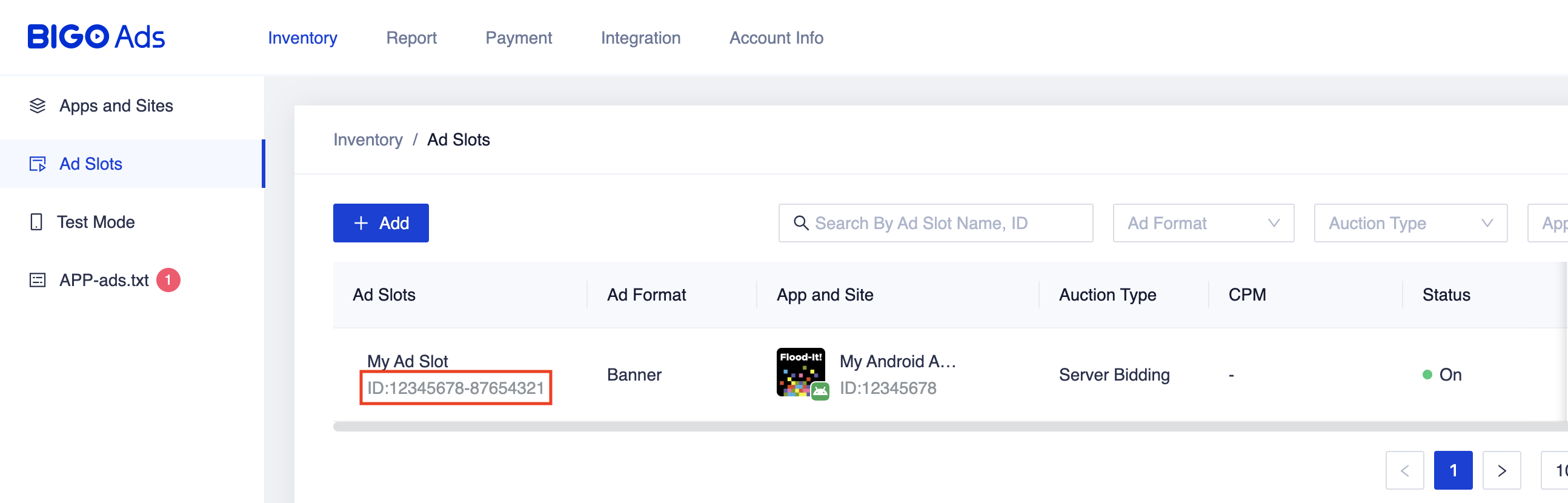
Take note of the Slot ID
Update your app-ads.txt
Authorized Sellers for Apps app-ads.txt is an IAB Tech Lab initiative that helps ensure your
app ad inventory is only sold through channels you've identified as authorized. To prevent a
significant loss in ad revenue, you'll need to implement an app-ads.txt file.
If you haven't done so already,
set up an app-ads.txt file for your app.
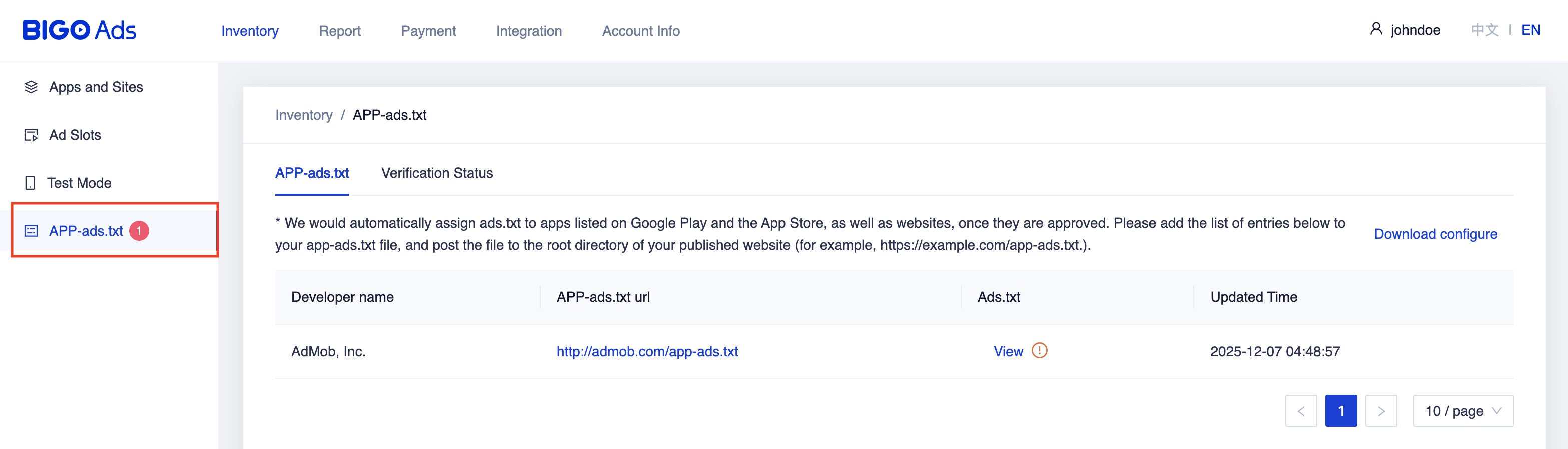
To implement app-ads.txt for BIGO Ads SDK, navigate to the APP-ads.txt
tab from the Dashboard and follow
the instructions located in the tab.
Step 2: Set up BIGO Ads SDK demand in AdMob UI
Configure mediation settings for your ad unit
You need to add BIGO Ads SDK to the mediation configuration for your ad unit.
First, sign in to your AdMob account. Next, navigate to the Mediation tab. If you have an existing mediation group you'd like to modify, click the name of that mediation group to edit it, and skip ahead to Add BIGO Ads SDK as an ad source.
To create a new mediation group, select Create Mediation Group.
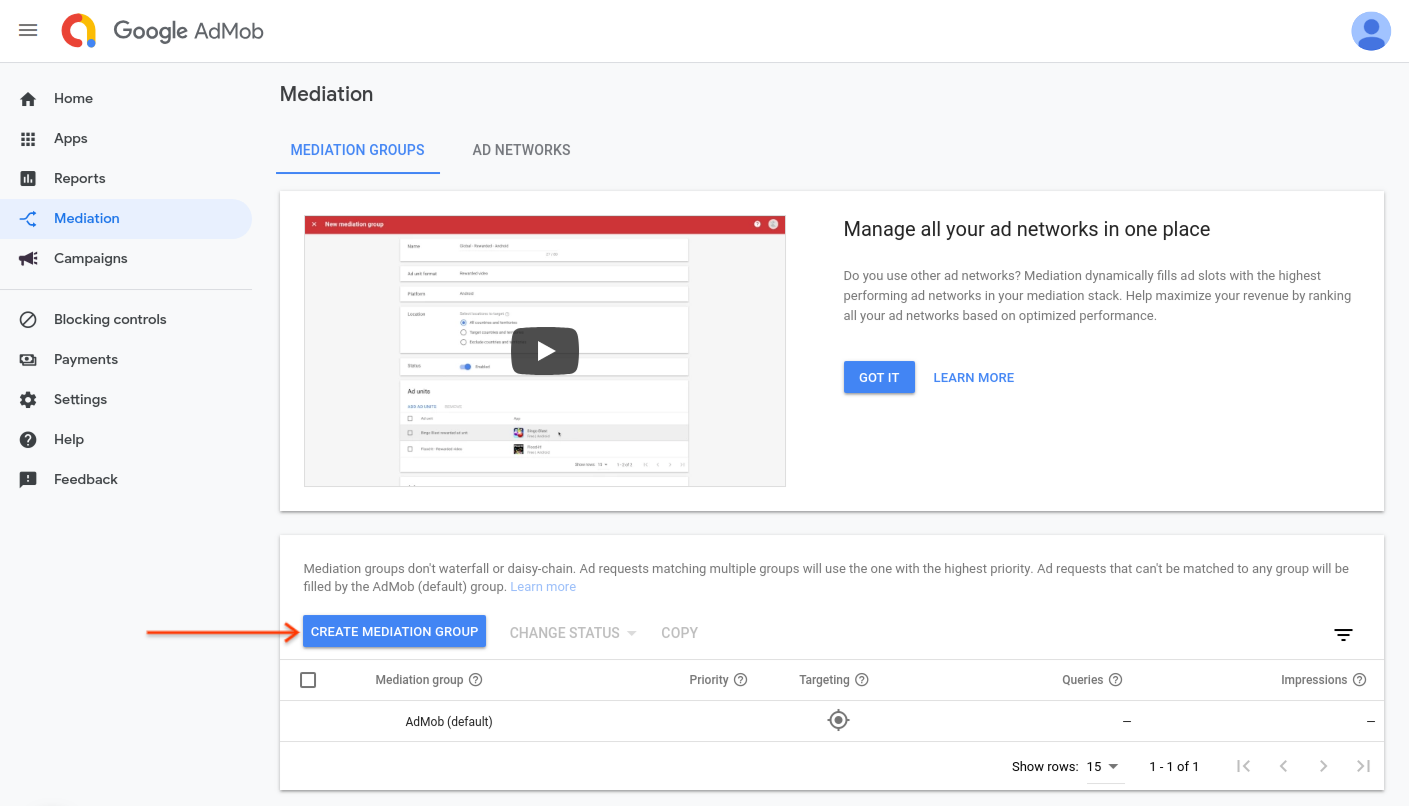
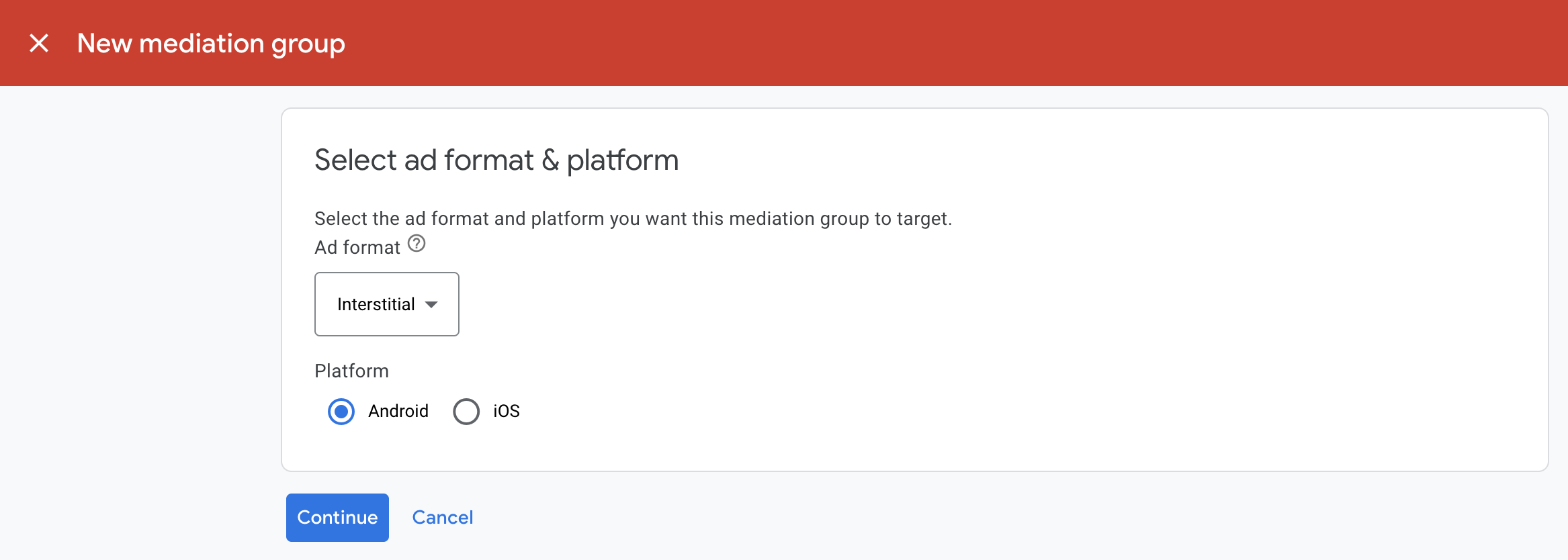
Enter your ad format and platform, then click Continue.
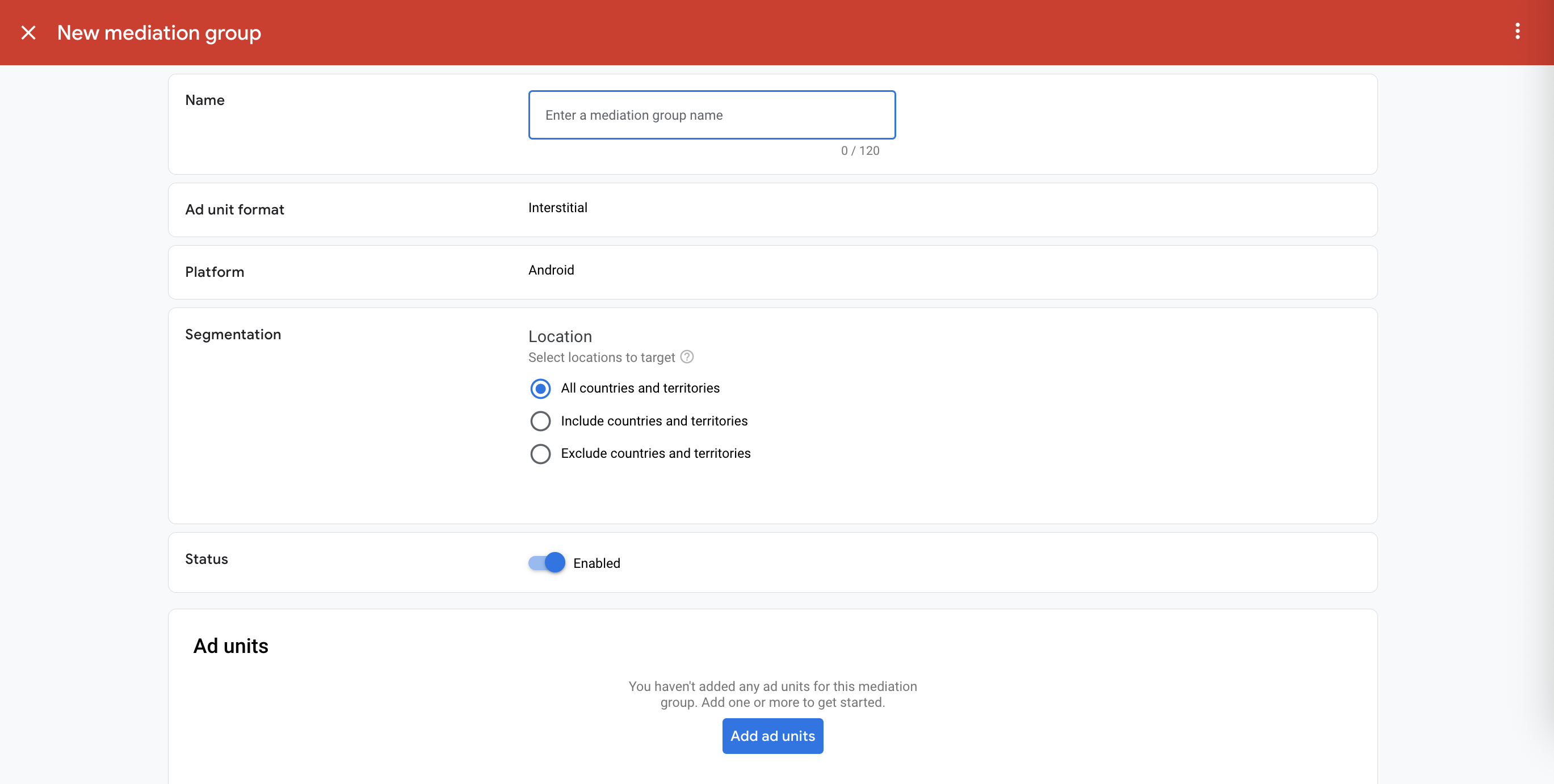
Give your mediation group a name, and select locations to target. Next, set the mediation group status to Enabled, and then click Add Ad Units.
Associate this mediation group with one or more of your existing AdMob ad units. Then click Done.

You should now see the ad units card populated with the ad units you selected:

Add BIGO Ads SDK as an ad source
In the Ad Sources section, find the Bidding card and select Add ad source. Then select BIGO Ads SDK .
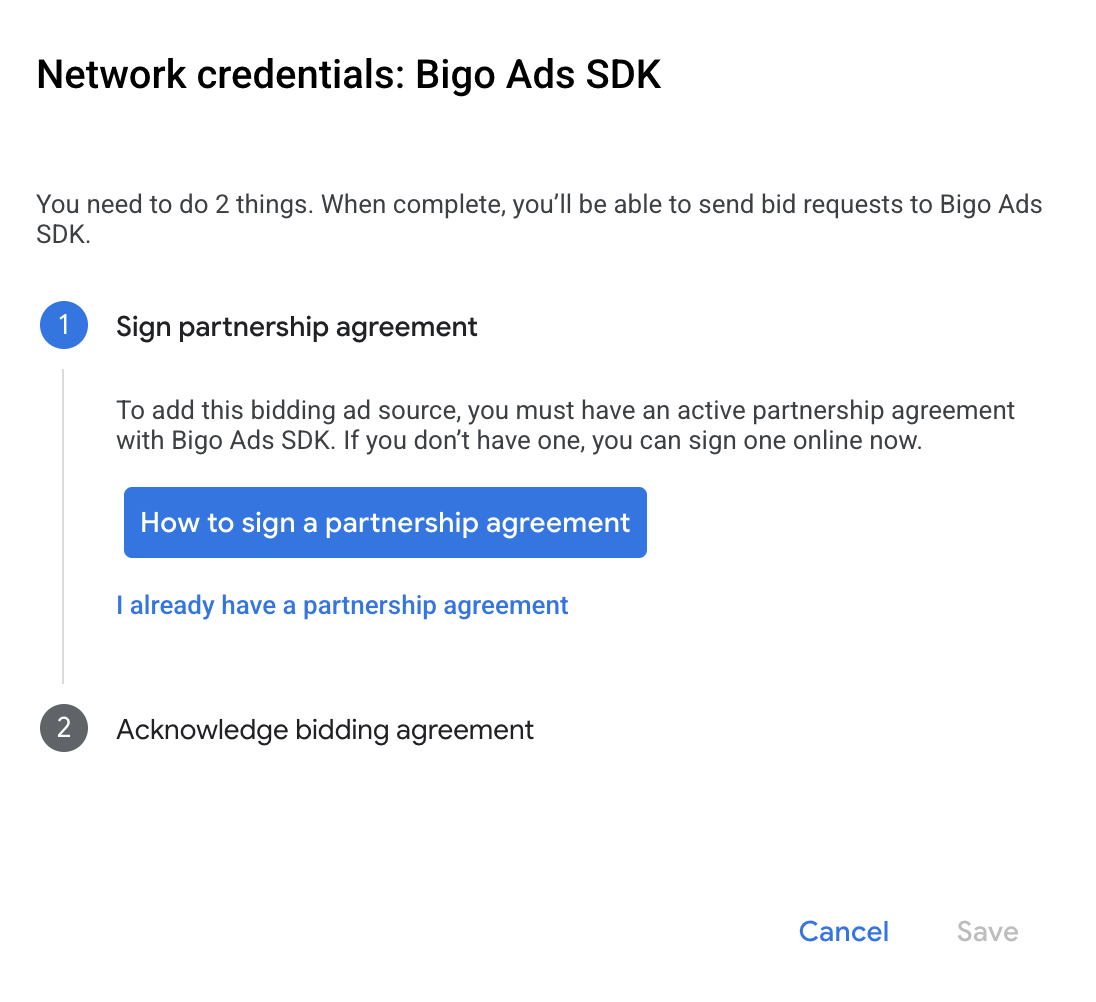
Click How to sign a partnership agreement and set up a bidding partnership with BIGO Ads SDK.
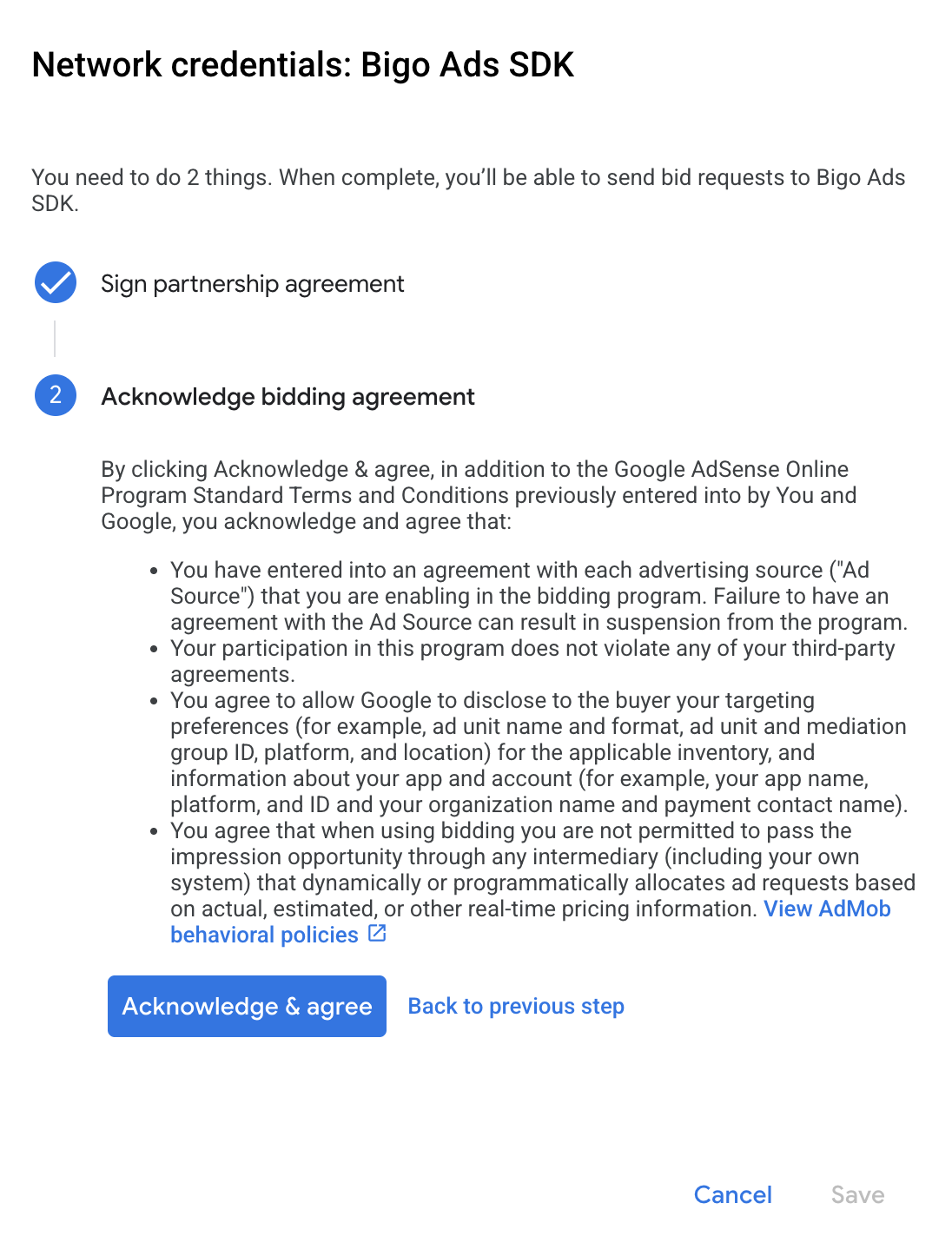
Click Acknowledge & agree, then click Continue.
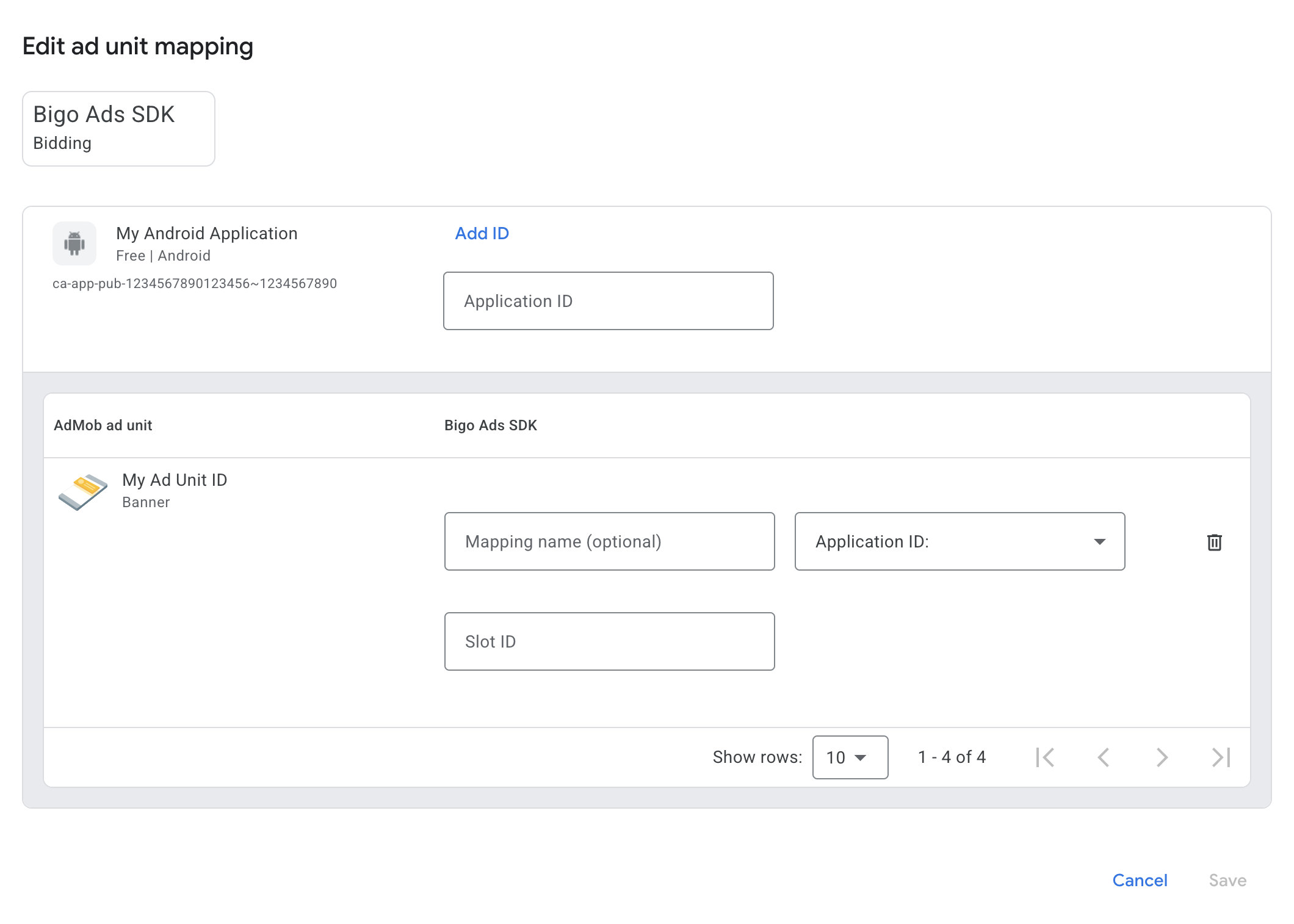
If you already have a mapping for BIGO Ads SDK, you can select it. Otherwise, click Add mapping.
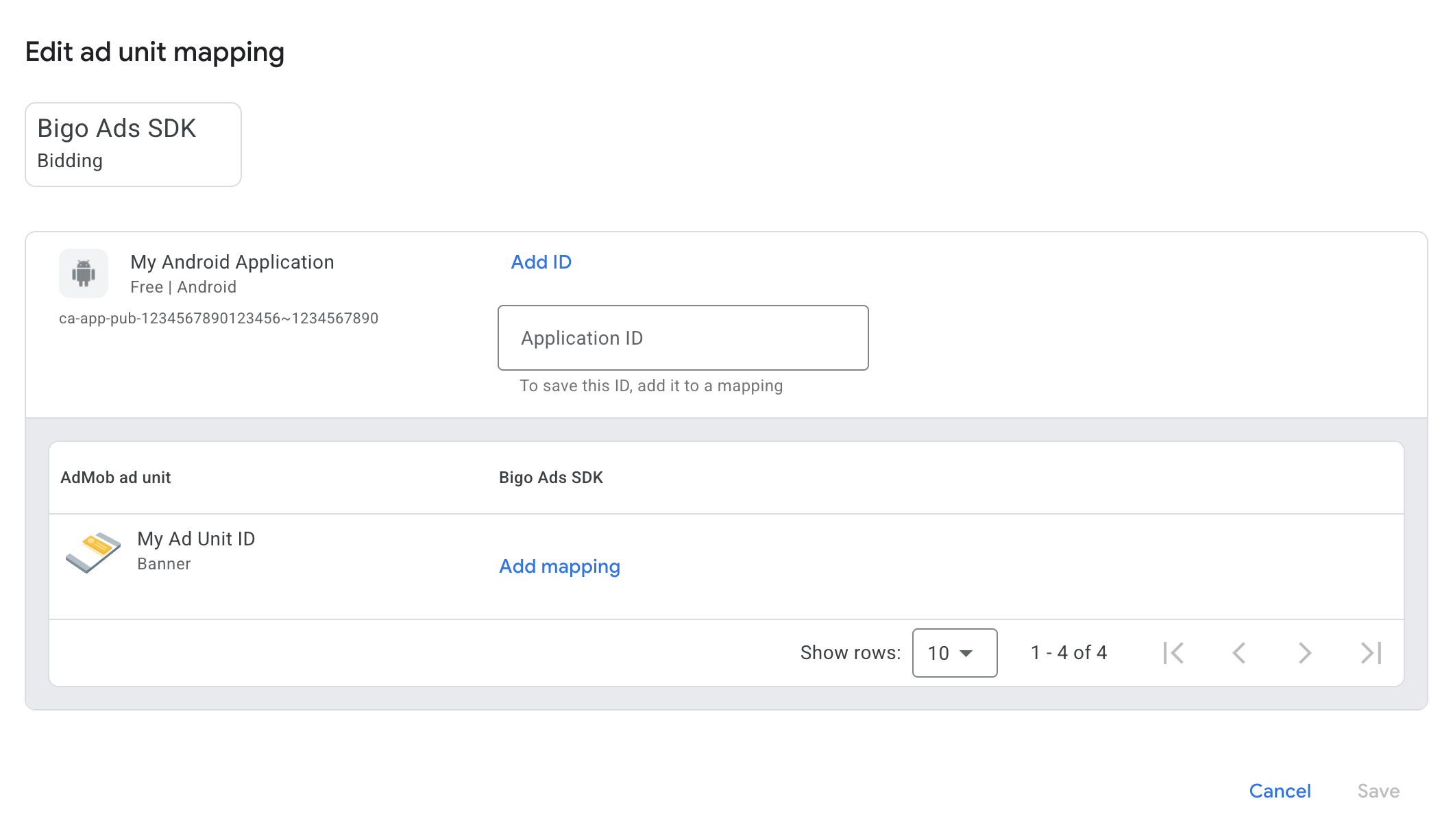
Next, enter the Slot ID obtained in the previous section. Then click Done.
Add BIGO TECHNOLOGY PTE LTD to GDPR and US state regulations ad partners list
Follow the steps in European regulations settings and US state regulations settings to add Empathy Technology Pte.Ltd. (BIGO Ads) to the European regulations ad partners list and ** BIGOAds** to the US state regulations ad partners list in the AdMob UI.
Step 3: Import the BIGO Ads SDK and adapter
Android Studio integration (recommended)
In your app-level gradle file, add the following implementation dependencies:
Kotlin
dependencies {
    implementation("com.google.android.gms:play-services-ads:25.5.0")
    implementation("com.google.ads.mediation:bigo:6.1.0.0")
}
Groovy
dependencies {
    implementation 'com.google.android.gms:play-services-ads:25.5.0'
    implementation 'com.google.ads.mediation:bigo:6.1.0.0'
}
Step 4: Implement privacy settings on BIGO Ads SDK
EU Consent and GDPR
To comply with the Google EU User Consent Policy, you must make certain disclosures to your users in the European Economic Area (EEA), the UK, and Switzerland, and obtain their consent for the use of cookies or other local storage where legally required, and for the collection, sharing, and use of personal data for ads personalization. This policy reflects the requirements of the EU ePrivacy Directive and the General Data Protection Regulation (GDPR). You are responsible for verifying that consent is propagated to each ad source in your mediation chain.
BIGO Ads SDK automatically reads GDPR consent set by consent management platforms including the UMP SDK. For more information, see BIGO Ads SDK's integration guide on GDPR.
US states privacy laws
US states privacy laws require giving users the right to opt out of the "sale" of their "personal information" (as the law defines those terms), with the opt-out offered through a prominent "Do Not Sell My Personal Information" link on the "selling" party's homepage. The US states privacy laws compliance guide offers the ability to enable restricted data processing for Google ad serving, but Google is unable to apply this setting to each ad network in your mediation chain. Therefore, you must identify each ad network in your mediation chain that may participate in the sale of personal information and follow guidance from each of those networks to ensure compliance.
The following sample code shows how to pass the consent flag to BIGO Ads SDK. Call this method before requesting ads through Google Mobile Ads SDK (Legacy).
Java
BigoAdSdk.setUserConsent(context, ConsentOptions.CCPA, true);
Kotlin
BigoAdSdk.setUserConsent(context, ConsentOptions.CCPA, true)
For more information, see BIGO Ads SDK's integration guide on CCPA.
Step 5: Add required code
No additional code needed for BIGO Ads SDK integration.
Step 6: Test your implementation
Enable test ads
Make sure you register your test device for AdMob.
BIGO Ads provides test Application IDs and Ad Slot IDs for Android to help with testing and integration.
Verify test ads
To verify that you are receiving test ads from BIGO Ads SDK, enable single ad source testing in ad inspector using the BIGO Ads SDK (Bidding) ad source(s).
Optional Steps
Native ads
Ad rendering
The BIGO Ads SDK adapter returns its native ads as
NativeAd
objects. It populates the following
fields
for a
NativeAd.
| Field | Assets always included by BIGO Ads SDK adapter |
|---|---|
| Headline | |
| Image | |
| Body | |
| Icon | |
| Call to action | |
| Star rating | |
| Store | |
| Price | |
| Advertiser |
Error codes
If the adapter fails to receive an ad from BIGO Ads SDK, you can check the
underlying error from the ad response using
ResponseInfo.getAdapterResponses()
under the following classes:
sg.bigo.ads
com.google.ads.mediation.bigo.BigoMediationAdapter
Here are the codes and accompanying messages thrown by the BIGO Ads SDK adapter when an ad fails to load:
| Error code | Domain | Reason |
|---|---|---|
| 101 | com.google.ads.mediation.bigo | Missing or empty Bigo Slot Id. |
| 1000-1100 | Sent by BIGO Ads SDK | BIGO Ads SDK returned an error. See BIGO Ads SDK's documentation for more details. |
Bigo Android Mediation Adapter Changelog
Version 6.1.0.0
- Verified compatibility with Bigo Ads SDK 6.1.0.
Built and tested with:
- Google Mobile Ads SDK version 25.5.0.
- Google Mobile Ads Next-Gen SDK version 1.4.0.
- Bigo Ads SDK version 6.1.0.
Version 6.0.1.0
- Verified compatibility with Bigo Ads SDK 6.0.1.
Built and tested with:
- Google Mobile Ads SDK version 25.4.0.
- Google Mobile Ads Next-Gen SDK version 1.4.0.
- Bigo Ads SDK version 6.0.1.
Version 6.0.0.1
- Pin the adapter's Kotlin dependency to 1.9.0 (the min Kotlin version supported by GMA NextGen SDK).
Built and tested with:
- Google Mobile Ads SDK version 25.4.0.
- Google Mobile Ads Next-Gen SDK version 1.4.0.
- Bigo Ads SDK version 6.0.0.
Version 6.0.0.0
- Verified compatibility with Bigo Ads SDK 6.0.0.
Built and tested with:
- Google Mobile Ads SDK version 25.4.0.
- Google Mobile Ads Next-Gen SDK version 1.3.1.
- Bigo Ads SDK version 6.0.0.
Version 5.10.1.0
- Verified compatibility with Bigo Ads SDK 5.10.1.
Built and tested with:
- Google Mobile Ads SDK version 25.4.0.
- Google Mobile Ads Next-Gen SDK version 1.2.1.
- Bigo Ads SDK version 5.10.1.
Version 5.9.0.1
- Maps
AgeRestrictedTreatmentto Bigo's COPPA API.
Built and tested with:
- Google Mobile Ads SDK version 25.4.0.
- Google Mobile Ads Next-Gen SDK version 1.2.1.
- Bigo Ads SDK version 5.9.0.
Version 5.9.0.0
- Verified compatibility with Bigo Ads SDK 5.9.0.
Built and tested with:
- Google Mobile Ads SDK version 25.2.0.
- Google Mobile Ads Next-Gen SDK version 1.0.1.
- Bigo Ads SDK version 5.9.0.
Version 5.8.0.0
- Added property to build the adapter with GMA Next-Gen SDK dependency.
- Verified compatibility with Bigo Ads SDK 5.8.0.
Built and tested with:
- Google Mobile Ads SDK version 25.1.0.
- Bigo Ads SDK version 5.8.0.
Version 5.7.1.0
- Verified compatibility with Bigo Ads SDK 5.7.1.
Built and tested with:
- Google Mobile Ads SDK version 25.0.0.
- Bigo Ads SDK version 5.7.1.
Version 5.7.0.0
- Added support for forwarding the
tagForUnderAgeOfConsentGoogle Mobile Ads SDK parameter to the Bigo Ads SDK. - Verified compatibility with Bigo Ads SDK 5.7.0.
Built and tested with:
- Google Mobile Ads SDK version 24.9.0.
- Bigo Ads SDK version 5.7.0.
Version 5.5.2.0
- Added support for banner, interstitial, rewarded and native ad formats.
- Verified compatibility with Bigo Ads SDK 5.5.2.
Built and tested with:
- Google Mobile Ads SDK version 24.9.0.
- Bigo Ads SDK version 5.5.2.