

Page Summary
-
Google periodically calls
getProofingStatusto check the status of a proofing request, with the specific interval determined through configuration between Google and the Issuer. -
The primary method for Issuers to communicate proofing status updates to Google is via the
notifyProofingStatusUpdateAvailablemethod, with polling used as a backup. -
The proofing process involves a user submitting evidence, Google sending this evidence to the Issuer, and the Issuer reviewing it and updating the status.
-
Google will repeatedly query the Issuer via
getProofingStatusuntil a status other thanpendingis received. -
Upon receiving an
acceptedstatus, Google informs the user of the outcome of the request.
At regular intervals, Google will call getProofingStatus to check the status
of a proofing request with the Issuer. The specific interval is configured
between Google and the Issuer.
Request flow
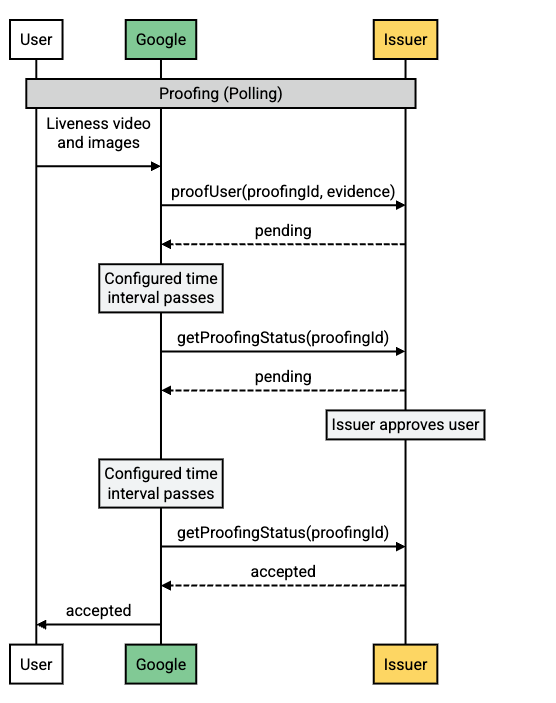
Flow description
| Step | Source | Description |
|---|---|---|
| 1 | Android-powered device | A user submits the liveness video and physical identity document images for VDC registration. |
| 2 | Google servers |
Google calls proofUser, sending the
evidence and a proofing ID to the Issuer.
|
| 3 | Issuer servers |
The Issuer sets the approval to pending and reviews the
submitted evidence.
|
| 4 | Google servers |
Once the configured time interval passes, Google calls
getProofingStatus to determine the status of the proofing
request.
|
| 5 | Issuer servers | The Issuer returns a pending status. |
| 6 | Google servers |
Once the configured time interval passes again, Google calls
getProofingStatus to determine the status of the proofing
request.
|
| 7 | Issuer servers | The Issuer returns an accepted status. |
| 8 | Google servers | Google relays the status to the user. |