This phase occurs after a credential has been provisioned onto a device, and repeats until the credential reaches an inactive state (such as when it is deleted from the device). When any details about the user's VDC have changed in the Issuer's system, this process updates them on the user's device. It is also used to notify the Issuer when the device is no longer using the VDC.
For more information on the different states of a credential’s lifecycle, see the Credential resource model in the API specification.
Request flow
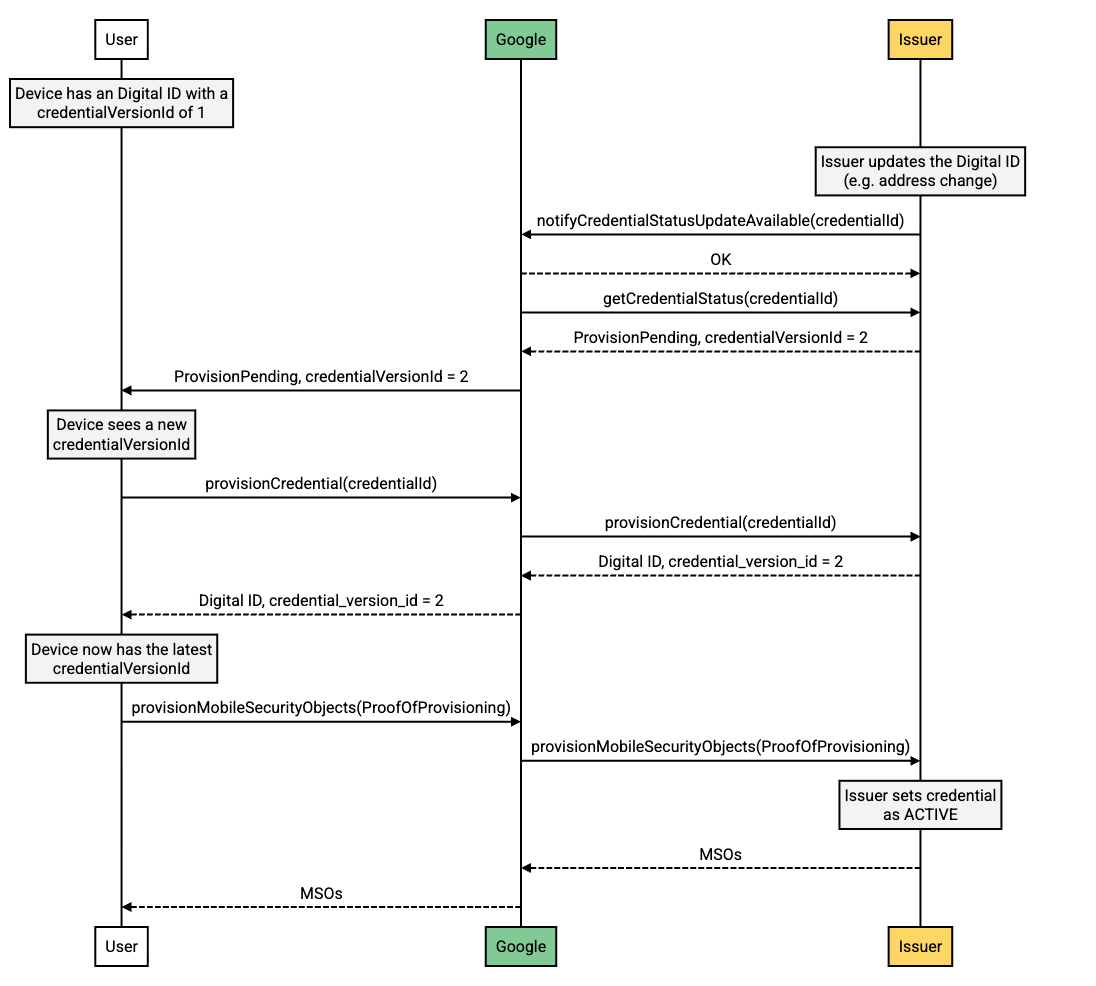
Flow details
| Step | Source | Description |
|---|---|---|
| 1 | Issuer servers | Information about the user's identity document has changed. The Issuer calls `notifyCredentialStatusUpdateAvailable` to inform Google of the change. |
| 2 | Google servers | Google calls `getCredentialStatus` to get the status of the VDC. |
| 3 | Issuer servers | The Issuer returns a `ProvisionPending` object and an updated `credentialVersionId`. |
| 4 | Google servers | Google relays this information to the user's device. |
| 5 | Android-powered device | The user's device sees the local VDC version is outdated and calls `provisionCredential` to get the new VDC. |
| 6 | Google servers | Google relays the `provisionCredential` call to the Issuer. |
| 7 | Issuer servers | The Issuer generates a new VDC with the updated version ID. |
| 8 | Google servers | Google relays the updated VDC to the user's device. |
| 9 | Android-powered device | The user's device updates the local VDC with the latest version and calls `provisionMobileSecurityObjects` to request updated MSOs. |
| 10 | Google servers | Google relays the request to the Issuer. |
| 11 | Issuer servers | The Issuer generates new MSOs and returns them to Google. |
| 12 | Google servers | Google relays the MSOs to the user's device. |