
نمایش قالب آگهی بومی تعریفشده توسط سیستم
وقتی آگهی بومی بار میشود، برنامهتان بااستفاده از یکی از پیامهای پروتکل GADAdLoaderDelegate، شیء آگهی بومی را دریافت خواهد کرد. سپس برنامه شما مسئول نمایش آگهی است (هرچند لزوماً نباید این کار را فوراً انجام دهد).
برای آسانتر کردن نمایش قالبهای آگهی تعریفشده توسط سیستم، کیت توسعه نرمافزار چند منبع مفید ارائه میدهد.
GADNativeAdView
برای GADNativeAd، کلاس «نمای آگهی» متناظری وجود دارد:
GADNativeAdView.
این کلاس نمای آگهی یک UIView است که ناشران باید برای نمایش آگهی از آن استفاده کنند.
برای مثال، یک GADNativeAdView میتواند یک نمونه از GADNativeAd را نمایش دهد. هریک از اشیاء UIView که برای نمایش داراییهای آن آگهی استفاده میشود باید زیرنمای آن شیء GADNativeAdView باشد.
برای مثال، اگر آگهیای را در UITableView نمایش میدادید،
سلسلهمراتب نمای یکی از سلولها ممکن است اینگونه باشد:
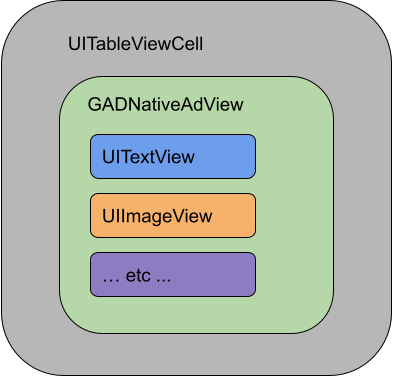
کلاس GADNativeAdView همچنین IBOutlets را ارائه میدهد که برای ثبت
نمای استفادهشده برای هر دارایی جداگانه استفاده میشود، و روشی برای ثبت
خود شیء GADNativeAd. ثبت نماها به این روش به کیت توسعه نرمافزار اجازه میدهد بهطور خودکار
تکالیفی مثل موارد زیر را انجام دهد:
- درحال ضبط کلیکها.
- ثبت ظهورها (زمانی که اولین پیکسل در صفحه نمایان میشود).
- درحال نمایش رونهاد AdChoices.
رونهاد AdChoices
برای آگهیهای بومی غیرمستقیم (که ازطریق رفع نواقص AdMob یا ازطریق Ad Exchange یا AdSense ارائه میشوند)، یک همپوشانی AdChoices توسط کیت توسعه نرمافزار اضافه میشود. در گوشه دلخواه نمای آگهی بومیتان، فضایی برای نشانواره AdChoices که بهطور خودکار درج میشود خالی بگذارید. همچنین، مطمئن شوید که رونهاد AdChoices روی محتوایی قرار داده شده است که اجازه میدهد نماد بهوضوح دیده شود. برای اطلاعات بیشتر درباره ظاهر و عملکرد همپوشانی، رهنمودهای پیادهسازی آگهیهای بومی برنامهای را ببینید.
ارجاع آگهی
هنگام نمایش آگهیهای بومی برنامهای، باید اسناد آگهی را نمایش دهید تا نشان دهید که این نما یک آگهی است.نمونه کد
این بخش نحوه نمایش آگهیهای بومی را بااستفاده از نماهای بارشده بهصورت پویا
از فایلهای xib نشان میدهد. این رویکرد میتواند بسیار مفید باشد، بهویژه زمانی که از GADAdLoaders
پیکربندیشده برای درخواست چندین قالب استفاده میشود.
چیدمان UIViews
اولین گام، چیدمان UIViews است که داراییهای آگهی بومی را نمایش خواهد داد.
میتوانید این کار را در Interface Builder انجام دهید، همانطور که هنگام ایجاد هر فایل xib دیگری انجام میدهید. در اینجا نحوه چیدمان برای آگهی بومی
ممکن است به این شکل باشد:
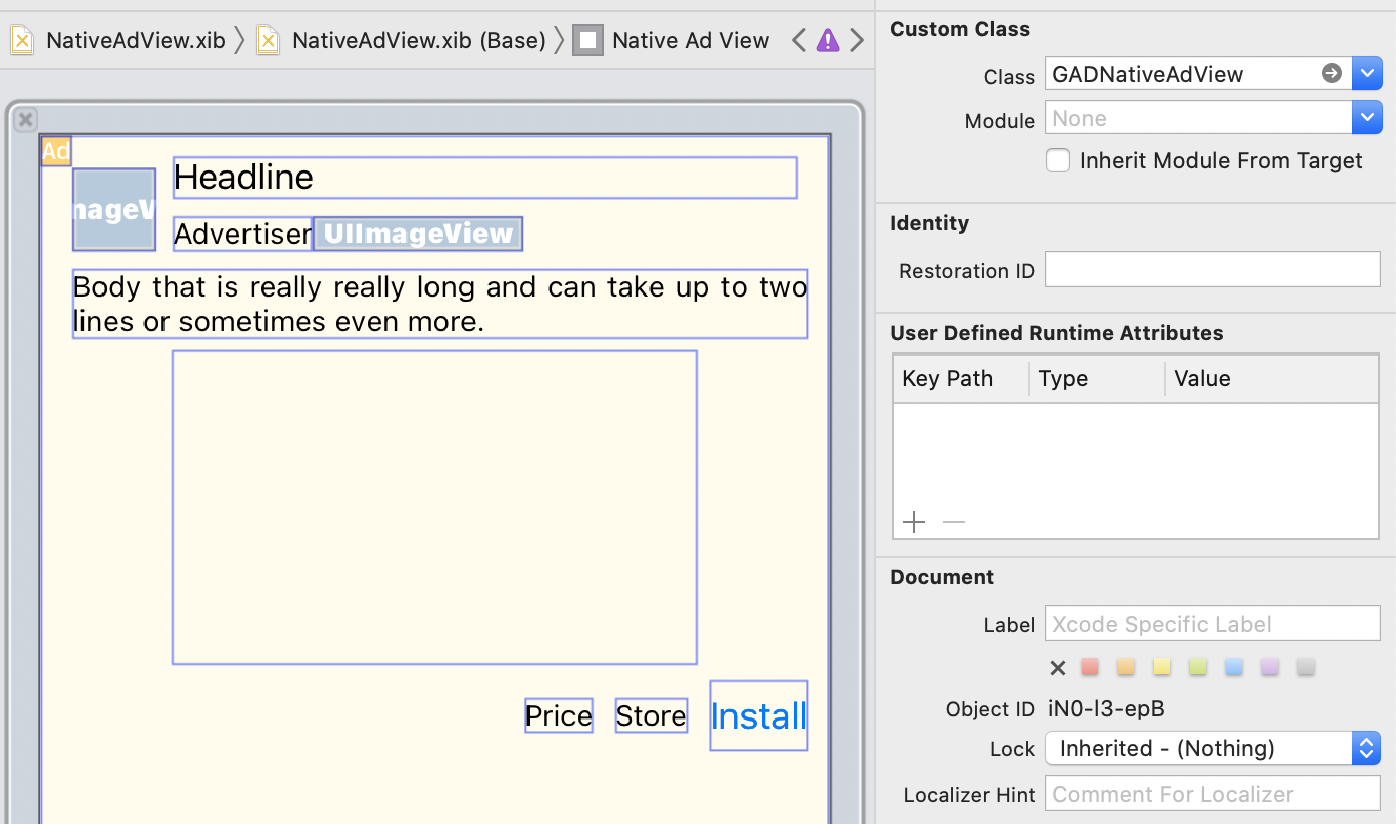
به مقدار «کلاس سفارشی» در بالا سمت چپ تصویر توجه کنید. روی دمای زیر تنظیم شده است
GADNativeAdView.
این کلاس نمای آگهی است که برای نمایش GADNativeAd استفاده میشود.
همچنین باید کلاس سفارشی را برای GADMediaView تنظیم کنید که برای نمایش ویدیو یا تصویر آگهی استفاده میشود.
پیوند دادن رسانهها به نماها
وقتی نماها در جای خود قرار گرفتند و کلاس نمای آگهی صحیح را به چیدمان اختصاص دادید،
خروجیهای دارایی نمای آگهی را به UIViews که ایجاد کردهاید پیوند دهید.
در اینجا نحوه پیوند دادن خروجیهای دارایی نمای آگهی به UIViews ایجادشده برای آگهی آمده است:
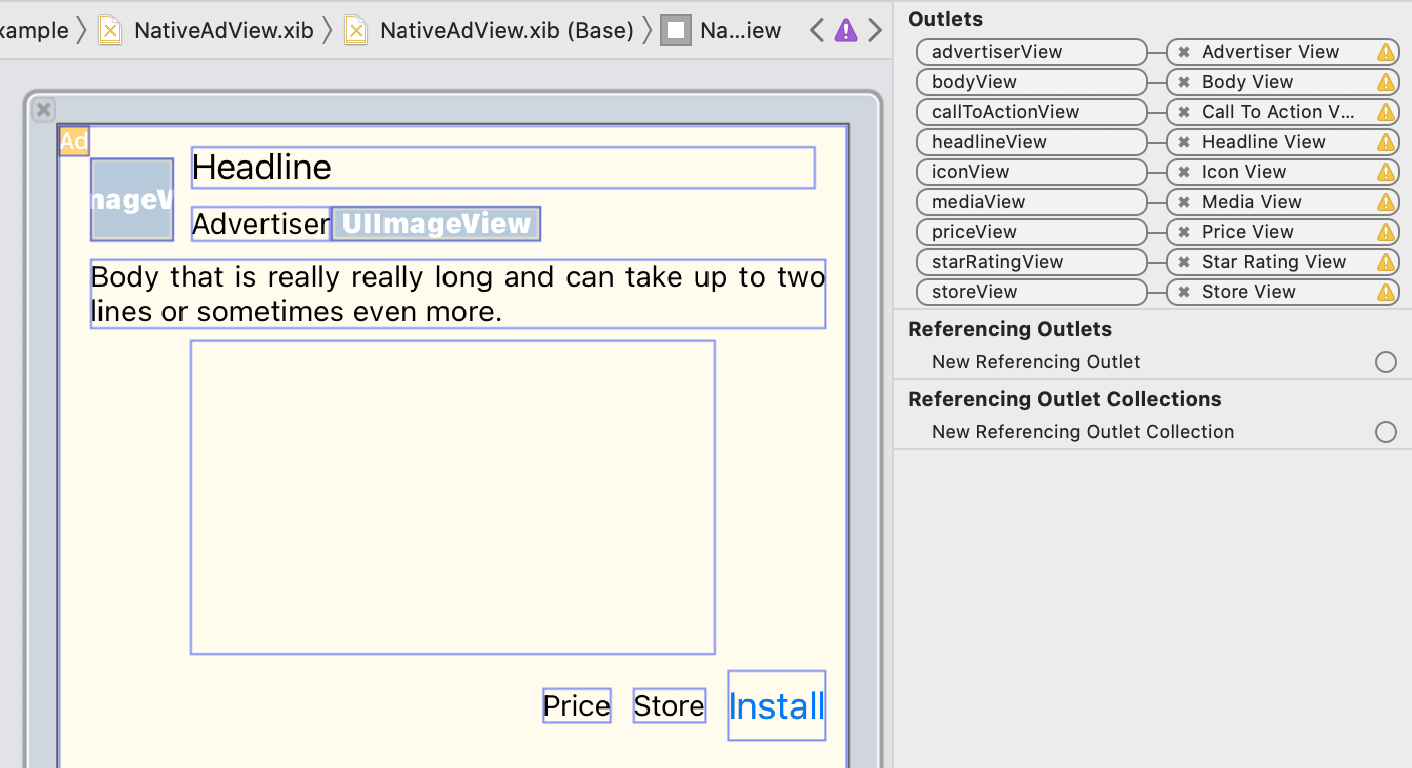
در پانل خروجی، خروجیهای GADNativeAdView به UIViews که در Interface Builder چیده شده است پیوند داده شدهاند. این کار به کیت توسعه نرمافزار اطلاع میدهد که کدام UIView کدام دارایی را نمایش میدهد.
همچنین مهم است بهخاطر داشته باشید که این رسانهها دیدگاههایی را نشان میدهند که در آگهی قابلکلیک هستند.
نمایش آگهی
پساز تکمیل چیدمان و پیوند شدن خروجیها، کد زیر را به برنامهتان اضافه کنید تا آگهی را پساز بار شدن نمایش دهد:
Swift
func adLoader(_ adLoader: AdLoader, didReceive nativeAd: NativeAd) {
// ...
// Set ourselves as the native ad delegate to be notified of native ad events.
nativeAd.delegate = self
// Populate the native ad view with the native ad assets.
// The headline and mediaContent are guaranteed to be present in every native ad.
(nativeAdView.headlineView as? UILabel)?.text = nativeAd.headline
nativeAdView.mediaView?.mediaContent = nativeAd.mediaContent
// Some native ads will include a video asset, while others do not. Apps can use the
// GADVideoController's hasVideoContent property to determine if one is present, and adjust their
// UI accordingly.
let mediaContent = nativeAd.mediaContent
if mediaContent.hasVideoContent {
// By acting as the delegate to the GADVideoController, this ViewController receives messages
// about events in the video lifecycle.
mediaContent.videoController.delegate = self
videoStatusLabel.text = "Ad contains a video asset."
} else {
videoStatusLabel.text = "Ad does not contain a video."
}
// This app uses a fixed width for the GADMediaView and changes its height to match the aspect
// ratio of the media it displays.
if let mediaView = nativeAdView.mediaView, nativeAd.mediaContent.aspectRatio > 0 {
let aspectRatioConstraint = NSLayoutConstraint(
item: mediaView,
attribute: .width,
relatedBy: .equal,
toItem: mediaView,
attribute: .height,
multiplier: CGFloat(nativeAd.mediaContent.aspectRatio),
constant: 0)
mediaView.addConstraint(aspectRatioConstraint)
nativeAdView.layoutIfNeeded()
}
// These assets are not guaranteed to be present. Check that they are before
// showing or hiding them.
(nativeAdView.bodyView as? UILabel)?.text = nativeAd.body
nativeAdView.bodyView?.isHidden = nativeAd.body == nil
(nativeAdView.callToActionView as? UIButton)?.setTitle(nativeAd.callToAction, for: .normal)
nativeAdView.callToActionView?.isHidden = nativeAd.callToAction == nil
(nativeAdView.iconView as? UIImageView)?.image = nativeAd.icon?.image
nativeAdView.iconView?.isHidden = nativeAd.icon == nil
(nativeAdView.starRatingView as? UIImageView)?.image = imageOfStars(from: nativeAd.starRating)
nativeAdView.starRatingView?.isHidden = nativeAd.starRating == nil
(nativeAdView.storeView as? UILabel)?.text = nativeAd.store
nativeAdView.storeView?.isHidden = nativeAd.store == nil
(nativeAdView.priceView as? UILabel)?.text = nativeAd.price
nativeAdView.priceView?.isHidden = nativeAd.price == nil
(nativeAdView.advertiserView as? UILabel)?.text = nativeAd.advertiser
nativeAdView.advertiserView?.isHidden = nativeAd.advertiser == nil
// In order for the SDK to process touch events properly, user interaction should be disabled.
nativeAdView.callToActionView?.isUserInteractionEnabled = false
// Associate the native ad view with the native ad object. This is
// required to make the ad clickable.
// Note: this should always be done after populating the ad views.
nativeAdView.nativeAd = nativeAd
}
SwiftUI
ایجاد مدل بازدید
مدل نمایشی ایجاد کنید که آگهی بومی را بار میکند و تغییرات دادههای آگهی بومی را منتشر میکند:
import GoogleMobileAds
class NativeAdViewModel: NSObject, ObservableObject, NativeAdLoaderDelegate {
@Published var nativeAd: NativeAd?
private var adLoader: AdLoader!
func refreshAd() {
adLoader = AdLoader(
adUnitID: "ca-app-pub-3940256099942544/3986624511",
// The UIViewController parameter is optional.
rootViewController: nil,
adTypes: [.native], options: nil)
adLoader.delegate = self
adLoader.load(Request())
}
func adLoader(_ adLoader: AdLoader, didReceive nativeAd: NativeAd) {
// Native ad data changes are published to its subscribers.
self.nativeAd = nativeAd
nativeAd.delegate = self
}
func adLoader(_ adLoader: AdLoader, didFailToReceiveAdWithError error: Error) {
print("\(adLoader) failed with error: \(error.localizedDescription)")
}
}
ایجاد UIViewRepresentable
UIViewRepresentable
برای NativeView ایجاد کنید و در تغییرات داده در کلاس ViewModel مشترک شوید:
private struct NativeAdViewContainer: UIViewRepresentable {
typealias UIViewType = NativeAdView
// Observer to update the UIView when the native ad value changes.
@ObservedObject var nativeViewModel: NativeAdViewModel
func makeUIView(context: Context) -> NativeAdView {
return
Bundle.main.loadNibNamed(
"NativeAdView",
owner: nil,
options: nil)?.first as! NativeAdView
}
func updateUIView(_ nativeAdView: NativeAdView, context: Context) {
guard let nativeAd = nativeViewModel.nativeAd else { return }
// Each UI property is configurable using your native ad.
(nativeAdView.headlineView as? UILabel)?.text = nativeAd.headline
nativeAdView.mediaView?.mediaContent = nativeAd.mediaContent
(nativeAdView.bodyView as? UILabel)?.text = nativeAd.body
(nativeAdView.iconView as? UIImageView)?.image = nativeAd.icon?.image
(nativeAdView.starRatingView as? UIImageView)?.image = imageOfStars(from: nativeAd.starRating)
(nativeAdView.storeView as? UILabel)?.text = nativeAd.store
(nativeAdView.priceView as? UILabel)?.text = nativeAd.price
(nativeAdView.advertiserView as? UILabel)?.text = nativeAd.advertiser
(nativeAdView.callToActionView as? UIButton)?.setTitle(nativeAd.callToAction, for: .normal)
// For the SDK to process touch events properly, user interaction should be disabled.
nativeAdView.callToActionView?.isUserInteractionEnabled = false
// Associate the native ad view with the native ad object. This is required to make the ad
// clickable.
// Note: this should always be done after populating the ad views.
nativeAdView.nativeAd = nativeAd
}
افزودن نما به سلسلهمراتب نما
کد زیر نحوه افزودن UIViewRepresentable به سلسلهمراتب
نمای را نشان میدهد:
struct NativeContentView: View {
// Single source of truth for the native ad data.
@StateObject private var nativeViewModel = NativeAdViewModel()
var body: some View {
ScrollView {
VStack(spacing: 20) {
// Updates when the native ad data changes.
NativeAdViewContainer(nativeViewModel: nativeViewModel)
.frame(minHeight: 300) // minHeight determined from xib.
آبجکتیو-سی
- (void)adLoader:(GADAdLoader *)adLoader didReceiveNativeAd:(GADNativeAd *)nativeAd {
// ...
GADNativeAdView *nativeAdView = self.nativeAdView;
// Set ourselves as the ad delegate to be notified of native ad events.
nativeAd.delegate = self;
// Populate the native ad view with the native ad assets.
// The headline and mediaContent are guaranteed to be present in every native ad.
((UILabel *)nativeAdView.headlineView).text = nativeAd.headline;
nativeAdView.mediaView.mediaContent = nativeAd.mediaContent;
// This app uses a fixed width for the GADMediaView and changes its height
// to match the aspect ratio of the media content it displays.
if (nativeAdView.mediaView != nil && nativeAd.mediaContent.aspectRatio > 0) {
NSLayoutConstraint *aspectRatioConstraint =
[NSLayoutConstraint constraintWithItem:nativeAdView.mediaView
attribute:NSLayoutAttributeWidth
relatedBy:NSLayoutRelationEqual
toItem:nativeAdView.mediaView
attribute:NSLayoutAttributeHeight
multiplier:(nativeAd.mediaContent.aspectRatio)
constant:0];
[nativeAdView.mediaView addConstraint:aspectRatioConstraint];
[nativeAdView layoutIfNeeded];
}
if (nativeAd.mediaContent.hasVideoContent) {
// By acting as the delegate to the GADVideoController, this ViewController
// receives messages about events in the video lifecycle.
nativeAd.mediaContent.videoController.delegate = self;
self.videoStatusLabel.text = @"Ad contains a video asset.";
} else {
self.videoStatusLabel.text = @"Ad does not contain a video.";
}
// These assets are not guaranteed to be present. Check that they are before
// showing or hiding them.
((UILabel *)nativeAdView.bodyView).text = nativeAd.body;
nativeAdView.bodyView.hidden = nativeAd.body ? NO : YES;
[((UIButton *)nativeAdView.callToActionView) setTitle:nativeAd.callToAction
forState:UIControlStateNormal];
nativeAdView.callToActionView.hidden = nativeAd.callToAction ? NO : YES;
((UIImageView *)nativeAdView.iconView).image = nativeAd.icon.image;
nativeAdView.iconView.hidden = nativeAd.icon ? NO : YES;
((UIImageView *)nativeAdView.starRatingView).image = [self imageForStars:nativeAd.starRating];
nativeAdView.starRatingView.hidden = nativeAd.starRating ? NO : YES;
((UILabel *)nativeAdView.storeView).text = nativeAd.store;
nativeAdView.storeView.hidden = nativeAd.store ? NO : YES;
((UILabel *)nativeAdView.priceView).text = nativeAd.price;
nativeAdView.priceView.hidden = nativeAd.price ? NO : YES;
((UILabel *)nativeAdView.advertiserView).text = nativeAd.advertiser;
nativeAdView.advertiserView.hidden = nativeAd.advertiser ? NO : YES;
// In order for the SDK to process touch events properly, user interaction
// should be disabled.
nativeAdView.callToActionView.userInteractionEnabled = NO;
// Associate the native ad view with the native ad object. This is
// required to make the ad clickable.
// Note: this should always be done after populating the ad views.
nativeAdView.nativeAd = nativeAd;
}
نمونه کامل در GitHub
با دنبال کردن پیوند GitHub مربوطه، نمونه کامل ادغام آگهیهای بومی در Swift، SwiftUI، و Objective-C را مشاهده کنید.
نمونه Swift Native Advanced نمونه SwiftUI Native Ads نمونه Objective-C Native AdvancedGADMediaView
داراییهای تصویری و ویدیویی بااستفاده از
GADMediaView به کاربران نمایش داده میشود.
این یک UIView است که میتواند در یک فایل xib تعریف شود یا بهصورت پویا ساخته شود.
این نما باید در سلسلهمراتب نمای GADNativeAdView قرار گیرد، درست مانند هر نمای دارایی دیگری.
همانند همه نماهای دارایی، نمای رسانه باید محتوای خود را داشته باشد. این مورد بااستفاده از خصوصیت
mediaContent
در GADMediaView تنظیم میشود. ویژگی
mediaContent
GADNativeAd
حاوی محتوای رسانهای است که میتواند به
GADMediaView
منتقل شود.
در اینجا قطعهای از
نمونه Native Advanced
(Swift |
Objective-C)
آورده شده است که نحوه پر کردن GADMediaView با داراییهای آگهی بومی را بااستفاده از
GADMediaContent از GADNativeAd نشان میدهد:
Swift
nativeAdView.mediaView?.mediaContent = nativeAd.mediaContent
آبجکتیو-سی
nativeAdView.mediaView.mediaContent = nativeAd.mediaContent;
مطمئن شوید که در فایل سازنده میانای خود برای نمای آگهی بومی، کلاس سفارشی نماها را روی GADMediaView تنظیم کردهاید و آن را به خروجی mediaView متصل کردهاید.
تغییر حالت محتوای تصویر
کلاس GADMediaView هنگام نمایش تصاویر، به ویژگی
contentMode
UIView احترام میگذارد. اگر میخواهید نحوه مقیاسبندی تصویر را در
GADMediaView تغییر دهید،
UIViewContentMode مربوطه را
در ویژگی contentMode از GADMediaView تنظیم کنید تا به این هدف برسید.
برای مثال، برای پر کردن GADMediaView وقتی تصویری نمایش داده میشود (آگهی ویدیو ندارد):
Swift
nativeAdView.mediaView?.contentMode = .scaleAspectFit
آبجکتیو-سی
nativeAdView.mediaView.contentMode = UIViewContentModeScaleAspectFit;
GADMediaContent
کلاس GADMediaContent
دادههای مربوط به محتوای رسانهای آگهی بومی را نگه میدارد که بااستفاده از کلاس GADMediaView نمایش داده میشود. وقتی روی خصوصیت GADMediaView
mediaContent تنظیم شده باشد:
اگر دارایی ویدیویی دردسترس باشد، میانگیری میشود و پخش آن در
GADMediaViewشروع میشود. با بررسیhasVideoContentمیتوانید ببینید دارایی ویدیویی دردسترس است یا نه.اگر آگهی حاوی دارایی ویدیویی نباشد، دارایی
mainImageبارگیری میشود و بهجای آن درGADMediaViewقرار میگیرد.
مراحل بعدی
درباره حریم خصوصی کاربر بیشتر بدانید.