
Ausgewählte Inhalte senden

Programmierkenntnisse: Anfänger
Dauer: 20 Minuten
Projekttyp: Automatisierung mit einem ereignisgesteuerten Trigger

Ziele

  • Verstehen, was die Lösung tut
  • Verstehen, wie die Apps Script-Dienste in der Lösung funktionieren
  • Das Script einrichten
  • Das Script ausführen.

Informationen zu dieser Lösung

Wenn Sie verschiedene Arten von Inhalten anbieten möchten, können Sie Nutzern mit Google Formulare die Möglichkeit geben, auszuwählen, welche Inhalte sie von Ihnen erhalten. Mit dieser Lösung können Nutzer die Themen auswählen, die sie interessieren, und erhalten dann automatisch eine E‑Mail mit den ausgewählten Inhalten.
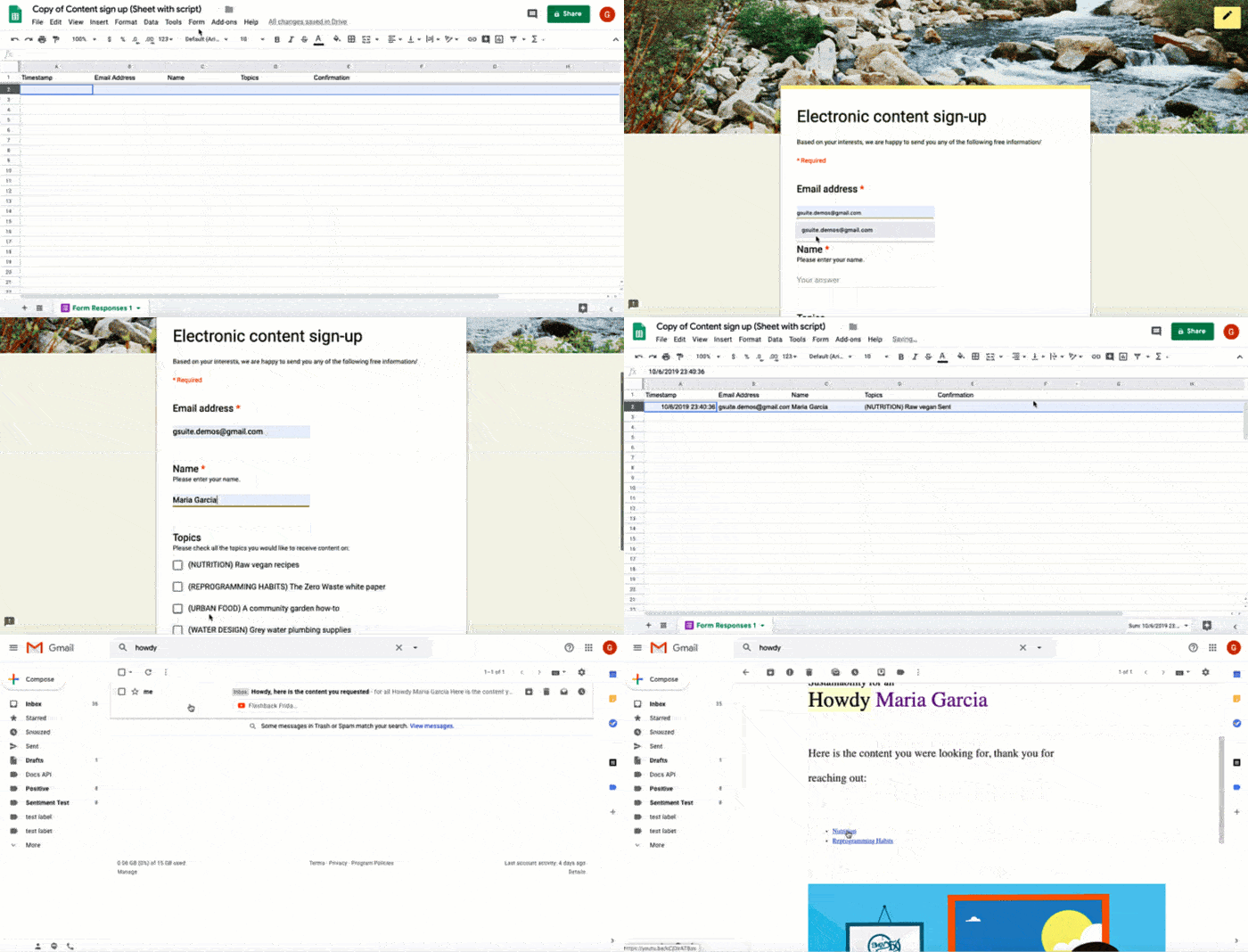
Demo zum Senden von Inhalten mit Google Formulare und Gmail

Funktionsweise

Das Script installiert einen ereignisgesteuerten Trigger, der jedes Mal ausgeführt wird, wenn ein Nutzer ein Formular sendet. Bei jeder Formulareinreichung erstellt und sendet das Script eine E‑Mail aus einer Google Docs-Vorlage. Die E‑Mail enthält den Namen des Nutzers und die ausgewählten Inhalte. Die von Ihnen angebotenen Inhalte können beliebiger Art sein, sofern sie über eine URL referenziert werden.

Apps Script-Dienste

Diese Lösung verwendet die folgenden Dienste:

  • Script-Dienst: Installiert den ereignisgesteuerten Trigger, der jedes Mal ausgeführt wird, wenn jemand das Formular sendet.
  • Dokument-Dienst: Öffnet die Docs-Vorlage, die das Script zum Erstellen der E‑Mail verwendet.
  • Mail-Dienst: Erstellt und sendet die E‑Mail mit dem Namen des Nutzers und der Auswahl der Inhalte.
  • Spreadsheet-Dienst: Fügt dem Tabellenblatt Formularantworten eine Bestätigung hinzu, nachdem das Script die E‑Mail gesendet hat.

Vorbereitung

Für die Verwendung dieses Beispiels müssen die folgenden Voraussetzungen erfüllt sein:

  • Ein Google-Konto (für Google Workspace-Konten ist möglicherweise die Genehmigung durch den Administrator erforderlich)
  • Ein Webbrowser mit Internetzugriff

Script einrichten

  1. Klicken Sie auf die folgende Schaltfläche, um eine Kopie der Google Sheets-Tabelle Send curated content zu erstellen. Das Apps Script-Projekt für diese Lösung ist an die Tabelle angehängt:

    Kopie erstellen

  2. Klicken Sie in der kopierten Tabelle auf Erweiterungen > Apps Script.

  3. Wählen Sie im Drop-down-Menü der Funktion installTrigger aus.

  4. Klicken Sie auf Ausführen.

  5. Autorisieren Sie die Skripts, wenn Sie dazu aufgefordert werden. <<../_snippets/oauth.md>>

Wichtig: Wenn Sie installTrigger mehrmals ausführen, erstellt das Script mehrere Trigger, die jeweils eine E‑Mail senden, wenn ein Nutzer das Formular sendet. Wenn Sie zusätzliche Trigger löschen und doppelte E‑Mails vermeiden möchten, klicken Sie auf Trigger . Klicken Sie mit der rechten Maustaste auf jeden zusätzlichen Trigger und dann auf Trigger löschen.

Das Script ausführen

  1. Wechseln Sie zurück zur Tabelle und klicken Sie auf Tools > Formular verwalten > Live-Formular aufrufen.
  2. Füllen Sie das Formular aus und klicken Sie auf Senden.
  3. In Ihrem E‑Mail-Posteingang sollte eine E‑Mail mit Links zu den von Ihnen ausgewählten Inhalten eingegangen sein.

Code ansehen

Wenn Sie den Apps Script-Code für diese Lösung ansehen möchten, klicken Sie auf Quellcode ansehen:

Quellcode ansehen

Code.gs

solutions/automations/content-signup/Code.js
// To learn how to use this script, refer to the documentation:
// https://developers.google.com/apps-script/samples/automations/content-signup

/*
Copyright 2022 Google LLC

Licensed under the Apache License, Version 2.0 (the "License");
you may not use this file except in compliance with the License.
You may obtain a copy of the License at

    https://www.apache.org/licenses/LICENSE-2.0

Unless required by applicable law or agreed to in writing, software
distributed under the License is distributed on an "AS IS" BASIS,
WITHOUT WARRANTIES OR CONDITIONS OF ANY KIND, either express or implied.
See the License for the specific language governing permissions and
limitations under the License.
*/

// To use your own template doc, update the below variable with the URL of your own Google Doc template.
// Make sure you update the sharing settings so that 'anyone'  or 'anyone in your organization' can view.
const EMAIL_TEMPLATE_DOC_URL =
  "https://docs.google.com/document/d/1enes74gWsMG3dkK3SFO08apXkr0rcYBd3JHKOb2Nksk/edit?usp=sharing";
// Update this variable to customize the email subject.
const EMAIL_SUBJECT = "Hello, here is the content you requested";

// Update this variable to the content titles and URLs you want to offer. Make sure you update the form so that the content titles listed here match the content titles you list in the form.
const topicUrls = {
  "Google Calendar how-to videos":
    "https://www.youtube.com/playlist?list=PLU8ezI8GYqs7IPb_UdmUNKyUCqjzGO9PJ",
  "Google Drive how-to videos":
    "https://www.youtube.com/playlist?list=PLU8ezI8GYqs7Y5d1cgZm2Obq7leVtLkT4",
  "Google Docs how-to videos":
    "https://www.youtube.com/playlist?list=PLU8ezI8GYqs4JKwZ-fpBP-zSoWPL8Sit7",
  "Google Sheets how-to videos":
    "https://www.youtube.com/playlist?list=PLU8ezI8GYqs61ciKpXf_KkV7ZRbRHVG38",
};

/**
 * Installs a trigger on the spreadsheet for when someone submits a form.
 */
function installTrigger() {
  ScriptApp.newTrigger("onFormSubmit")
    .forSpreadsheet(SpreadsheetApp.getActive())
    .onFormSubmit()
    .create();
}

/**
 * Sends a customized email for every form response.
 *
 * @param {Object} event - Form submit event
 */
function onFormSubmit(e) {
  const responses = e.namedValues;

  // If the question title is a label, it can be accessed as an object field.
  // If it has spaces or other characters, it can be accessed as a dictionary.
  const timestamp = responses.Timestamp[0];
  const email = responses["Email address"][0].trim();
  const name = responses.Name[0].trim();
  const topicsString = responses.Topics[0].toLowerCase();

  // Parse topics of interest into a list (since there are multiple items
  // that are saved in the row as blob of text).
  const topics = Object.keys(topicUrls).filter((topic) => {
    // indexOf searches for the topic in topicsString and returns a non-negative
    // index if the topic is found, or it will return -1 if it's not found.
    return topicsString.indexOf(topic.toLowerCase()) !== -1;
  });

  // If there is at least one topic selected, send an email to the recipient.
  let status = "";
  if (topics.length > 0) {
    MailApp.sendEmail({
      to: email,
      subject: EMAIL_SUBJECT,
      htmlBody: createEmailBody(name, topics),
    });
    status = "Sent";
  } else {
    status = "No topics selected";
  }

  // Append the status on the spreadsheet to the responses' row.
  const sheet = SpreadsheetApp.getActiveSheet();
  const row = sheet.getActiveRange().getRow();
  const column = e.values.length + 1;
  sheet.getRange(row, column).setValue(status);

  console.log(`status=${status}; responses=${JSON.stringify(responses)}`);
}

/**
 * Creates email body and includes the links based on topic.
 *
 * @param {string} recipient - The recipient's email address.
 * @param {string[]} topics - List of topics to include in the email body.
 * @return {string} - The email body as an HTML string.
 */
function createEmailBody(name, topics) {
  let topicsHtml = topics
    .map((topic) => {
      const url = topicUrls[topic];
      return `<li><a href="${url}">${topic}</a></li>`;
    })
    .join("");
  topicsHtml = `<ul>${topicsHtml}</ul>`;

  // Make sure to update the emailTemplateDocId at the top.
  const docId = DocumentApp.openByUrl(EMAIL_TEMPLATE_DOC_URL).getId();
  let emailBody = docToHtml(docId);
  emailBody = emailBody.replace(/{{NAME}}/g, name);
  emailBody = emailBody.replace(/{{TOPICS}}/g, topicsHtml);
  return emailBody;
}

/**
 * Downloads a Google Doc as an HTML string.
 *
 * @param {string} docId - The ID of a Google Doc to fetch content from.
 * @return {string} The Google Doc rendered as an HTML string.
 */
function docToHtml(docId) {
  // Downloads a Google Doc as an HTML string.
  const url = `https://docs.google.com/feeds/download/documents/export/Export?id=${docId}&exportFormat=html`;
  const param = {
    method: "get",
    headers: { Authorization: `Bearer ${ScriptApp.getOAuthToken()}` },
    muteHttpExceptions: true,
  };
  return UrlFetchApp.fetch(url, param).getContentText();
}
</section>

Beitragende

Dieses Beispiel wird von Google mit Unterstützung von Google Developer Experts verwaltet.

Nächste Schritte