
Page Summary
-
GPay uses machine learning to pre-qualify users for credit card offers, which are then displayed within the GPay app.
-
Users who click on an offer can apply, with many application fields pre-filled using data from various sources with user consent.
-
Applications are submitted to the partner bank via GPay, and the bank sends back an in-principle approval or rejection.
-
Approved users are redirected to the partner's site to complete the KYC process and obtain their credit card account information.
The GPay Credit Card platform enables partner financial institutions (banks and card issuers) to distribute, underwrite, issue, and manage credit cards directly within Google Pay (GPay). By combining GPay's user experience with the partner bank's credit underwriting and card management systems, the platform supports an end-to-end digital credit card lifecycle, from offer discovery and application to Know Your Customer (KYC) verification and post-issuance account management.
High-level use cases
The GPay Credit Card platform supports the following core use cases across the credit card lifecycle:
- Offer discovery and eligibility: GPay collaborates with partner banks to expose relevant credit card offers to eligible users across GPay entry points, honoring user privacy settings and consent. When a user selects an offer, GPay displays the core value proposition, fees, rewards, and eligibility details of the credit card with an option to apply.
- Low-friction, pre-filled application flows: When a user applies, GPay streamlines the application journey by pre-filling customer information from verified data sources with explicit user consent. This reduces manual data entry and minimizes application drop-offs.
- Flexible customer onboarding cohorts: Partner banks can onboard customers
across multiple relationship segments:
- Existing to Bank (ETB): Users who already hold an active bank account with the partner bank (supporting both pre-approved offers and standard ETB applications).
- Existing to Card (ETC) / Multicarding: Users who already hold an active credit card issued by the partner bank and are eligible for an additional card, with optional credit limit sharing across cards.
- New to Bank (NTB): Users without an existing relationship with the partner bank, supported through an end-to-end digital onboarding workflow.
- Digital KYC and income verification: The platform orchestrates regulatory KYC checks—including electronic KYC (eKYC), Video KYC (vKYC), Central KYC (cKYC), and offline physical verification—as well as online or offline income document verification through secure redirection to the partner bank's verification surfaces.
- Post-issuance card and account management: Once the credit card account is created, cardholders can view their application and card status, access card details for transactions, check real-time account balances, and review monthly billing statements directly within GPay.
Business logic and end-to-end workflow
The GPay Credit Card platform operates through a hybrid integration model that combines real-time, low-latency APIs with encrypted asynchronous batch exchanges between the Google Pay platform and the partner bank's core banking and card management systems.
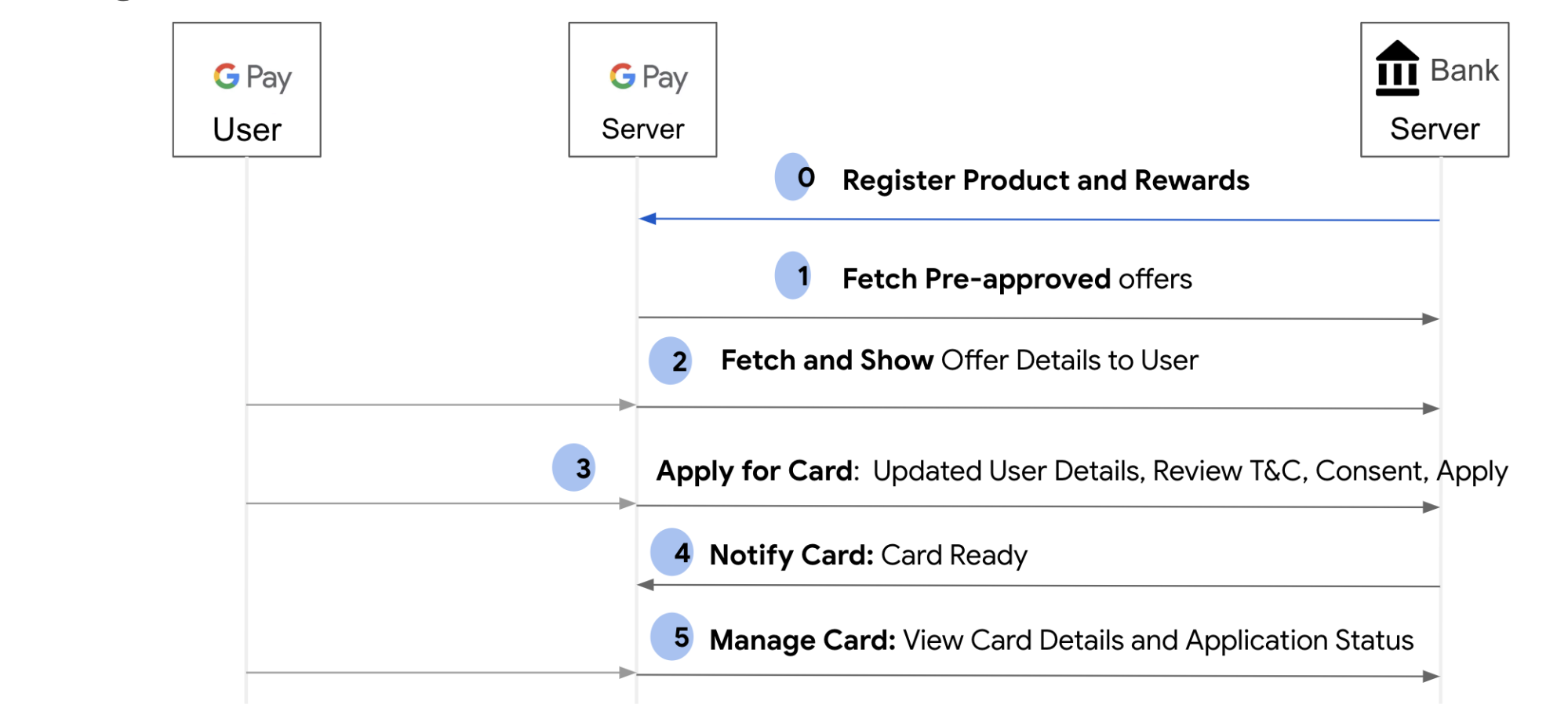
1. Offer eligibility and ingestion
Before an offer is presented to a user, GPay and the partner bank synchronize product metadata and offer eligibility:
- Product and offer synchronization: The partner bank registers credit card products, reward propositions, and offer eligibility rules with GPay. For batch campaigns, GPay and the partner bank exchange encrypted batch files over a secure file transfer channel to synchronize pre-approved offers and remove expired or claimed offers.
- Dynamic input requirements: Each offer defines its credit limit bounds and the specific customer attributes required by the partner bank to evaluate an application for that customer cohort (such as ETB or NTB).
- Real-time offer lookup: When a user interacts with a credit card offer in GPay, the Google Pay platform queries the partner bank's eligibility services in real time to validate current offer eligibility, credit limit ranges, and required application fields.
2. Customer verification and application submission
When a user chooses to apply for a credit card, the platform adapts the data collection and verification steps based on the user's relationship with the partner bank:
- One-time password (OTP) authentication: To verify the user's identity before retrieving bank records or submitting an application, GPay initiates a challenge request with the partner bank. The partner bank generates and sends an OTP to the user's registered mobile number or email address.
- Fetching and pre-filling customer details:
- For ETB and ETC users: After the user verifies the OTP, GPay requests the customer's verified profile details from the partner bank (such as name, residential and communication addresses, and masked bank account or existing card references) and displays them to the user for confirmation.
- For NTB users: GPay collects the required personal, residential, employment, and income details needed by the partner bank, pre-filling fields from consented data sources where available.
- Terms acceptance and application submission: The user configures card preferences (such as statement delivery mode, optional auto-debit setup for repayments, or shared credit limits for ETC) and accepts the partner bank's Terms and Conditions (TnC) using an OTP challenge. GPay then submits the application payload and auditable consent metadata to the partner bank.
3. Application processing, KYC, and income verification
After receiving the application, the partner bank performs credit checks, income validation, and KYC verification:
- In-principle evaluation and status tracking: The partner bank evaluates the application synchronously or asynchronously and returns the current application status (such as in-process, pending underwriter review, pending KYC, approved, counter-offered, or rejected). GPay synchronizes with the partner bank's status tracking interfaces for real-time updates and reconciles bulk status changes through scheduled, encrypted reconciliation batches.
- Determining verification steps: When an application receives in-principle
approval and requires identity or income verification, the partner bank
specifies the required verification workflow, which can include:
- eKYC: Aadhaar-based electronic KYC.
- Video KYC (vKYC): Assisted video verification with a bank agent.
- cKYC: Central KYC registry lookup.
- Offline KYC: Physical verification at the user's address.
- Income verification: Online or offline collection and verification of income documents.
- Secure partner redirection and step tracking: When the user proceeds with KYC or online income verification, GPay establishes a short-lived, cryptographically bound session with the partner bank and securely transitions the user to the partner bank's hosted verification surface. After verification, the partner bank redirects the user back to GPay. GPay tracks the completion status of each verification step so users can resume interrupted steps or retry temporary failures.
4. Underwriting, account creation, and card management
Once KYC and underwriting are completed, the partner bank finalizes card issuance and enables ongoing account management in GPay:
- Underwriting and account provisioning: The partner bank underwrites the user, creates the credit card account, and returns an account identifier to GPay for subsequent account-level communication.
- Card activation and usage in GPay: GPay notifies the user that their card is ready and displays onboarding guidance on how to use the credit card.
- Ongoing account and statement management: Through post-issuance servicing
APIs and encrypted statement exchanges, GPay enables cardholders to:
- Authenticate account management sessions using OTP verification.
- View masked card metadata and access step-up authenticated card credentials for transactions.
- Check real-time credit limits, total outstanding amounts, and available balances.
- View billing cycles, minimum amount due, due dates, and monthly statements.
Integration architecture and security
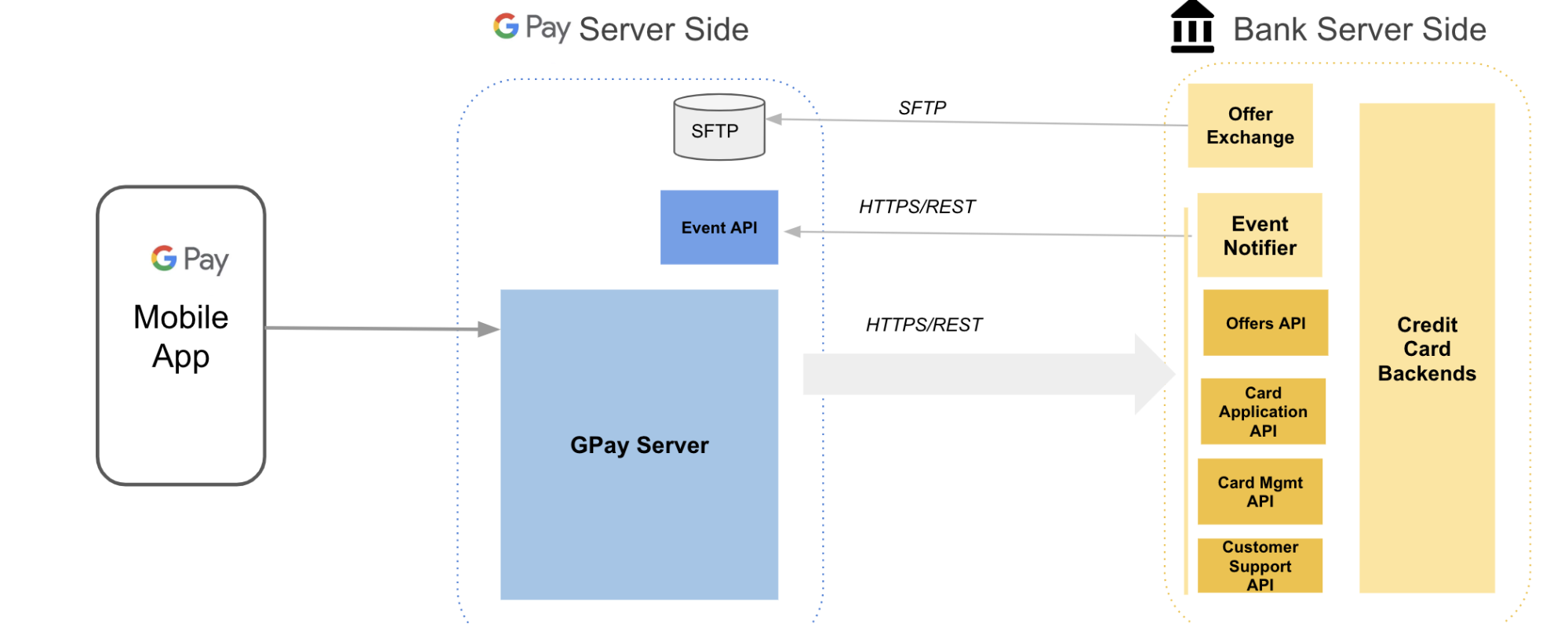
The platform is designed around banking-grade, defense-in-depth security and regulatory compliance across every integration touchpoint:
- Zero-trust transport and message-level encryption: All real-time API traffic between Google Pay and the partner bank is protected by TLS 1.2+ transport encryption paired with asymmetric, message-level payload encryption and digital signatures—ensuring end-to-end confidentiality, integrity, and non-repudiation across every request and response.
- Encrypted asynchronous batch channels: High-volume data exchanges for pre-approved offer campaigns, status reconciliation, and billing statements are transmitted as asymmetrically encrypted and cryptographically signed batch files over dedicated secure transfer channels.
- Explicit consent and step-up authentication: Sensitive lifecycle actions—including profile pre-filling, terms acceptance, application submission, and post-issuance account servicing—require explicit user consent and real-time multi-factor verification (OTP challenges) validated directly by the partner bank.
Partner eligibility and access
The GPay Credit Card platform is available to participating financial institutions in India. To integrate with the platform and access the full technical specifications, partner banks must complete a Non-Disclosure Agreement (NDA) and a partner agreement with Google.
If you are an authorized partner and need access to the detailed integration guides and API reference documentation, contact your Google Pay representative.