
The Google Docs API supports creating lists in new documents, converting existing plain paragraphs to bulleted lists, and removing bullets from paragraphs.
Create a numbered list in a new document
The Docs API supports creating a numbered list in a new document by inserting text and then applying a list style to the text in a single batch request.
To create a numbered list in a new document:
Use the
documents.createmethod to create a document.Use the
documents.batchUpdatemethod and supply anInsertTextRequestto add content to the document. Use newline characters (\n) to separate the list items.In the same batch update, include a
CreateParagraphBulletsRequest, aRangeto specify the range of text, and aBulletGlyphPresetto set the pattern for the numbering.
The following code sample shows how to create a document and then insert three
items as a numbered list. The BulletGlyphPreset uses
NUMBERED_DECIMAL_ALPHA_ROMAN to format the list. This means the first three
nesting levels of the numbered list are represented by a decimal number, a
lowercase letter, and a lowercase Roman numeral.
Java
Document doc = new Document().setTitle("New List Document");
doc = docsService.documents().create(doc).execute();
String documentId = doc.getDocumentId();

List<Request> requests = new ArrayList<>();
requests.add(new Request().setInsertText(new InsertTextRequest()
        .setText("Item 1\nItem 2\nItem 3\n")
        .setLocation(new Location().setIndex(1).setTabId(<var>TAB_ID</var>))));

requests.add(new Request().setCreateParagraphBullets(
        new CreateParagraphBulletsRequest()
                .setRange(new Range()
                        .setStartIndex(1)
                        .setEndIndex(22)
                        .setTabId(<var>TAB_ID</var>))
                .setBulletPreset("NUMBERED_DECIMAL_ALPHA_ROMAN")));

BatchUpdateDocumentRequest body = new BatchUpdateDocumentRequest().setRequests(requests);
docsService.documents().batchUpdate(documentId, body).execute();

System.out.println("Created document with ID: " + documentId);
Python
title = 'New List Document'
body = {'title': title}
doc = service.documents().create(body=body).execute()
document_id = doc.get('documentId')

requests = [
    {
        'insertText': {
            'location': {
                'index': 1,
                'tabId': <var>TAB_ID</var>
            },
            'text': 'Item 1\nItem 2\nItem 3\n'
        }
    },
    {
        'createParagraphBullets': {
            'range': {
                'startIndex': 1,
                'endIndex': 22,
                'tabId': <var>TAB_ID</var>
            },
            'bulletPreset': 'NUMBERED_DECIMAL_ALPHA_ROMAN'
        }
    }
]

result = service.documents().batchUpdate(
    documentId=document_id, body={'requests': requests}).execute()

print(f"Created document with ID: {document_id}")
Replace TAB_ID with the ID of the tab that contains the list content.
Convert a paragraph to a list
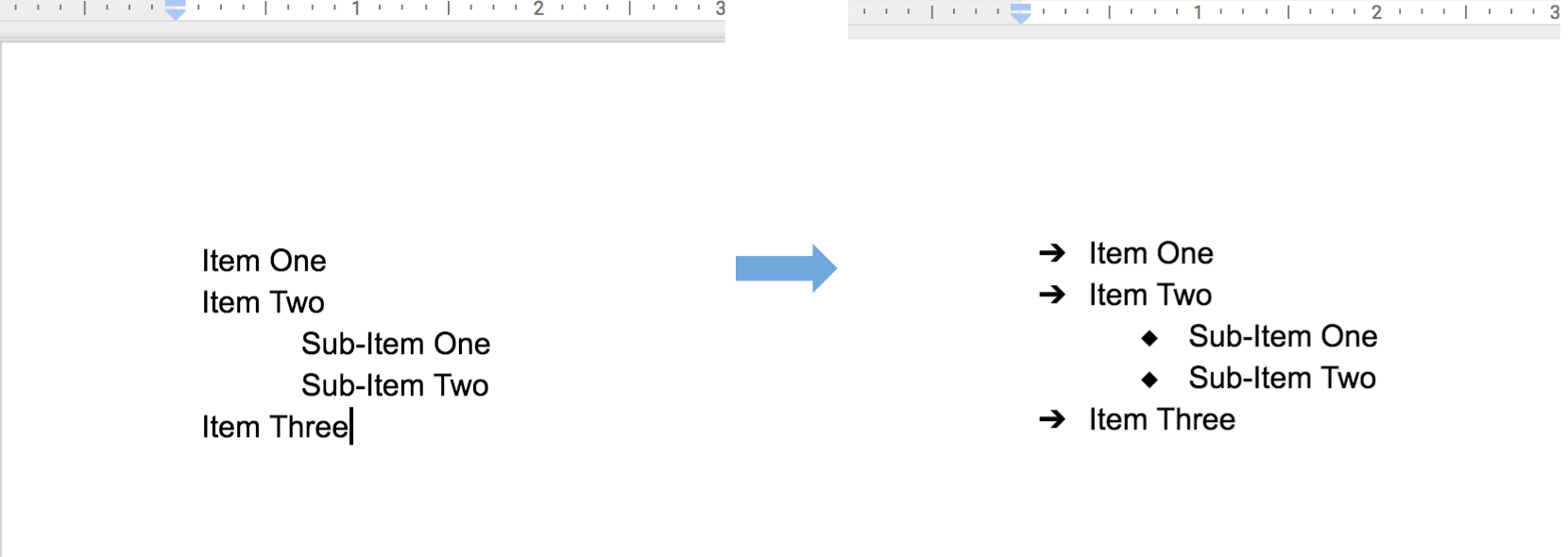
A common paragraph formatting operation is converting existing paragraphs into a bulleted list.
To create a list, use the
documents.batchUpdate
method and supply a
CreateParagraphBulletsRequest.
Include a Range to
specify the affected text and a
BulletGlyphPreset
to set the pattern for the bullet.
All paragraphs that overlap with the given range are bulleted. If the specified range overlaps with a table, the bullets are applied within the table cells. The nesting level of each paragraph is determined by counting leading tabs in front of each paragraph.
You can't adjust the nesting level of an existing bullet. Instead, you must delete the bullet, set the leading tabs in front of the paragraph, and then create the bullet again. For more information, see Remove bullets from a list.
You can also use CreateParagraphBulletsRequest to change the bullet style for
an existing list.
The following code sample shows a batch request that first inserts text at the
start of the document, and then it creates a list from the paragraphs spanning
the first 50 characters. The BulletGlyphPreset uses
BULLET_ARROW_DIAMOND_DISC which means the first three nesting levels of the
bulleted list are represented by an arrow, a diamond, and a disc.
Java
List<Request> requests = new ArrayList<>();
requests.add(new Request().setInsertText(new InsertTextRequest()
        .setText("Item One\n")
        .setLocation(new Location().setIndex(1).setTabId(<var>TAB_ID</var>))));

requests.add(new Request().setCreateParagraphBullets(
        new CreateParagraphBulletsRequest()
                .setRange(new Range()
                        .setStartIndex(1)
                        .setEndIndex(50)
                        .setTabId(<var>TAB_ID</var>))
                .setBulletPreset("BULLET_ARROW_DIAMOND_DISC")));

BatchUpdateDocumentRequest body = new BatchUpdateDocumentRequest().setRequests(requests);
BatchUpdateDocumentResponse response = docsService.documents()
        .batchUpdate(<var>DOCUMENT_ID</var>, body).execute();
Python
requests = [
        {
        'insertText': {
            'location': {
                'index': 1,
                'tabId': <var>TAB_ID</var>
            },
            'text': 'Item One\n',
        }}, {
        'createParagraphBullets': {
            'range': {
                'startIndex': 1,
                'endIndex':  50,
                'tabId': <var>TAB_ID</var>
            },
            'bulletPreset': 'BULLET_ARROW_DIAMOND_DISC',
        }
    }
]

result = service.documents().batchUpdate(
    documentId=<var>DOCUMENT_ID</var>, body={'requests': requests}).execute()
Replace TAB_ID with the ID of the tab that contains the list content, or omit it to default to the first tab in the document.
Remove bullets from a list
To remove bullets from a paragraph list, use the
documents.batchUpdate
method and supply a
DeleteParagraphBulletsRequest.
Include a Range to
specify the affected text.
The method deletes all bullets that overlap with the given range, regardless of nesting level. To visually preserve the nesting level, indentation is added to the start of each corresponding paragraph.
The following code sample shows a batch request that deletes bullets from a paragraph list.
Java
List<Request> requests = new ArrayList<>();
requests.add(new Request().setDeleteParagraphBullets(
        new DeleteParagraphBulletsRequest()
                .setRange(new Range()
                        .setStartIndex(1)
                        .setEndIndex(50)
                        .setTabId(<var>TAB_ID</var>))));

BatchUpdateDocumentRequest body = new BatchUpdateDocumentRequest().setRequests(requests);
BatchUpdateDocumentResponse response = docsService.documents()
        .batchUpdate(<var>DOCUMENT_ID</var>, body).execute();
Python
requests = [
        {
        'deleteParagraphBullets': {
            'range': {
                'startIndex': 1,
                'endIndex':  50,
                'tabId': <var>TAB_ID</var>
            },
        }
    }
]

result = service.documents().batchUpdate(
    documentId=<var>DOCUMENT_ID</var>, body={'requests': requests}).execute()
Replace TAB_ID with the ID of the tab that contains the list content, or omit it to default to the first tab in the document.