

Page Summary
-
Every Google Chat app needs its own Google Cloud project with the Chat API enabled and configured, following specific prerequisites.
-
Chat apps require a display name, avatar URL, and description, which are visible to users and used by Chat for attributions.
-
The Chat API is configured in the Google Cloud console, where you can set the app's details, enable/disable interactive features, and optionally enable error logging.
-
Access to the Chat app configuration page can be granted to other users via specific Google Cloud IAM roles.
Each Google Chat app that you create requires its own Google Cloud project with the Chat API enabled and configured.
To perform read-only API calls with user authentication, like getting spaces and listing messages, you only need to enable the API and create an OAuth client.
To perform create, update, and delete API calls, or to deploy and test an interactive Chat app (built as a Google Workspace add-on that extends Chat), you must also configure the Chat API. The Chat API configuration settings are where you specify all the details about the Chat app, including its display name, avatar, deployment endpoints, and interactive features.
Prerequisites
- A Business or Enterprise Google Workspace account with access to Google Chat.
- Create a Google Cloud project.
- Configure the OAuth consent screen.
- Enable the Google Chat API.
Choose a display name, avatar, and description for your Chat app
When you enable the Chat API, you configure the details about your Chat app that appear to users in Chat, including a display name, avatar, and description. These details only appear in Chat. To publish your Chat app to the Marketplace, you must also specify the details that appear in your Chat app's Marketplace listing.
Before you configure a Chat app, prepare the following information:
| Field | Description | Format |
|---|---|---|
| App name | The display name for the Chat app. | Up to 25 alphanumeric characters |
| Avatar URL | The image that displays as your Chat app's avatar. | An HTTPS URL pointing to a square graphics image (PNG or JPEG). Recommended size is 256 by 256 pixels or more. |
| Description | A short description of the Chat app, displayed when users search for apps in Chat. | Up to 40 alphanumeric characters |
| Long description | Optional. A description of what the Chat app can do, displayed when users start a conversation with the Chat app or open the sessions home page for an agent. Currently only supported when updating the app configuration using the Google Cloud console and not supported through the Google Workspace add-ons API. | Up to 250 characters |
The Chat app's name, avatar, and description are displayed to users in the Chat UI. For some Chat API write requests, Chat uses this information to attribute the actions that a Chat app takes in Chat.
For example, if you call the spaces.create() method, Chat
includes the name of the Chat app in the
description of who created the space, as shown in the following image:
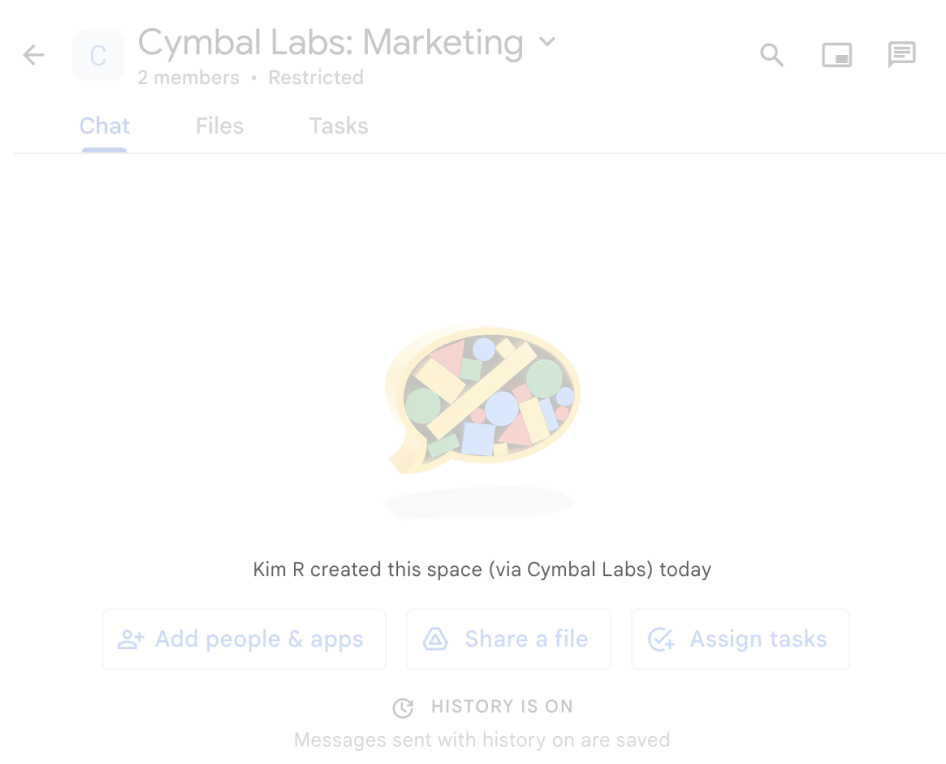
spaces.create() method is used to create a
space on behalf of a user.
To interact with Chat apps, users also see or use this information in the following ways:
- @mention the Chat app to add it to a space or send it a message.
- Find and start a direct message with the Chat app. In the Apps menu, direct messages display the Chat app's name and avatar.
- From the compose bar, users can browse Chat apps and see their name, avatar, and description.
Configure your Chat app in the Google Cloud console
When you have your Chat app details, open your Cloud project and configure the Chat API:
In the Google Cloud console, go to the Chat API page and click the Configuration page:
Under Application info, fill out the App name, Avatar URL, and Description fields.
Optional: Fill in the Long description field.
Optional: From the Markup syntax menu, select the default markup syntax (Markdown or Chat) for your Chat app's messages. To learn more about text formatting and how Chat determines the markup syntax for API requests, see Format messages.
Under Interactive features, configure whether your Chat app responds to user interactions:
To build an interactive Chat app, turn on Enable interactive features and complete the following:
- Under Functionality:
- Optional: Select Support App Home to display a homepage card in the Home tab of 1:1 direct messages with the Chat app.
- Select Join spaces and group conversations to make your Chat app available to install and use. By default, users can install and message with the Chat app in a dedicated space between the user and Chat app. Users can also add and interact with the Chat app in spaces with multiple people.
Under Connection settings, select the architecture that you want to use to receive event objects from Chat:
- To use an HTTP service, select HTTP endpoint URL and provide a URL.
- To use a Google Apps Script project, select Apps Script and provide a deployment ID for the project.
- To use a Dialogflow agent, select Dialogflow, select Dialogflow CX or Dialogflow ES, and provide the agent's resource name.
- To use Pub/Sub, select Cloud Pub/Sub and enter the topic name.
Optional: To route event objects to specific endpoints or functions, go to Connection settings > Triggers and provide or update the callback endpoints or functions for the following Chat triggers:
- App home (if Support App Home is enabled): A user opens the Home tab in a 1:1 direct message with the Chat app.
- Added to space: A user adds the Chat app to a group conversation or space, or installs the Chat app for 1:1 messages.
- Message: A user sends a message to the Chat app. For example, a user sends a direct message to the Chat app or @mentions the Chat app in a space with multiple people.
- Removed from space: A user uninstalls or removes the Chat app from a space.
- App command: A user invokes a quick command, slash command, or message action from the Chat app.
Optional: Add other interactive features such as sessions, starter prompts, commands (quick commands, slash commands, and message actions), or link previews.
Under Visibility, select Make this Chat app available to specific people and groups and enter the email addresses of individuals or Google Groups in your Google Workspace organization:
- To install and test your app yourself, enter your own email address.
- To share an internal Chat app across a team
or your entire organization without publishing to the
Marketplace, enter one or more
Google Groups. Groups don't have a member limit. If your app
requests
chat.app.*scopes, you must still publish the app for administrator approval. - If your administrator restricts Marketplace installs to apps on an allowlist, Google Cloud console limits this field to five individual user email addresses for development. Group visibility applies only after an administrator adds the app to the allowlist.
- Under Functionality:
Optional: Under Logs, select the Log errors to Logging checkbox to use Google Cloud Logging. For more information, see Query error logs for Chat apps.
Click Save.
After you save the configuration, anyone that you specified in the Chat API's Visibility setting can install, test, or use the Chat app. To start testing and debugging your Chat app, see Test interactive features for Google Chat apps.
Configure your Chat app using the Google Cloud CLI
Instead of using the Google Cloud console, you can view and update the configuration of a Chat app from the command line with the Google Cloud CLI (gcloud CLI). For example, you can configure a Chat app from a script, or keep its configuration in a file that you store with your code.
The gcloud beta workspace-add-ons chat-app-config command group has the
following commands:
describe: Shows the configuration.update: Configures a Chat app for the first time, or changes its configuration.
The commands use the
chatAppConfig
resource in the Google Workspace add-ons API.
Before you begin
- Install the gcloud CLI. If you
installed the gcloud CLI previously, make sure that you have the latest
version by running
gcloud components update. Sign in to the gcloud CLI with your user account. The commands don't support service accounts.
gcloud auth loginSet the Cloud project of your Chat app as the default project of the gcloud CLI. Use the project ID, because the commands don't accept a project number.
gcloud config set project PROJECT_IDAlternatively, add the
--projectflag to each command.Enable the Google Workspace add-ons API in the Cloud project:
gcloud services enable gsuiteaddons.googleapis.comMake sure that you have the following Identity and Access Management (IAM) roles on the Cloud project:
- Google Workspace Add-ons Developer
(
roles/gsuiteaddons.developer) to view and update the configuration, or Google Workspace Add-ons Reader (roles/gsuiteaddons.reader) to only view it. These roles include the permissions that are listed in Prerequisites and authentication. - Service Usage Consumer
(
roles/serviceusage.serviceUsageConsumer). The gcloud CLI uses the Cloud project as the quota project for its requests, which requires theserviceusage.services.usepermission.
The Owner and Editor roles include all of these permissions. The Chat apps Owner and Chat apps Viewer roles, which give access to the configuration page in the Google Cloud console, aren't sufficient.
- Google Workspace Add-ons Developer
(
View the configuration
To view the configuration of your Chat app, run the
describe command:
gcloud beta workspace-add-ons chat-app-config describeThe output is similar to the following:
avatarUri: https://www.gstatic.com/dynamite/images/quickstart-app-avatar.png
description: Helps manage tasks and schedules
displayName: Cymbal Assistant
errorLoggingEnabled: true
interactiveFeatureConfig:
  allowlistedTestingPrincipals:
  - user@example.com
  appCommands:
  - command: /help
    commandId: 1
    commandType: SLASH_COMMAND
    description: Show available commands
  connectionConfig:
    httpEndpointConfig:
      commonUrl: https://example.com/chat
  supportsMultiuserSpaces: true
  urlPatterns:
  - hostPattern: example.com
    pathPrefix: tasks/
name: projects/123456789012/chatAppConfig
state: ACTIVE
If the Cloud project doesn't have a Chat app
yet, the command succeeds and prints only the name field of the
configuration:
name: projects/123456789012/chatAppConfig
To change the output, add one of the following flags:
--format=json: Prints the configuration in JSON format.--view=basic: Leaves out the interactive feature settings (interactiveFeatureConfig).--format="value(displayName)": Prints only the display name, or an empty line if the Cloud project doesn't have a Chat app yet. A configured Chat app always has a display name, so you can use this flag in a script to check whether a Chat app exists.
Update the configuration
To configure a Chat app for the first time, or to
change its configuration, run the update command. Specify the settings with
flags or in a configuration file. You can't combine the two in one command.
The first time that you run the command for a Cloud project, you must specify at least a display name and a description. Unless you set the state to disabled, the Chat app is active as soon as the command finishes. The people that you list as testers can then find and use it.
Use flags
The following example configures a Chat app that receives events at an HTTP endpoint:
gcloud beta workspace-add-ons chat-app-config update \
    --display-name="Quickstart App" \
    --description="Quickstart app" \
    --avatar-uri=https://developers.google.com/workspace/chat/images/quickstart-app-avatar.png \
    --http-endpoint-url=HTTP_ENDPOINT_URL \
    --supports-multiuser-spaces \
    --add-allowlisted-testing-principals=USER_EMAIL \
    --error-logging-enabled
Replace the following:
HTTP_ENDPOINT_URL: the HTTPS URL that receives event objects from Chat.USER_EMAIL: the email address of a person or a group in your Google Workspace organization who can install and test the Chat app, such as your own email address.
The command prints the updated configuration.
The following table lists the flags for the settings on the Chat API
Configuration page in the Google Cloud console. For details about each flag,
see the
update command reference.
| Setting in the Google Cloud console | Flags |
|---|---|
| App name | --display-name |
| Avatar URL | --avatar-uri with the HTTPS URL of an image that meets the
avatar requirements, or
--clear-avatar-uri to use the default avatar |
| Description | --description |
| App status | --state=active or --state=disabled |
| Markup syntax | --markup-syntax=markdown or
--markup-syntax=chat |
| Join spaces and group conversations | --supports-multiuser-spaces or
--no-supports-multiuser-spaces |
| Connection settings | One of the following:
|
| Visibility | --add-allowlisted-testing-principals,
--remove-allowlisted-testing-principals, and
--clear-allowlisted-testing-principals |
| Log errors to Logging | --error-logging-enabled or
--no-error-logging-enabled |
Commands, link previews, and separate endpoints for each trigger don't have flags. To configure them, use a configuration file.
For example, to
turn off your Chat app
without changing its other settings, run the following command. To turn it on
again, use --state=active.
gcloud beta workspace-add-ons chat-app-config update --state=disabledUse a configuration file
To keep the configuration in a file, or to configure settings that don't have
flags, pass a YAML or JSON file to the update command. The file uses the
fields of the
chatAppConfig
resource, which are the same fields that the describe command prints.
Create a file that contains the settings to update. For example, create a file named
chat_app_config.yamlwith the following content:displayName: Cymbal Assistant description: Helps manage tasks and schedules avatarUri: https://www.gstatic.com/dynamite/images/quickstart-app-avatar.png state: ACTIVE errorLoggingEnabled: true interactiveFeatureConfig: supportsMultiuserSpaces: true connectionConfig: httpEndpointConfig: commonUrl: https://example.com/chat appCommands: - commandId: 1 commandType: SLASH_COMMAND command: /help description: Show available commands urlPatterns: - hostPattern: example.com pathPrefix: tasks/ allowlistedTestingPrincipals: - USER_EMAILReplace
USER_EMAILwith the email address of a person or a group in your Google Workspace organization who can install and test the Chat app.Run the
updatecommand with the--config-fileflag:gcloud beta workspace-add-ons chat-app-config update \ --config-file=chat_app_config.yaml
To start from the current configuration of a Chat app,
save the output of the describe command to a file:
gcloud beta workspace-add-ons chat-app-config describe > chat_app_config.yamlThen edit the file, delete the fields that you don't want to change, and pass
the file to the update command. If the file contains a setting that the
command can't update, the command fails. For details, see
Limitations.
The update command ignores the name field in the file. It always updates the
Cloud project that you set in the gcloud CLI, so you can use the same
file to configure a Chat app in another
Cloud project.
How the command applies your changes
- Only the settings that you specify change. With flags, the command changes the settings for the flags that you pass. With a configuration file, it changes the fields that are in the file, so the file doesn't need to contain the whole configuration. The connection settings are an exception: a connection type that you set replaces the current one, and a Dialogflow edition that you set replaces the whole Dialogflow configuration.
- Lists are replaced as a whole. If the file contains the
appCommands,urlPatterns, orallowlistedTestingPrincipalsfield, the list in the file replaces the current list. To add or remove individual testers instead, use the--add-allowlisted-testing-principalsand--remove-allowlisted-testing-principalsflags. - An empty value clears a setting. For example, a file that contains
urlPatterns: []underinteractiveFeatureConfigremoves all link preview URL patterns. - A command that fails doesn't change anything. If a value isn't valid, the command prints the error and leaves the configuration as it was.
- Requests are rate limited. The API limits the number of read requests
and update requests per minute, for each Cloud project and for
each organization. Each
updatecommand sends one update request. If you add or remove testers with flags, the command also sends a read request. To change several settings, pass them in one command or one file instead of running a command for each setting.
Limitations
- The commands only support Chat apps built as Google Workspace add-ons.
- The commands don't support service accounts or service account impersonation. You must sign in to the gcloud CLI with a user account.
- A Cloud project has one Chat app configuration, and the commands can't delete it. To stop people from using the Chat app, set its state to disabled or delete the Cloud project.
- An update applies to the live Chat app. The commands don't have a draft or dry-run mode.
- While a Chat app is published or under review in the Google Workspace Marketplace, the commands can't change its display name, avatar, description, commands, or link preview URL patterns.
- The commands support the settings in the
chatAppConfigresource. To configure a setting that the resource doesn't include, use the Google Cloud console.
Troubleshoot
If a command fails, find the text from the error message in the following
table. If the message starts with a status such as INVALID_ARGUMENT, the
Google Workspace add-ons API rejected the request, and the text after the
status describes the problem.
| Error message contains | Cause | Solution |
|---|---|---|
Invalid choice: 'chat-app-config' or
Invalid choice: 'workspace-add-ons' |
The command doesn't include beta, or your version of the
gcloud CLI doesn't include the commands. |
Start the command with
gcloud beta workspace-add-ons chat-app-config. If the error
persists, update the gcloud CLI to the latest version. |
PROJECT ID |
The project is set to a project number. | Set the project to the project ID. |
Failed to parse value(s) in protobuf |
The configuration file contains a field that the gcloud CLI doesn't recognize. The error message names the field. | Compare the field name with the output of the describe
command. If the field is new, update the gcloud CLI to the latest
version. |
does not have permission to access projects instance |
The API denied the request. The text after this message gives the
reason. For example:
|
Check the requirements in Before you begin. |
INVALID_ARGUMENT |
A value isn't valid. For example, the display name must have between 3
and 25 characters, and the description between 1 and 40 characters. If
the message contains not found or deleted, the project ID
isn't correct. |
Correct the value that the error message describes, and run the command again. |
FAILED_PRECONDITION |
The Chat app doesn't allow the request. For example, it isn't built as a Google Workspace add-on, or it's published in the Google Workspace Marketplace and the setting can't be changed. | Follow the instructions in the error message. To configure a Chat app that isn't a Google Workspace add-on, use the Google Cloud console or convert it. |
RESOURCE_EXHAUSTED or 429 |
The API received too many requests for the Cloud project or for your organization in a short time. | Wait a minute, and then run the command again. |
Configure your Chat app using the Google Workspace add-ons API
Instead of configuring your Chat app manually in the
Google Cloud console, you can programmatically read and update the configuration
for a Chat app built as a Google Workspace add-on
using the chatAppConfig resource in the
Google Workspace add-ons API.
chatAppConfig is a singleton resource that always exists for each
Cloud project. Before you save a configuration for the first time, the
resource contains an empty configuration (which is also what
GetChatAppConfig
returns if you read the resource before the first save). Because the resource
already exists, you don't need to create it separately—use
UpdateChatAppConfig
both to save the initial configuration and to update an existing configuration.
Prerequisites and authentication
Before calling GetChatAppConfig or UpdateChatAppConfig, complete the
following prerequisites:
- Enable the Google Workspace add-ons API
(
gsuiteaddons.googleapis.com) in your Cloud project. Optionally, you can enable the Google Chat API (chat.googleapis.com) if you want to view or update the Chat app configuration in the Google Cloud console or call the Chat API. - Authenticate as a human user with an OAuth 2.0 credential that includes the
https://www.googleapis.com/auth/cloud-platformscope. Service account authentication isn't supported forchatAppConfigmethods. - Ensure the authenticated user has the required Identity and Access
Management (IAM) permissions on the target Cloud project:
gsuiteaddons.chatAppConfigs.getandchat.bots.getto read the configuration (GetChatAppConfig).gsuiteaddons.chatAppConfigs.update,chat.bots.update, andchat.bots.getto update the configuration (UpdateChatAppConfig).
- If you use a client library, install the latest version of the Google Workspace add-ons API client library for your language. For a list of client libraries, see the Google Workspace add-ons API reference.
Update a Chat app configuration
To configure a Chat app for the first time or update an
existing configuration, send a PATCH request
(UpdateChatAppConfig)
to the singleton
chatAppConfig
resource for your Cloud project:
- For the initial save on a Cloud project with an empty
chatAppConfig,displayName(3 to 25 characters) anddescription(1 to 40 characters) are required. If you omitinteractiveFeatureConfigon the initial save, the Chat app is configured as non-interactive. - For subsequent updates, use the optional
updateMaskquery parameter to specify the comma-separated fields to update (or omitupdateMaskto update all provided fields). Updating a repeated field (appCommands,urlPatterns, orallowlistedTestingPrincipals) replaces the entire list.
PATCH https://gsuiteaddons.googleapis.com/v1/projects/PROJECT_NUMBER/chatAppConfig?updateMask=displayName,description,avatarUri,state,errorLoggingEnabled,markupSyntax,interactiveFeatureConfig
Authorization: Bearer ACCESS_TOKEN
Content-Type: application/json

{
  "name": "projects/PROJECT_NUMBER/chatAppConfig",
  "displayName": "Cymbal Assistant",
  "description": "Helps manage tasks and schedules",
  "avatarUri": "https://www.gstatic.com/dynamite/images/quickstart-app-avatar.png",
  "state": "ACTIVE",
  "errorLoggingEnabled": true,
  "markupSyntax": "MARKUP_SYNTAX_MARKDOWN",
  "interactiveFeatureConfig": {
    "supportsMultiuserSpaces": false,
    "connectionConfig": {
      "httpEndpointConfig": {
        "commonUrl": "https://example.com/chat"
      }
    },
    "appCommands": [
      {
        "commandType": "SLASH_COMMAND",
        "commandId": 1,
        "command": "/help",
        "description": "Show available commands",
        "dialogEnabled": false
      }
    ],
    "urlPatterns": [
      {
        "hostPattern": "example.com",
        "pathPrefix": "tasks/"
      }
    ],
    "allowlistedTestingPrincipals": [
      "USER_EMAIL"
    ]
  }
}
Replace the following in the request URL, header, and body:
PROJECT_NUMBER: The numeric project number of the Cloud project hosting your Chat app.ACCESS_TOKEN: A user OAuth 2.0 access token authorized with thehttps://www.googleapis.com/auth/cloud-platformscope.USER_EMAIL: An email address or Google Group from your Google Workspace organization to allowlist for testing the Chat app (for example, your own email address).- The example configuration fields in the request body (such as
displayName,description,avatarUri, andinteractiveFeatureConfig, including your endpoint configuration, commands, link preview URL patterns, and testing principals) with the values for your Chat app. For details on all supported fields and endpoint options, see theprojects.chatAppConfigREST reference andprojects.chatAppConfig.patch.
Get a Chat app configuration
To read the current Chat app configuration for a
Cloud project, call
GetChatAppConfig.
You can pass the optional view query parameter (ChatAppConfigView):
BASIC(default): Returns basic metadata withoutinteractiveFeatureConfig.FULL: Returns all configuration fields, includinginteractiveFeatureConfig.
If the Chat app configuration hasn't been saved for the
Cloud project yet, the method returns an empty ChatAppConfig object.
HTTP
GET https://gsuiteaddons.googleapis.com/v1/projects/PROJECT_NUMBER/chatAppConfig?view=FULL
Authorization: Bearer ACCESS_TOKEN
Node.js
const {GSuiteAddOnsClient} = require('@google-cloud/gsuiteaddons').v1;

const client = new GSuiteAddOnsClient();

async function getChatAppConfig() {
  const [response] = await client.getChatAppConfig({
    name: 'projects/PROJECT_NUMBER/chatAppConfig',
    view: 'FULL',
  });
  console.log(JSON.stringify(response, null, 2));
}

getChatAppConfig();
Python
from google.cloud import gsuiteaddons_v1

client = gsuiteaddons_v1.GSuiteAddOnsClient()

request = gsuiteaddons_v1.GetChatAppConfigRequest(
    name="projects/PROJECT_NUMBER/chatAppConfig",
    view=gsuiteaddons_v1.GetChatAppConfigRequest.ChatAppConfigView.FULL,
)
response = client.get_chat_app_config(request=request)
print(response)
Usage limits
The chatAppConfig methods have per-project quotas. If you exceed a quota, the
request fails with a 429: Too many requests HTTP status code. For the quota
limits, see Google Workspace add-ons API usage limits.
Troubleshoot errors
If a chatAppConfig request fails, check the HTTP status code and the message
field in the error response. The following table lists common errors, their
causes, and how to resolve them.
| HTTP status code | Common causes | Resolution |
|---|---|---|
400: Bad Request (INVALID_ARGUMENT) |
|
Check the message field for the invalid field, and
correct the request. For supported fields and values, see the
projects.chatAppConfig
reference. |
400: Bad Request (FAILED_PRECONDITION) |
|
|
403: Forbidden (PERMISSION_DENIED) |
|
|
404: Not Found (NOT_FOUND) |
The Cloud project in the resource name doesn't exist, or the authenticated user can't access it. | Check that the resource name uses the correct project number in the
format projects/PROJECT_NUMBER/chatAppConfig,
and that the user has access to the Cloud project. |
429: Too Many Requests (RESOURCE_EXHAUSTED) |
The per-project quota is exceeded. | Wait and retry the request later. For limits, see Usage limits. |
Considerations for existing Google Workspace add-ons
Chat apps require a different configuration compared to Google Workspace add-ons that extend other Google Workspace applications. If your add-on extends other Google Workspace applications, consider the following requirements for configuring the Chat app:
- Both individuals and Google Workspace administrators must be able to install your add-on from the Marketplace. You configure these installation settings in the Marketplace SDK.
- Chat apps don't use the name and logo that you configure
for other Google Workspace applications in the
addons.commonobject of the manifest. - For add-ons that are published to the Google Workspace Marketplace, you can't save a draft of any changes to the Google Chat API configuration settings. After you update and save the Chat API configuration settings, the updated Chat app is immediately available to all existing users. To update your Marketplace listing, you can create a draft before submitting any changes.
- If you built your add-on using
Apps Script:
- You must use the same Apps Script deployment ID that you use for the rest of your add-on configuration.
- You can't use the Apps Script editor to install test deployments in Chat. Instead, you must install them directly from the Chat UI.
- If you built your add-on using an HTTP service,
omit any Chat app configuration details in the
projects.deploymentsmanifest that you create using the Google Workspace add-ons API. The HTTP deployments that you specify in the Google Workspace Marketplace SDK are only used for other Google Workspace applications. Instead, configure your Chat app in the Google Cloud console, with the gcloud CLI, or using thechatAppConfigresource in the Google Workspace add-ons API.
Grant other people permission to configure the Chat API
You can give specific users access to the Chat app configuration page by granting them the Chat apps Owner or Chat apps Viewer Google Cloud Identity Access Management (IAM) role. Users with these roles can't navigate to the Chat apps configuration page by using the APIs & Services dashboard, but can access the configuration page by navigating to the Google Cloud console for the Chat app's host Cloud project as follows:
https://console.developers.google.com/apis/api/chat.googleapis.com/hangouts-chat?project=PROJECT_ID
Where PROJECT_ID is the project ID of the
Google Cloud project hosting the Chat app.
Related topics
- Choose a Chat app architecture
- Receive and respond to user interactions
- Test interactive features for Google Chat apps
Chat apps that aren't add-ons: Configure the Google Chat API
If you maintain a Chat app that isn't a Google Workspace add-on, your configuration uses a single endpoint for all interaction events rather than per-event triggers:
In the Google Cloud console, go to the Chat API Configuration page:
Under Interactive features, turn on Enable interactive features.
Clear Build this Chat app as a Google Workspace add-on. A dialog opens asking you to confirm. In the dialog, click Disable.
Under Functionality, select Support App Home or Join spaces and group conversations as needed.
Under Connection settings, specify a single endpoint for your Chat app (HTTP endpoint URL, Apps Script deployment ID, Cloud Pub/Sub topic name, or Dialogflow).
Configure optional Commands, Starter prompts, Link previews, Visibility, and Logs, then click Save.
To upgrade a Chat app that isn't an add-on to a Google Workspace add-on that extends Google Chat, see Convert a Google Chat app to a Google Workspace add-on.