

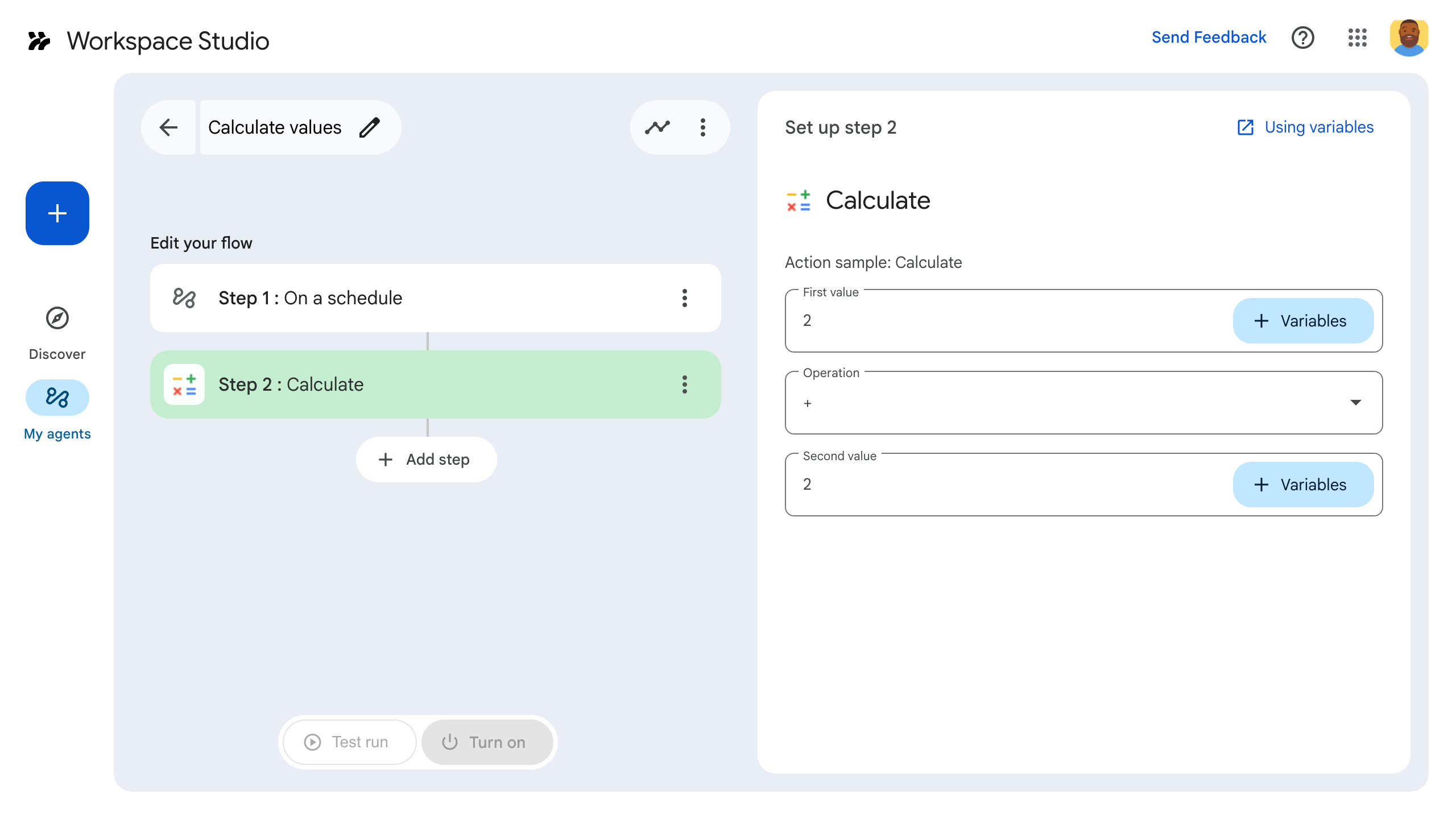
इस क्विकस्टार्ट में, Google Apps Script का इस्तेमाल करके, Workspace Studio के लिए कस्टम चरण बनाने का तरीका बताया गया है. कस्टम चरण, इनपुट के तौर पर दो नंबर और एक अंकगणितीय ऑपरेशन लेता है. इसके बाद, कैलकुलेशन करता है और नतीजा दिखाता है.
मकसद
- Google Apps Script की मदद से, Workspace Studio के लिए कस्टम चरण बनाना.
- अपने Google Workspace संगठन में कस्टम चरण डिप्लॉय करना.
- Workspace Studio में कस्टम चरण की जांच करना.
ज़रूरी शर्तें
- Workspace Studio का ऐक्सेस वाला Google खाता.
स्क्रिप्ट सेट अप करना
स्क्रिप्ट सेट अप करने के लिए, Apps Script का नया प्रोजेक्ट बनाएं. इसके बाद, उसे अपने क्लाउड प्रोजेक्ट से कनेक्ट करें.
कैलकुलेटर क्विकस्टार्ट Apps Script प्रोजेक्ट खोलने के लिए, यहां दिया गया बटन क्लिक करें.
खास जानकारी पर क्लिक करें.
खास जानकारी वाले पेज पर,
 कॉपी बनाएं पर क्लिक करें.
Apps Script प्रोजेक्ट की अपनी कॉपी को नाम दें:
कैलकुलेटर क्विकस्टार्ट की कॉपी पर क्लिक करें.
**प्रोजेक्ट का टाइटल** में,
Calculator quickstartटाइप करें.नाम बदलें पर क्लिक करें.
ज़रूरी नहीं है: क्विकस्टार्ट कोड की समीक्षा करना
पिछले सेक्शन में, आपने Apps Script का पूरा प्रोजेक्ट कॉपी किया है. इसमें, आपके फ़्लो के कस्टम चरण के लिए ज़रूरी सभी ऐप्लिकेशन कोड शामिल हैं. इसलिए, आपको हर फ़ाइल को कॉपी और चिपकाने की ज़रूरत नहीं है.
ज़रूरी नहीं है, लेकिन पिछले सेक्शन में कॉपी की गई हर फ़ाइल की समीक्षा यहां की जा सकती है:
appsscript.jsonमेनिफ़ेस्ट फ़ाइल. यह एक खास JSON फ़ाइल है. इसमें प्रोजेक्ट की बुनियादी जानकारी दी जाती है. स्क्रिप्ट चलाने के लिए, Apps Script को इस जानकारी की ज़रूरत होती है.
appsscript.jsonकोड देखना{ "timeZone": "America/Los_Angeles", "exceptionLogging": "STACKDRIVER", "runtimeVersion": "V8", "addOns": { "common": { "name": "Calculator", "logoUrl": "https://www.gstatic.com/images/branding/productlogos/calculator_search/v1/web-24dp/logo_calculator_search_color_1x_web_24dp.png", "useLocaleFromApp": true }, "flows": { "workflowElements": [ { "id": "actionElement", "state": "ACTIVE", "name": "Calculate", "description": "Asks the user for two values and a math operation, then performs the math operation on the values and outputs the result.", "workflowAction": { "inputs": [ { "id": "value1", "description": "value1", "cardinality": "SINGLE", "dataType": { "basicType": "INTEGER" } }, { "id": "value2", "description": "value2", "cardinality": "SINGLE", "dataType": { "basicType": "INTEGER" } }, { "id": "operation", "description": "operation", "cardinality": "SINGLE", "dataType": { "basicType": "STRING" } } ], "outputs": [ { "id": "result", "description": "Calculated result", "cardinality": "SINGLE", "dataType": { "basicType": "INTEGER" } } ], "onConfigFunction": "onConfigCalculateFunction", "onExecuteFunction": "onExecuteCalculateFunction" } } ] } } }
Calculator.gsयह Google Workspace Studio के लिए कस्टम चरण तय करता है. "कैलकुलेट करें" नाम का यह चरण, इनपुट के तौर पर दो नंबर और एक ऑपरेशन लेता है. इसके बाद, कैलकुलेशन का नतीजा दिखाता है.
Calculator.gsकोड देखना/** * This script defines a custom step for Google Workspace Studio. * The step, named "Calculate", takes two numbers and an operation as input * and returns the result of the calculation. * * The script includes functions to: * * 1. Define the configuration UI for the step using Card objects: * * - `onConfigCalculateFunction()`: Generates the main configuration card. * - Helper functions like `pushCard()`, `saveButton()` to build card components. * * 2. Handle the execution of the step. * * - `onExecuteCalculateFunction()`: Retrieves inputs, performs the calculation, * and returns outputs. * * To learn more, see the following quickstart guide: * https://developers.google.com/workspace/add-ons/studio/quickstart */ /** * Creates an action response to push a new card onto the card stack. * * This function generates an action object that, when returned, causes the * provided card to be pushed onto the card stack, making it the currently * displayed card in the configuration UI. * @param {Object} card The Card object to push. * @return {Object} The action response object. */ function pushCard(card) { return { "action": { "navigations": [{ "push_card": card } ] } }; } /** * Creates an action response to update the currently displayed card. * * This function generates an action object that, when returned, causes the * currently displayed card to be replaced with the provided card in the * configuration UI. * @param {Object} card The Card object to update. * @return {Object} The render actions object. */ function updateCard(card) { return { "render_actions": { "action": { "navigations": [{ "update_card": card } ] } } }; } /** * Creates a button configuration object for saving the step. * * This function generates a button definition that, when clicked, triggers * a save action for the current step configuration. * @return {Object} The button widget object. */ function saveButton() { return { "text": "Save", "onClick": { "hostAppAction" : { "workflowAction" : { "saveWorkflowAction" : {} } } }, }; } /** * Creates a button configuration object for a refresh action. * * This function generates a button definition that, when clicked, triggers * a function to refresh the current card. * @param {string} functionName The name of the Apps Script function to call on click. * @return {Object} The button widget object. */ function refreshButton(functionName) { return { "text": "Refresh", "onClick": { "action" : { "function" : functionName } }, }; } /** * Generates and displays a configuration card for the sample calculation action. * * This function creates a card with input fields for two values and a dropdown * for selecting an arithmetic operation. The card also includes a "Save" * button to save the action configuration for the step. * * The input fields are configured to let the user select outputs from previous * steps as input values using the `hostAppDataSource` property. * This function is called when the user adds or edits the "Calculate" step in the UI. * @return {Object} The action response object containing the card to display. */ function onConfigCalculateFunction() { var card = { "sections": [ { "header": "Action sample: Calculate", "widgets": [ { "textInput": { "name": "value1", "label": "First value", "hostAppDataSource" : { "workflowDataSource" : { "includeVariables" : true } } } }, { "selectionInput": { "name": "operation", "label": "Operation", "type": "DROPDOWN", "items": [ { "text": "+", "value": "+", }, { "text": "-", "value": "-", }, { "text": "x", "value": "x", }, { "text": "/", "value": "/", } ] } }, { "textInput": { "name": "value2", "label": "Second value", "hostAppDataSource" : { "workflowDataSource" : { "includeVariables" : true } } } } ] } ] }; return pushCard(card); } /** * Gets an integer value from variable data, handling both string and integer formats. * * This function attempts to extract an integer value from the provided variable data. * It checks if the data contains string values and, if so, parses the first string * as an integer. If integer values are present, it returns the first integer. * @param {Object} variableData The variable data object from the event. * @return {number} The extracted integer value. */ function getIntValue(variableData) { if (variableData.stringValues) { return parseInt(variableData.stringValues[0]); } return variableData.integerValues[0]; } /** * Returns output variables from a step. * * This function constructs an object that, when returned, sends the * provided variable values as output from the current step. * The variable values are logged to the console for debugging purposes. */ function outputVariables(variableDataMap) { const workflowAction = AddOnsResponseService.newReturnOutputVariablesAction() .setVariableDataMap(variableDataMap); const hostAppAction = AddOnsResponseService.newHostAppAction() .setWorkflowAction(workflowAction); const renderAction = AddOnsResponseService.newRenderActionBuilder() .setHostAppAction(hostAppAction) .build(); return renderAction; } /** * Executes the calculation action based on the inputs from an event. * * This function retrieves input values ("value1", "value2") and the "operation" * from the event, performs the calculation, and returns the "result" and * "log" as output variables. * This function is called when the flow reaches this custom step. * @param {Object} event The event object passed by the runtime. * @return {Object} The output variables object. */ function onExecuteCalculateFunction(event) { console.log("output: " + JSON.stringify(event)); var calculatedValue = 0; var value1 = event.workflow.actionInvocation.inputs["value1"].integerValues[0]; var value2 = event.workflow.actionInvocation.inputs["value2"].integerValues[0]; var operation = event.workflow.actionInvocation.inputs["operation"].stringValues[0]; if (operation == "+") { calculatedValue = value1 + value2; } else if (operation == "-") { calculatedValue = value1 - value2; } else if (operation == "x") { calculatedValue = value1 * value2; } else if (operation == "/") { calculatedValue = value1 / value2; } const variableDataMap = { "result": AddOnsResponseService.newVariableData().addIntegerValue(calculatedValue) }; return outputVariables(variableDataMap); }
अपना चरण डिप्लॉय करना और उसकी जांच करना
अपने चरण की जांच करने के लिए, अपने ऐड-ऑन के लिए टेस्ट डिप्लॉयमेंट सेट अप करें. इसके बाद, चरण को किसी फ़्लो में जोड़ें और फ़्लो चलाएं.
अपने ऐड-ऑन के लिए टेस्ट डिप्लॉयमेंट सेट अप करें:
- Apps Script एडिटर में स्क्रिप्ट प्रोजेक्ट खोलें.
- डिप्लॉय करें > टेस्ट डिप्लॉयमेंट पर क्लिक करें.
- इंस्टॉल करें पर क्लिक करें.
- सबसे नीचे, हो गया पर क्लिक करें.
Apps Script प्रोजेक्ट को अपने खाते के साथ शेयर करके, दूसरे उपयोगकर्ताओं को ऐड-ऑन की जांच करने की अनुमति दी जा सकती है. इसके लिए, उन्हें बदलाव करने का ऐक्सेस देना ज़रूरी है. इसके बाद, उपयोगकर्ताओं को ऊपर बताए गए चरण पूरे करने के लिए कहें.
इंस्टॉल होने के बाद, ऐड-ऑन तुरंत फ़्लो में उपलब्ध हो जाता है. ऐड-ऑन दिखने से पहले, आपको फ़्लो को रीफ़्रेश करना पड़ सकता है. ऐड-ऑन का इस्तेमाल करने से पहले, आपको उसे अनुमति भी देनी होगी.
टेस्ट डिप्लॉयमेंट के बारे में ज़्यादा जानने के लिए, पब्लिश न किए गए ऐड-ऑन को इंस्टॉल करना लेख पढ़ें.
फ़्लो खोलें.
ऐसा फ़्लो बनाएं जिसमें आपका चरण शामिल हो:
- नया फ़्लो पर क्लिक करें.
- चुनें कि फ़्लो कैसे शुरू होगा. अगर आपके चरण के लिए इनपुट वैरिएबल की ज़रूरत है, तो स्टार्टर के आउटपुट के हिस्से के तौर पर, इनपुट वैरिएबल को कॉन्फ़िगर करें.
- चरण जोड़ें पर क्लिक करें. बनाया या अपडेट किया गया चरण चुनें. इसे कैलकुलेट करें कहा जाता है.
- अपना चरण कॉन्फ़िगर करें. कैलकुलेट करने वाले चरण के लिए, दो वैल्यू और एक गणित का ऑपरेशन चुनें. यह चरण अपने-आप सेव हो जाता है.
- अपने चरण के आउटपुट की जांच करने के लिए, एक और चरण जोड़ें. उदाहरण के लिए, Google Chat मैसेज में आउटपुट जोड़ने के लिए, Chat का मुझे Chat में सूचना दें चरण जोड़ें. मैसेज में, वैरिएबल पर क्लिक करें और अपने चरण का आउटपुट चुनें. कैलकुलेट करने वाले चरण के लिए, वैरिएबल > दूसरा चरण: कैलकुलेट करें > कैलकुलेट किया गया नतीजा चुनें. मैसेज फ़ील्ड में, वैरिएबल चिप के तौर पर दिखता है.
- चालू करें पर क्लिक करें. आपका फ़्लो चलने के लिए तैयार है.
अपने फ़्लो का स्टार्टर सेट ऑफ़ करके, फ़्लो चलाएं. उदाहरण के लिए, अगर आपका फ़्लो किसी शेड्यूल पर शुरू होता है, तो यह तय की गई तारीख और समय पर चलेगा.
पक्का करें कि फ़्लो उम्मीद के मुताबिक चल रहा हो. फ़्लो बिल्डर के गतिविधि टैब पर जाकर, लॉग देखें. गतिविधि टैब में कस्टम लॉग बनाने का तरीका जानने के लिए, गतिविधि लॉग देखें.
अगले चरण
आपने Workspace Studio के लिए कस्टम चरण बना लिया है और उसकी जांच कर ली है. अब आपको ये काम करने की अनुमति है:
Gemini से ज़्यादा मुश्किल लॉजिक लागू करने में मदद लेकर, चरण को अपनी पसंद के मुताबिक बनाना जारी रखना.
चरण के कॉन्फ़िगरेशन को अपनी पसंद के मुताबिक बनाने के लिए, कॉन्फ़िगरेशन कार्ड बनाना.
गतिविधि और गड़बड़ियों को लॉग करना ताकि आप अपने चरण के रन को रिकॉर्ड कर सकें और उसकी समस्याओं को हल कर सकें.
इवेंट ऑब्जेक्ट की समीक्षा करके, उस JSON पेलोड की समीक्षा करना जिसे फ़्लो, चरण के रन के दौरान भेजते और पाते हैं.