In the United States, over two million individuals are diagnosed with opioid use disorder, a condition that frequently co-occurs with chronic pain. Patients receiving medication for opioid use disorder have a much higher chronic pain prevalence (1.8-3 times higher than the general population) and often experience significant pain spikes that can increase the risk of relapse, treatment disengagement, and overdose. However, these changes are difficult to observe during periodic clinical visits, leaving providers with limited visibility into a patient's status between appointments. While wearable devices and assessments now capture continuous signals related to sleep, activity, and stress, the core challenge lies in interpreting this heterogeneous longitudinal data in a clinically meaningful way relative to each patient's unique baseline.
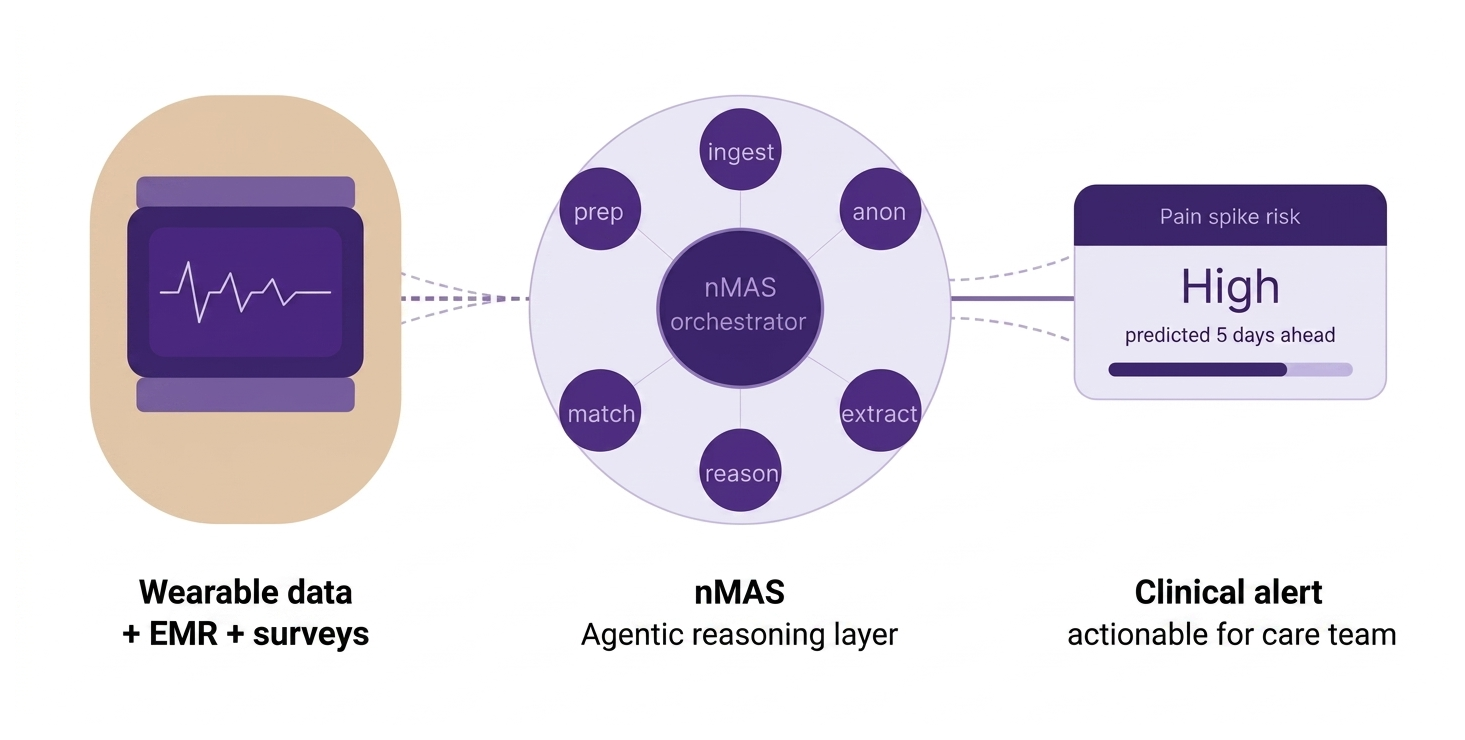
To help bridge this gap, Nimblemind fine-tuned several LLMs, including MedGemma and used within the Nimblemind multi-agent system (nMAS) to support the longitudinal monitoring of chronic pain dynamics. The nMAS coordinates multiple specialized agents to ingest and structure multimodal data from three primary sources:
- Electronic Medical Records (EMR): Clinical history, medication changes, and prior diagnoses.
- Patient Surveys: Regular ecological momentary assessments (EMA) capturing subjective pain scores and cravings.
- Wearable Devices: Passive continuous data streams including heart rate variability (HRV), sleep staging, and physical activity metrics.
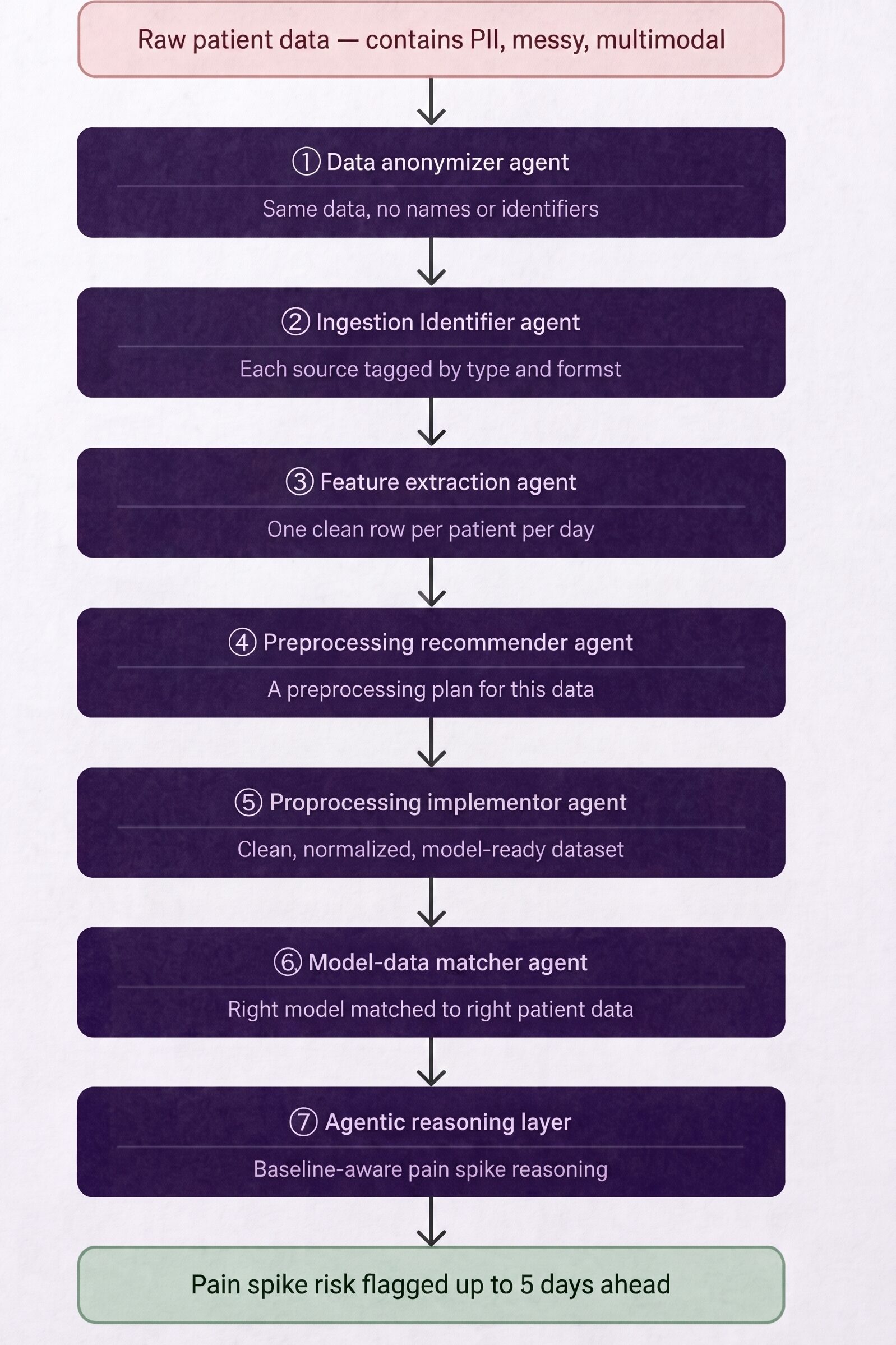
Compared with general-purpose LLMs that often produced descriptive summaries, developing the system with healthcare-specific models like MedGemma, along with speciality level fine-tuning, resulted in more consistent reasoning anchored to patient-specific baselines and clinically defined thresholds. While these behaviors of healthcare-specific models did not eliminate errors, they made outputs more directly interpretable within a rule-based clinical workflow. For example, when patients exhibited sustained high evening pain combined with poor sleep and reduced activity, MedGemma generated explicit predictions of elevated next-day spike risk and surfaced the underlying behavioral and physiological drivers. In contrast, when pain levels were elevated but consistent with prior baseline patterns, the model differentiated persistence from true spike events. These results demonstrate that MedGemma's value lies not only in generating fluent summaries, but in producing structured, baseline-aware reasoning that integrates directly into reproducible, leakage-aware pipelines.
| Model | Accuracy | Precision | Recall | F1 Score |
|---|---|---|---|---|
| Fine-tuned MedGemma 1.5 | 0.73 | 0.70 | 0.68 | 0.69 |
| Qwen3-7B | 0.64 | 0.61 | 0.60 | 0.60 |
| Gemini 3-Pro | 0.57 | 0.55 | 0.53 | 0.54 |
| Claude-Opus 4.5 | 0.50 | 0.48 | 0.46 | 0.47 |
Table 1. Comparative model performance on pain spike prediction.
A pilot study at the APT Foundation, a substance use treatment provider in Connecticut, collected multimodal data from patients derived from wearable sensors and clinical assessments. Nimblemind's proprietary AI system achieved relatively high accuracy (>0.7) in predicting future pain spikes, which are fairly common in this demographic, up to five days in advance. By integrating wearable monitoring with MedGemma-driven interpretation, raw multimodal data can be converted into a reliable signal that can enable the care team to take action sooner and personalize treatment adjustments to reduce relapse risk.
"By organizing and curating data from our EMR, patient surveys, and wearable devices, they [Nimblemind] are helping us identify patient interventions more effectively. This kind of AI-driven insight is the future of personalized, proactive care."
— Lynn M. Madden, PhD, CEO of APT Foundation
Building on these results, Nimblemind plans to expand the role of generative AI to support care teams with structured, patient-specific next-step recommendations within nMAS. These outputs will serve as a clinically grounded co-pilot, preparing actionable options for review by clinicians to ensure proactive, personalized care pathways.