WeatherNext models are rigorously evaluated against the European Centre for Medium-Range Weather Forecasts (ECMWF) operational systems, including HRES (deterministic) and ENS (probabilistic). Performance is measured using RMSE, CRPS, Anomaly Correlation Coefficient, and Relative Economic Value across multiple variables, pressure levels, and lead times. For standardized comparison, we use WeatherBench 2, a benchmark developed by Google Research and ECMWF for assessing data-driven global weather models.
WeatherNext 3
WeatherNext 3 is evaluated against both ECMWF operational systems and WeatherNext 2. Key evaluation highlights include:
- Precipitation: Up to 50% reduction in Brier score and CRPS compared to numerical weather prediction baselines when evaluated against global IMERG observations.
- Resolution: Up to 5× improvement in resolution over WeatherNext 2 (0.05° / ~5 km for station-calibrated surface variables and 0.1° / ~10 km for gridded surface variables versus 0.25° / ~25 km).
Initialization: Initialized every hour, using live geostationary satellite input.
Paper: WeatherNext 3: Increasing resolution and performance of global weather models with raw observations (Rasp et al., 2026)
Blog: Introducing WeatherNext 3, our most advanced and accurate global weather AI model
Independent Benchmark: Brightband Operational WeatherBench (OWB) live evaluations
Performance and resolution comparisons
Evaluation against high-resolution observational datasets demonstrates significant gains in precision and localized feature representation.
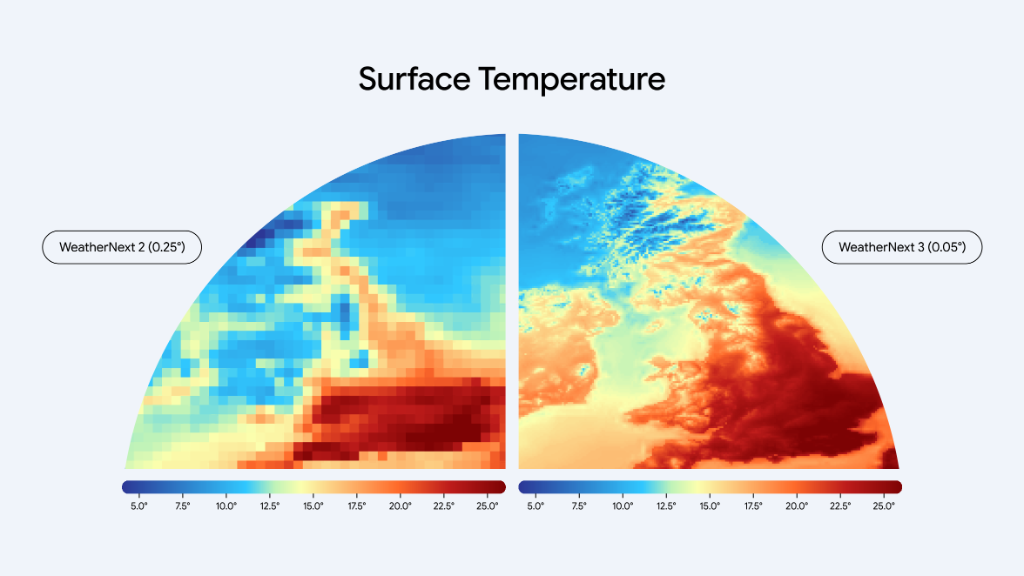
Surface temperature resolution (0.25° versus 0.05°)
WeatherNext 3 delivers 5× higher core spatial resolution (0.05° / ~5 km) for surface temperature and dew point, resolving fine topographic features, valleys, and coastlines compared to WeatherNext 2's 0.25° grid.
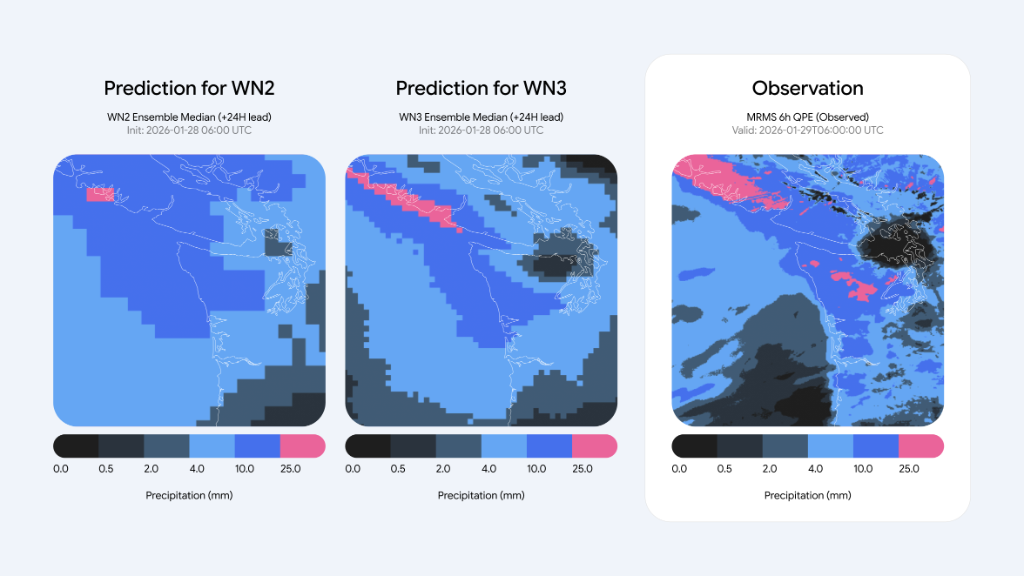
Precipitation accuracy versus observational radar (MRMS QPE)
By training directly against multiple observational targets including NASA IMERG and radar reanalysis, WeatherNext 3 accurately captures sharp, localized precipitation bands that numerical weather prediction baselines and earlier AI models miss or blur.
Independent live evaluation (Brightband)
According to independent live evaluations by Brightband on their Operational WeatherBench (OWB), WeatherNext 3 is the most advanced and accurate global weather model to date. Brightband provides continuous, independent tracking and verification of operational AI and numerical weather prediction systems under real-time conditions.
WeatherNext 2
WeatherNext 2 (FGN) demonstrates further advancement over WeatherNext Gen, with around 10-20% improvement across variables, forecast horizons, and levels. It generates a full 64-member ensemble in a single forward pass, 8× faster than GenCast's iterative diffusion. WeatherNext 2 was also extended for operational tropical cyclone forecasting, improving track and intensity predictions by a full day compared to existing methods.
- Preprint: Skillful joint probabilistic weather forecasting from marginals (Alet et al., arXiv 2025)
- Paper: Operational tropical cyclone forecasting with AI (Alet et al., Nature 2026)
- Blog: WeatherNext 2: Our most advanced weather forecasting model
- Blog: WeatherNext: AI model achieves breakthrough in forecasting cyclones
WeatherNext Gen
WeatherNext Gen (GenCast) is a probabilistic diffusion model that outperformed ECMWF's ENS in over 96% of targets. The model excels at generating large ensembles to characterize predictive uncertainty, providing a 6-12 hour lead time advantage for tropical cyclone tracking over ENS.
- Paper: Probabilistic weather forecasting with machine learning (Price et al., Nature 2024)
- Blog: GenCast predicts weather and the risks of extreme conditions with state-of-the-art accuracy
WeatherNext Graph
WeatherNext Graph (GraphCast) is a deterministic GNN model that outperformed ECMWF's HRES in over 90% of tested cases and variables, showing particular skill in predicting tropical cyclones, atmospheric rivers, and extreme temperatures. Named a runner-up to Science's Breakthrough of the Year in 2023. Won the MacRobert Award in 2024.
- Paper: Learning skillful medium-range global weather forecasting (Lam et al., Science 2023)
- Blog: GraphCast: AI model for faster and more accurate global weather forecasting
Other research
While WeatherNext focuses on medium-range forecasting, Google also invests in complementary models:
- MetNet: Short-range, high-resolution precipitation nowcasting (0-12 hours). The latest model expands nowcasting globally using geostationary satellite data, enabling support in data-sparse regions.
- NeuralGCM: ML-powered General Circulation Model for long-range global weather simulations, enabling large forecast ensembles for long-range uncertainty at a fraction of conventional physics-based computational cost.