|
toolresults
v1beta3
|
|
toolresults
v1beta3
|
Any contains an arbitrary serialized protocol buffer message along with a URL that describes the type of the serialized message.
More...
Properties | |
| virtual string | TypeUrl [get, set] |
| A URL/resource name whose content describes the type of the serialized protocol buffer message. | |
| virtual string | Value [get, set] |
| Must be a valid serialized protocol buffer of the above specified type. | |
| virtual string | ETag [get, set] |
| The ETag of the item. | |
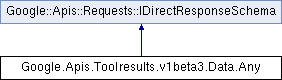
 Properties inherited from Google::Apis::Requests::IDirectResponseSchema Properties inherited from Google::Apis::Requests::IDirectResponseSchema | |
| string | ETag |
Any contains an arbitrary serialized protocol buffer message along with a URL that describes the type of the serialized message.
Protobuf library provides support to pack/unpack Any values in the form of utility functions or additional generated methods of the Any type.
Example 1: Pack and unpack a message in C++.
Foo foo = ...; Any any; any.PackFrom(foo); ... if (any.UnpackTo()) { ... }
Example 2: Pack and unpack a message in Java.
Foo foo = ...; Any any = Any.pack(foo); ... if (any.is(Foo.class)) { foo = any.unpack(Foo.class); }
The pack methods provided by protobuf library will by default use 'type.googleapis.com/full.type.name' as the type URL and the unpack methods only use the fully qualified type name after the last '/' in the type URL, for example "foo.bar.com/x/y.z" will yield type name "y.z".
JSON ==== The JSON representation of an Any value uses the regular representation of the deserialized, embedded message, with an additional field @type which contains the type URL. Example:
package google.profile; message Person { string first_name = 1; string last_name = 2; }
{ "@type": "type.googleapis.com/google.profile.Person", "firstName": , "lastName": }
If the embedded message type is well-known and has a custom JSON representation, that representation will be embedded adding a field value which holds the custom JSON in addition to the @type field. Example (for message [google.protobuf.Duration][]):
{ "@type": "type.googleapis.com/google.protobuf.Duration", "value": "1.212s" }
|
getset |
The ETag of the item.
|
getset |
A URL/resource name whose content describes the type of the serialized protocol buffer message.
For URLs which use the schema http, https, or no schema, the following restrictions and interpretations apply:
https is assumed. * The last segment of the URL's path must represent the fully qualified name of the type (as in path/google.protobuf.Duration). * An HTTP GET on the URL must yield a [google.protobuf.Type][] value in binary format, or produce an error. * Applications are allowed to cache lookup results based on the URL, or have them precompiled into a binary to avoid any lookup. Therefore, binary compatibility needs to be preserved on changes to types. (Use versioned type names to manage breaking changes.)Schemas other than http, https (or the empty schema) might be used with implementation specific semantics.
|
getset |
Must be a valid serialized protocol buffer of the above specified type.

© 2016 Google - Privacy Policy - Terms and Conditions - About Google

