#include <dataset.h>
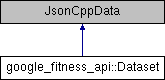
Public Member Functions | |
| Dataset (const Json::Value &storage) | |
| Dataset (Json::Value *storage) | |
| virtual | ~Dataset () |
| const StringPiece | GetTypeName () const |
| bool | has_data_source_id () const |
| void | clear_data_source_id () |
| const StringPiece | get_data_source_id () const |
| void | set_data_source_id (const StringPiece &value) |
| bool | has_max_end_time_ns () const |
| void | clear_max_end_time_ns () |
| int64 | get_max_end_time_ns () const |
| void | set_max_end_time_ns (int64 value) |
| bool | has_min_start_time_ns () const |
| void | clear_min_start_time_ns () |
| int64 | get_min_start_time_ns () const |
| void | set_min_start_time_ns (int64 value) |
| bool | has_next_page_token () const |
| void | clear_next_page_token () |
| const StringPiece | get_next_page_token () const |
| void | set_next_page_token (const StringPiece &value) |
| bool | has_point () const |
| void | clear_point () |
| const client::JsonCppArray< DataPoint > | get_point () const |
| client::JsonCppArray< DataPoint > | mutable_point () |
Static Public Member Functions | |
| static Dataset * | New () |
Detailed Description
A dataset represents a projection container for data points. They do not carry any info of their own. Datasets represent a set of data points from a particular data source. A data point can be found in more than one dataset.
Constructor & Destructor Documentation
◆ Dataset() [1/2]
|
explicit |
Standard constructor for an immutable data object instance.
- Parameters
-
[in] storage The underlying data storage for this instance.
◆ Dataset() [2/2]
|
explicit |
Standard constructor for a mutable data object instance.
- Parameters
-
[in] storage The underlying data storage for this instance.
◆ ~Dataset()
|
virtual |
Standard destructor.
Member Function Documentation
◆ clear_data_source_id()
|
inline |
Clears the 'dataSourceId' attribute.
◆ clear_max_end_time_ns()
|
inline |
Clears the 'maxEndTimeNs' attribute.
◆ clear_min_start_time_ns()
|
inline |
Clears the 'minStartTimeNs' attribute.
◆ clear_next_page_token()
|
inline |
Clears the 'nextPageToken' attribute.
◆ clear_point()
|
inline |
Clears the 'point' attribute.
◆ get_data_source_id()
|
inline |
Get the value of the 'dataSourceId' attribute.
◆ get_max_end_time_ns()
|
inline |
Get the value of the 'maxEndTimeNs' attribute.
◆ get_min_start_time_ns()
|
inline |
Get the value of the 'minStartTimeNs' attribute.
◆ get_next_page_token()
|
inline |
Get the value of the 'nextPageToken' attribute.
◆ get_point()
| const client::JsonCppArray<DataPoint > google_fitness_api::Dataset::get_point | ( | ) | const |
Get a reference to the value of the 'point' attribute.
◆ GetTypeName()
|
inline |
Returns a string denoting the type of this data object.
- Returns
google_fitness_api::Dataset
◆ has_data_source_id()
|
inline |
Determine if the 'dataSourceId' attribute was set.
- Returns
- true if the '
dataSourceId' attribute was set.
◆ has_max_end_time_ns()
|
inline |
Determine if the 'maxEndTimeNs' attribute was set.
- Returns
- true if the '
maxEndTimeNs' attribute was set.
◆ has_min_start_time_ns()
|
inline |
Determine if the 'minStartTimeNs' attribute was set.
- Returns
- true if the '
minStartTimeNs' attribute was set.
◆ has_next_page_token()
|
inline |
Determine if the 'nextPageToken' attribute was set.
- Returns
- true if the '
nextPageToken' attribute was set.
◆ has_point()
|
inline |
Determine if the 'point' attribute was set.
- Returns
- true if the '
point' attribute was set.
◆ mutable_point()
| client::JsonCppArray<DataPoint > google_fitness_api::Dataset::mutable_point | ( | ) |
Gets a reference to a mutable value of the 'point' property.
A partial list of data points contained in the dataset, ordered by largest endTimeNanos first. This list is considered complete when retrieving a small dataset and partial when patching a dataset or retrieving a dataset that is too large to include in a single response.
- Returns
- The result can be modified to change the attribute value.
◆ New()
|
static |
Creates a new default instance.
- Returns
- Ownership is passed back to the caller.
◆ set_data_source_id()
|
inline |
Change the 'dataSourceId' attribute.
The data stream ID of the data source that created the points in this dataset.
- Parameters
-
[in] value The new value.
◆ set_max_end_time_ns()
|
inline |
Change the 'maxEndTimeNs' attribute.
The largest end time of all data points in this possibly partial representation of the dataset. Time is in nanoseconds from epoch. This should also match the second part of the dataset identifier.
- Parameters
-
[in] value The new value.
◆ set_min_start_time_ns()
|
inline |
Change the 'minStartTimeNs' attribute.
The smallest start time of all data points in this possibly partial representation of the dataset. Time is in nanoseconds from epoch. This should also match the first part of the dataset identifier.
- Parameters
-
[in] value The new value.
◆ set_next_page_token()
|
inline |
Change the 'nextPageToken' attribute.
This token will be set when a dataset is received in response to a GET request and the dataset is too large to be included in a single response. Provide this value in a subsequent GET request to return the next page of data points within this dataset.
- Parameters
-
[in] value The new value.
The documentation for this class was generated from the following files:
- google/fitness_api/dataset.h
- google/fitness_api/dataset.cc