container  v1
Properties | List of all members
Google.Apis.Container.v1.Data.Cluster Class Reference

A Google Kubernetes Engine cluster. More...

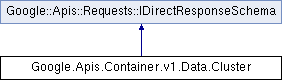
Inheritance diagram for Google.Apis.Container.v1.Data.Cluster:
Google::Apis::Requests::IDirectResponseSchema
Properties

virtual AddonsConfig AddonsConfig [get, set]
 Configurations for the various addons available to run in the cluster. More...
 
virtual AuthenticatorGroupsConfig AuthenticatorGroupsConfig [get, set]
 Configuration controlling RBAC group membership information. More...
 
virtual ClusterAutoscaling Autoscaling [get, set]
 Cluster-level autoscaling configuration. More...
 
virtual BinaryAuthorization BinaryAuthorization [get, set]
 Configuration for Binary Authorization. More...
 
virtual string ClusterIpv4Cidr [get, set]
 The IP address range of the container pods in this cluster, in CIDR notation (e.g. 10.96.0.0/14). Leave blank to have one automatically chosen or specify a /14 block in 10.0.0.0/8. More...
 
virtual System.Collections.Generic.IList< StatusConditionConditions [get, set]
 Which conditions caused the current cluster state. More...
 
virtual string CreateTime [get, set]
 [Output only] The time the cluster was created, in RFC3339 text format. More...
 
virtual string CurrentMasterVersion [get, set]
 [Output only] The current software version of the master endpoint. More...
 
virtual System.Nullable< int > CurrentNodeCount [get, set]
 [Output only] The number of nodes currently in the cluster. Deprecated. Call Kubernetes API directly to retrieve node information. More...
 
virtual string CurrentNodeVersion [get, set]
 [Output only] Deprecated, use NodePools.version instead. The current version of the node software components. If they are currently at multiple versions because they're in the process of being upgraded, this reflects the minimum version of all nodes. More...
 
virtual DatabaseEncryption DatabaseEncryption [get, set]
 Configuration of etcd encryption. More...
 
virtual MaxPodsConstraint DefaultMaxPodsConstraint [get, set]
 The default constraint on the maximum number of pods that can be run simultaneously on a node in the node pool of this cluster. Only honored if cluster created with IP Alias support. More...
 
virtual string Description [get, set]
 An optional description of this cluster. More...
 
virtual System.Nullable< bool > EnableKubernetesAlpha [get, set]
 Kubernetes alpha features are enabled on this cluster. This includes alpha API groups (e.g. v1alpha1) and features that may not be production ready in the kubernetes version of the master and nodes. The cluster has no SLA for uptime and master/node upgrades are disabled. Alpha enabled clusters are automatically deleted thirty days after creation. More...
 
virtual System.Nullable< bool > EnableTpu [get, set]
 Enable the ability to use Cloud TPUs in this cluster. More...
 
virtual string Endpoint [get, set]
 [Output only] The IP address of this cluster's master endpoint. The endpoint can be accessed from the internet at https://username:password@endpoint/. More...
 
virtual string ExpireTime [get, set]
 [Output only] The time the cluster will be automatically deleted in RFC3339 text format. More...
 
virtual string InitialClusterVersion [get, set]
 The initial Kubernetes version for this cluster. Valid versions are those found in validMasterVersions returned by getServerConfig. The version can be upgraded over time; such upgrades are reflected in currentMasterVersion and currentNodeVersion. More...
 
virtual System.Nullable< int > InitialNodeCount [get, set]
 The number of nodes to create in this cluster. You must ensure that your Compute Engine resource quota is sufficient for this number of instances. You must also have available firewall and routes quota. For requests, this field should only be used in lieu of a "node_pool" object, since this configuration (along with the "node_config") will be used to create a "NodePool" object with an auto-generated name. Do not use this and a node_pool at the same time. More...
 
virtual System.Collections.Generic.IList< string > InstanceGroupUrls [get, set]
 Deprecated. Use node_pools.instance_group_urls. More...
 
virtual IPAllocationPolicy IpAllocationPolicy [get, set]
 Configuration for cluster IP allocation. More...
 
virtual string LabelFingerprint [get, set]
 The fingerprint of the set of labels for this cluster. More...
 
virtual LegacyAbac LegacyAbac [get, set]
 Configuration for the legacy ABAC authorization mode. More...
 
virtual string Location [get, set]
 [Output only] The name of the Google Compute Engine zone or region in which the cluster resides. More...
 
virtual System.Collections.Generic.IList< string > Locations [get, set]
 The list of Google Compute Engine zones in which the cluster's nodes should be located. More...
 
virtual string LoggingService [get, set]
 The logging service the cluster should use to write logs. Currently available options: More...
 
virtual MaintenancePolicy MaintenancePolicy [get, set]
 Configure the maintenance policy for this cluster. More...
 
virtual MasterAuth MasterAuth [get, set]
 The authentication information for accessing the master endpoint. If unspecified, the defaults are used: For clusters before v1.12, if master_auth is unspecified, username will be set to "admin", a random password will be generated, and a client certificate will be issued. More...
 
virtual MasterAuthorizedNetworksConfig MasterAuthorizedNetworksConfig [get, set]
 The configuration options for master authorized networks feature. More...
 
virtual string MonitoringService [get, set]
 The monitoring service the cluster should use to write metrics. Currently available options: More...
 
virtual string Name [get, set]
 The name of this cluster. The name must be unique within this project and location (e.g. zone or region), and can be up to 40 characters with the following restrictions: More...
 
virtual string Network [get, set]
 The name of the Google Compute Engine network to which the cluster is connected. If left unspecified, the default network will be used. More...
 
virtual NetworkConfig NetworkConfig [get, set]
 Configuration for cluster networking. More...
 
virtual NetworkPolicy NetworkPolicy [get, set]
 Configuration options for the NetworkPolicy feature. More...
 
virtual NodeConfig NodeConfig [get, set]
 Parameters used in creating the cluster's nodes. For requests, this field should only be used in lieu of a "node_pool" object, since this configuration (along with the "initial_node_count") will be used to create a "NodePool" object with an auto-generated name. Do not use this and a node_pool at the same time. For responses, this field will be populated with the node configuration of the first node pool. (For configuration of each node pool, see node_pool.config) More...
 
virtual System.Nullable< int > NodeIpv4CidrSize [get, set]
 [Output only] The size of the address space on each node for hosting containers. This is provisioned from within the container_ipv4_cidr range. This field will only be set when cluster is in route-based network mode. More...
 
virtual System.Collections.Generic.IList< NodePoolNodePools [get, set]
 The node pools associated with this cluster. This field should not be set if "node_config" or "initial_node_count" are specified. More...
 
virtual PrivateClusterConfig PrivateClusterConfig [get, set]
 Configuration for private cluster. More...
 
virtual System.Collections.Generic.IDictionary< string, string > ResourceLabels [get, set]
 The resource labels for the cluster to use to annotate any related Google Compute Engine resources. More...
 
virtual ResourceUsageExportConfig ResourceUsageExportConfig [get, set]
 Configuration for exporting resource usages. Resource usage export is disabled when this config is unspecified. More...
 
virtual string SelfLink [get, set]
 [Output only] Server-defined URL for the resource. More...
 
virtual string ServicesIpv4Cidr [get, set]
 [Output only] The IP address range of the Kubernetes services in this cluster, in CIDR notation (e.g. 1.2.3.4/29). Service addresses are typically put in the last /16 from the container CIDR. More...
 
virtual ShieldedNodes ShieldedNodes [get, set]
 Shielded Nodes configuration. More...
 
virtual string Status [get, set]
 [Output only] The current status of this cluster. More...
 
virtual string StatusMessage [get, set]
 [Output only] Additional information about the current status of this cluster, if available. More...
 
virtual string Subnetwork [get, set]
 The name of the Google Compute Engine subnetwork to which the cluster is connected. More...
 
virtual string TpuIpv4CidrBlock [get, set]
 [Output only] The IP address range of the Cloud TPUs in this cluster, in CIDR notation (e.g. 1.2.3.4/29). More...
 
virtual VerticalPodAutoscaling VerticalPodAutoscaling [get, set]
 Cluster-level Vertical Pod Autoscaling configuration. More...
 
virtual WorkloadIdentityConfig WorkloadIdentityConfig [get, set]
 Configuration for the use of Kubernetes Service Accounts in GCP IAM policies. More...
 
virtual string Zone [get, set]
 [Output only] The name of the Google Compute Engine zone in which the cluster resides. This field is deprecated, use location instead. More...
 
virtual string ETag [get, set]
 The ETag of the item. More...
 
- Properties inherited from Google::Apis::Requests::IDirectResponseSchema
string ETag
 

Detailed Description

A Google Kubernetes Engine cluster.

Property Documentation

◆ AddonsConfig

virtual AddonsConfig Google.Apis.Container.v1.Data.Cluster.AddonsConfig
getset

Configurations for the various addons available to run in the cluster.

◆ AuthenticatorGroupsConfig

virtual AuthenticatorGroupsConfig Google.Apis.Container.v1.Data.Cluster.AuthenticatorGroupsConfig
getset

Configuration controlling RBAC group membership information.

◆ Autoscaling

virtual ClusterAutoscaling Google.Apis.Container.v1.Data.Cluster.Autoscaling
getset

Cluster-level autoscaling configuration.

◆ BinaryAuthorization

virtual BinaryAuthorization Google.Apis.Container.v1.Data.Cluster.BinaryAuthorization
getset

Configuration for Binary Authorization.

◆ ClusterIpv4Cidr

virtual string Google.Apis.Container.v1.Data.Cluster.ClusterIpv4Cidr
getset

The IP address range of the container pods in this cluster, in CIDR notation (e.g. 10.96.0.0/14). Leave blank to have one automatically chosen or specify a /14 block in 10.0.0.0/8.

◆ Conditions

virtual System.Collections.Generic.IList<StatusCondition> Google.Apis.Container.v1.Data.Cluster.Conditions
getset

Which conditions caused the current cluster state.

◆ CreateTime

virtual string Google.Apis.Container.v1.Data.Cluster.CreateTime
getset

[Output only] The time the cluster was created, in RFC3339 text format.

◆ CurrentMasterVersion

virtual string Google.Apis.Container.v1.Data.Cluster.CurrentMasterVersion
getset

[Output only] The current software version of the master endpoint.

◆ CurrentNodeCount

virtual System.Nullable<int> Google.Apis.Container.v1.Data.Cluster.CurrentNodeCount
getset

[Output only] The number of nodes currently in the cluster. Deprecated. Call Kubernetes API directly to retrieve node information.

◆ CurrentNodeVersion

virtual string Google.Apis.Container.v1.Data.Cluster.CurrentNodeVersion
getset

[Output only] Deprecated, use NodePools.version instead. The current version of the node software components. If they are currently at multiple versions because they're in the process of being upgraded, this reflects the minimum version of all nodes.

◆ DatabaseEncryption

virtual DatabaseEncryption Google.Apis.Container.v1.Data.Cluster.DatabaseEncryption
getset

Configuration of etcd encryption.

◆ DefaultMaxPodsConstraint

virtual MaxPodsConstraint Google.Apis.Container.v1.Data.Cluster.DefaultMaxPodsConstraint
getset

The default constraint on the maximum number of pods that can be run simultaneously on a node in the node pool of this cluster. Only honored if cluster created with IP Alias support.

◆ Description

virtual string Google.Apis.Container.v1.Data.Cluster.Description
getset

An optional description of this cluster.

◆ EnableKubernetesAlpha

virtual System.Nullable<bool> Google.Apis.Container.v1.Data.Cluster.EnableKubernetesAlpha
getset

Kubernetes alpha features are enabled on this cluster. This includes alpha API groups (e.g. v1alpha1) and features that may not be production ready in the kubernetes version of the master and nodes. The cluster has no SLA for uptime and master/node upgrades are disabled. Alpha enabled clusters are automatically deleted thirty days after creation.

◆ EnableTpu

virtual System.Nullable<bool> Google.Apis.Container.v1.Data.Cluster.EnableTpu
getset

Enable the ability to use Cloud TPUs in this cluster.

◆ Endpoint

virtual string Google.Apis.Container.v1.Data.Cluster.Endpoint
getset

[Output only] The IP address of this cluster's master endpoint. The endpoint can be accessed from the internet at https://username:password@endpoint/.

See the masterAuth property of this resource for username and password information.

◆ ETag

virtual string Google.Apis.Container.v1.Data.Cluster.ETag
getset

The ETag of the item.

◆ ExpireTime

virtual string Google.Apis.Container.v1.Data.Cluster.ExpireTime
getset

[Output only] The time the cluster will be automatically deleted in RFC3339 text format.

◆ InitialClusterVersion

virtual string Google.Apis.Container.v1.Data.Cluster.InitialClusterVersion
getset

The initial Kubernetes version for this cluster. Valid versions are those found in validMasterVersions returned by getServerConfig. The version can be upgraded over time; such upgrades are reflected in currentMasterVersion and currentNodeVersion.

Users may specify either explicit versions offered by Kubernetes Engine or version aliases, which have the following behavior:

  • "latest": picks the highest valid Kubernetes version - "1.X": picks the highest valid patch+gke.N patch in the 1.X version - "1.X.Y": picks the highest valid gke.N patch in the 1.X.Y version - "1.X.Y-gke.N": picks an explicit Kubernetes version - "","-": picks the default Kubernetes version

◆ InitialNodeCount

virtual System.Nullable<int> Google.Apis.Container.v1.Data.Cluster.InitialNodeCount
getset

The number of nodes to create in this cluster. You must ensure that your Compute Engine resource quota is sufficient for this number of instances. You must also have available firewall and routes quota. For requests, this field should only be used in lieu of a "node_pool" object, since this configuration (along with the "node_config") will be used to create a "NodePool" object with an auto-generated name. Do not use this and a node_pool at the same time.

This field is deprecated, use node_pool.initial_node_count instead.

◆ InstanceGroupUrls

virtual System.Collections.Generic.IList<string> Google.Apis.Container.v1.Data.Cluster.InstanceGroupUrls
getset

Deprecated. Use node_pools.instance_group_urls.

◆ IpAllocationPolicy

virtual IPAllocationPolicy Google.Apis.Container.v1.Data.Cluster.IpAllocationPolicy
getset

Configuration for cluster IP allocation.

◆ LabelFingerprint

virtual string Google.Apis.Container.v1.Data.Cluster.LabelFingerprint
getset

The fingerprint of the set of labels for this cluster.

◆ LegacyAbac

virtual LegacyAbac Google.Apis.Container.v1.Data.Cluster.LegacyAbac
getset

Configuration for the legacy ABAC authorization mode.

◆ Location

virtual string Google.Apis.Container.v1.Data.Cluster.Location
getset

[Output only] The name of the Google Compute Engine zone or region in which the cluster resides.

◆ Locations

virtual System.Collections.Generic.IList<string> Google.Apis.Container.v1.Data.Cluster.Locations
getset

The list of Google Compute Engine zones in which the cluster's nodes should be located.

◆ LoggingService

virtual string Google.Apis.Container.v1.Data.Cluster.LoggingService
getset

The logging service the cluster should use to write logs. Currently available options:

  • "logging.googleapis.com/kubernetes" - the Google Cloud Logging service with Kubernetes-native resource model * logging.googleapis.com - the Google Cloud Logging service. * none - no logs will be exported from the cluster. * if left as an empty string,logging.googleapis.com will be used.

◆ MaintenancePolicy

virtual MaintenancePolicy Google.Apis.Container.v1.Data.Cluster.MaintenancePolicy
getset

Configure the maintenance policy for this cluster.

◆ MasterAuth

virtual MasterAuth Google.Apis.Container.v1.Data.Cluster.MasterAuth
getset

The authentication information for accessing the master endpoint. If unspecified, the defaults are used: For clusters before v1.12, if master_auth is unspecified, username will be set to "admin", a random password will be generated, and a client certificate will be issued.

◆ MasterAuthorizedNetworksConfig

virtual MasterAuthorizedNetworksConfig Google.Apis.Container.v1.Data.Cluster.MasterAuthorizedNetworksConfig
getset

The configuration options for master authorized networks feature.

◆ MonitoringService

virtual string Google.Apis.Container.v1.Data.Cluster.MonitoringService
getset

The monitoring service the cluster should use to write metrics. Currently available options:

  • monitoring.googleapis.com - the Google Cloud Monitoring service. * none - no metrics will be exported from the cluster. * if left as an empty string, monitoring.googleapis.com will be used.

◆ Name

virtual string Google.Apis.Container.v1.Data.Cluster.Name
getset

The name of this cluster. The name must be unique within this project and location (e.g. zone or region), and can be up to 40 characters with the following restrictions:

  • Lowercase letters, numbers, and hyphens only. * Must start with a letter. * Must end with a number or a letter.

◆ Network

virtual string Google.Apis.Container.v1.Data.Cluster.Network
getset

The name of the Google Compute Engine network to which the cluster is connected. If left unspecified, the default network will be used.

◆ NetworkConfig

virtual NetworkConfig Google.Apis.Container.v1.Data.Cluster.NetworkConfig
getset

Configuration for cluster networking.

◆ NetworkPolicy

virtual NetworkPolicy Google.Apis.Container.v1.Data.Cluster.NetworkPolicy
getset

Configuration options for the NetworkPolicy feature.

◆ NodeConfig

virtual NodeConfig Google.Apis.Container.v1.Data.Cluster.NodeConfig
getset

Parameters used in creating the cluster's nodes. For requests, this field should only be used in lieu of a "node_pool" object, since this configuration (along with the "initial_node_count") will be used to create a "NodePool" object with an auto-generated name. Do not use this and a node_pool at the same time. For responses, this field will be populated with the node configuration of the first node pool. (For configuration of each node pool, see node_pool.config)

If unspecified, the defaults are used. This field is deprecated, use node_pool.config instead.

◆ NodeIpv4CidrSize

virtual System.Nullable<int> Google.Apis.Container.v1.Data.Cluster.NodeIpv4CidrSize
getset

[Output only] The size of the address space on each node for hosting containers. This is provisioned from within the container_ipv4_cidr range. This field will only be set when cluster is in route-based network mode.

◆ NodePools

virtual System.Collections.Generic.IList<NodePool> Google.Apis.Container.v1.Data.Cluster.NodePools
getset

The node pools associated with this cluster. This field should not be set if "node_config" or "initial_node_count" are specified.

◆ PrivateClusterConfig

virtual PrivateClusterConfig Google.Apis.Container.v1.Data.Cluster.PrivateClusterConfig
getset

Configuration for private cluster.

◆ ResourceLabels

virtual System.Collections.Generic.IDictionary<string,string> Google.Apis.Container.v1.Data.Cluster.ResourceLabels
getset

The resource labels for the cluster to use to annotate any related Google Compute Engine resources.

◆ ResourceUsageExportConfig

virtual ResourceUsageExportConfig Google.Apis.Container.v1.Data.Cluster.ResourceUsageExportConfig
getset

Configuration for exporting resource usages. Resource usage export is disabled when this config is unspecified.

◆ SelfLink

virtual string Google.Apis.Container.v1.Data.Cluster.SelfLink
getset

[Output only] Server-defined URL for the resource.

◆ ServicesIpv4Cidr

virtual string Google.Apis.Container.v1.Data.Cluster.ServicesIpv4Cidr
getset

[Output only] The IP address range of the Kubernetes services in this cluster, in CIDR notation (e.g. 1.2.3.4/29). Service addresses are typically put in the last /16 from the container CIDR.

◆ ShieldedNodes

virtual ShieldedNodes Google.Apis.Container.v1.Data.Cluster.ShieldedNodes
getset

Shielded Nodes configuration.

◆ Status

virtual string Google.Apis.Container.v1.Data.Cluster.Status
getset

[Output only] The current status of this cluster.

◆ StatusMessage

virtual string Google.Apis.Container.v1.Data.Cluster.StatusMessage
getset

[Output only] Additional information about the current status of this cluster, if available.

◆ Subnetwork

virtual string Google.Apis.Container.v1.Data.Cluster.Subnetwork
getset

The name of the Google Compute Engine subnetwork to which the cluster is connected.

◆ TpuIpv4CidrBlock

virtual string Google.Apis.Container.v1.Data.Cluster.TpuIpv4CidrBlock
getset

[Output only] The IP address range of the Cloud TPUs in this cluster, in CIDR notation (e.g. 1.2.3.4/29).

◆ VerticalPodAutoscaling

virtual VerticalPodAutoscaling Google.Apis.Container.v1.Data.Cluster.VerticalPodAutoscaling
getset

Cluster-level Vertical Pod Autoscaling configuration.

◆ WorkloadIdentityConfig

virtual WorkloadIdentityConfig Google.Apis.Container.v1.Data.Cluster.WorkloadIdentityConfig
getset

Configuration for the use of Kubernetes Service Accounts in GCP IAM policies.

◆ Zone

virtual string Google.Apis.Container.v1.Data.Cluster.Zone
getset

[Output only] The name of the Google Compute Engine zone in which the cluster resides. This field is deprecated, use location instead.


The documentation for this class was generated from the following file: