#include <entitlement.h>
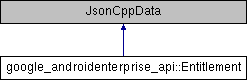
Public Member Functions | |
| Entitlement (const Json::Value &storage) | |
| Entitlement (Json::Value *storage) | |
| virtual | ~Entitlement () |
| const StringPiece | GetTypeName () const |
| bool | has_kind () const |
| void | clear_kind () |
| const StringPiece | get_kind () const |
| void | set_kind (const StringPiece &value) |
| bool | has_product_id () const |
| void | clear_product_id () |
| const StringPiece | get_product_id () const |
| void | set_product_id (const StringPiece &value) |
| bool | has_reason () const |
| void | clear_reason () |
| const StringPiece | get_reason () const |
| void | set_reason (const StringPiece &value) |
Static Public Member Functions | |
| static Entitlement * | New () |
Detailed Description
The presence of an Entitlements resource indicates that a user has the right to use a particular app. Entitlements are user specific, not device specific. This allows a user with an entitlement to an app to install the app on all their devices. It's also possible for a user to hold an entitlement to an app without installing the app on any device.
The API can be used to create an entitlement. As an option, you can also use the API to trigger the installation of an app on all a user's managed devices at the same time the entitlement is created.
If the app is free, creating the entitlement also creates a group license for that app. For paid apps, creating the entitlement consumes one license, and that license remains consumed until the entitlement is removed. If the enterprise hasn't purchased enough licenses, then no entitlement is created and the installation fails. An entitlement is also not created for an app if the app requires permissions that the enterprise hasn't accepted.
If an entitlement is deleted, the app may be uninstalled from a user's device. As a best practice, uninstall the app by calling Installs.delete() before deleting the entitlement.
Entitlements for apps that a user pays for on an unmanaged profile have "userPurchase" as the entitlement reason. These entitlements cannot be removed via the API.
Constructor & Destructor Documentation
◆ Entitlement() [1/2]
|
explicit |
Standard constructor for an immutable data object instance.
- Parameters
-
[in] storage The underlying data storage for this instance.
◆ Entitlement() [2/2]
|
explicit |
Standard constructor for a mutable data object instance.
- Parameters
-
[in] storage The underlying data storage for this instance.
◆ ~Entitlement()
|
virtual |
Standard destructor.
Member Function Documentation
◆ clear_kind()
|
inline |
Clears the 'kind' attribute.
◆ clear_product_id()
|
inline |
Clears the 'productId' attribute.
◆ clear_reason()
|
inline |
Clears the 'reason' attribute.
◆ get_kind()
|
inline |
Get the value of the 'kind' attribute.
◆ get_product_id()
|
inline |
Get the value of the 'productId' attribute.
◆ get_reason()
|
inline |
Get the value of the 'reason' attribute.
◆ GetTypeName()
|
inline |
Returns a string denoting the type of this data object.
◆ has_kind()
|
inline |
Determine if the 'kind' attribute was set.
- Returns
- true if the '
kind' attribute was set.
◆ has_product_id()
|
inline |
Determine if the 'productId' attribute was set.
- Returns
- true if the '
productId' attribute was set.
◆ has_reason()
|
inline |
Determine if the 'reason' attribute was set.
- Returns
- true if the '
reason' attribute was set.
◆ New()
|
static |
Creates a new default instance.
- Returns
- Ownership is passed back to the caller.
◆ set_kind()
|
inline |
Change the 'kind' attribute.
- Parameters
-
[in] value The new value.
◆ set_product_id()
|
inline |
Change the 'productId' attribute.
The ID of the product that the entitlement is for. For example, "app:com.google.android.gm".
- Parameters
-
[in] value The new value.
◆ set_reason()
|
inline |
Change the 'reason' attribute.
The reason for the entitlement. For example, "free" for free apps. This property is temporary: it will be replaced by the acquisition kind field of group licenses.
- Parameters
-
[in] value The new value.
The documentation for this class was generated from the following files:
- google/androidenterprise_api/entitlement.h
- google/androidenterprise_api/entitlement.cc