總覽
以 OAuth 為基礎的「使用 Google 帳戶登入」簡化連結功能,會在OAuth 連結的基礎上新增「使用 Google 帳戶登入」功能。這項功能可為 Google 使用者提供流暢的帳戶連結體驗,並啟用帳戶建立功能,讓使用者透過 Google 帳戶在您的服務上建立新帳戶。
如要使用 OAuth 和「使用 Google 帳戶登入」功能連結帳戶,請按照下列一般步驟操作:
- 首先,請使用者同意存取他們的 Google 個人資料。
- 使用個人資料中的資訊,確認使用者帳戶是否存在。
- 如果是現有使用者,請連結帳戶。
- 如果驗證系統中沒有相符的 Google 使用者,請驗證從 Google 收到的 ID 權杖。然後,您可以根據 ID 權杖中包含的設定檔資訊建立使用者。
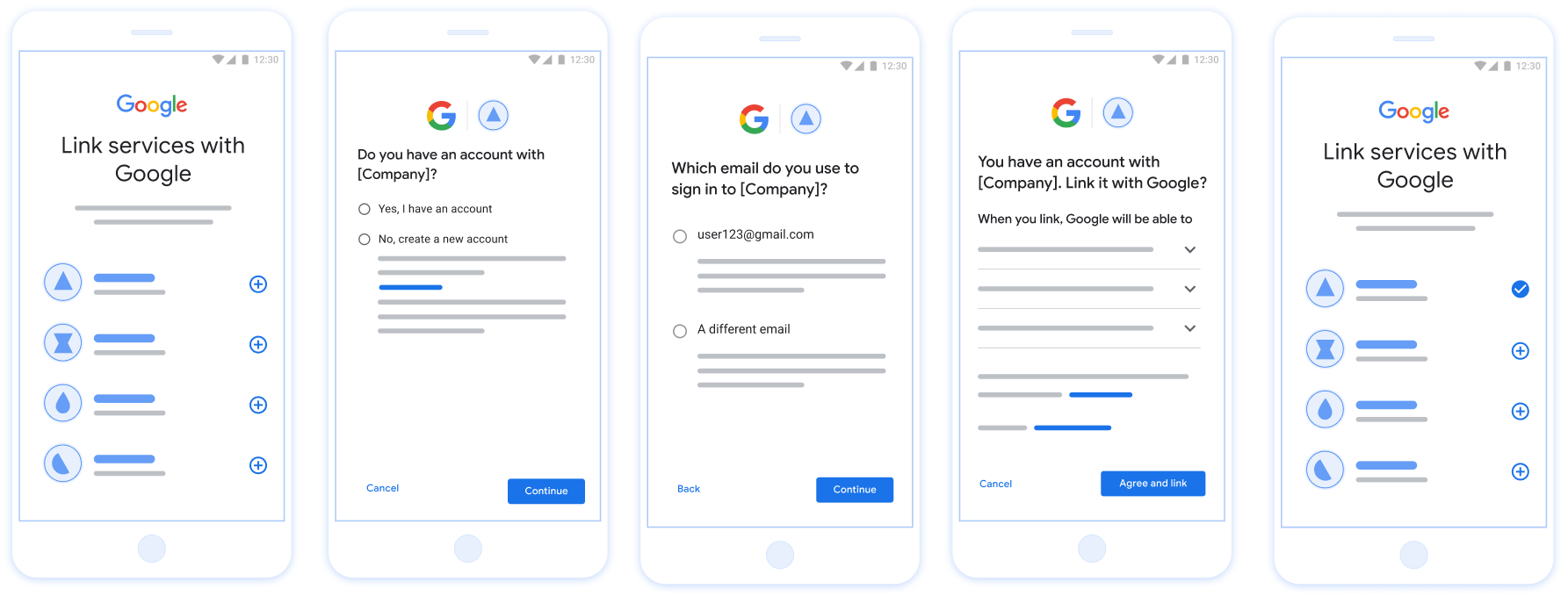
圖 1. 在使用者手機上透過簡化連結功能連結帳戶
簡化連結的相關規定
- 實作基本網頁 OAuth 連結流程。您的服務必須支援符合 OAuth 2.0 規範的授權和權杖交換端點。
- 您的權杖交換端點必須支援 JSON Web Token (JWT) 聲明,並實作
check、create和get意圖。
導入 OAuth 伺服器
您的權杖交換端點必須支援 check、create、get 意圖。請按照下列步驟完成帳戶連結流程,並瞭解何時會使用不同的意圖:
- 使用者是否在您的驗證系統中擁有帳戶?(使用者選取「是」或「否」來決定)
- 是:使用者是否使用與 Google 帳戶相關聯的電子郵件地址登入您的平台?(使用者選取「是」或「否」來決定)
- 是:使用者在您的驗證系統中是否有相符帳戶?(
check intent會呼叫以確認)- 是:如果取得意圖傳回成功,系統會呼叫
get intent並連結帳戶。 - 否:建立新帳戶?(使用者選取「是」或「否」來決定)
- 是:如果建立意圖傳回成功,系統會呼叫
create intent並連結帳戶。 - 否:系統會觸發網頁 OAuth 流程,將使用者導向瀏覽器,並提供連結至其他電子郵件地址的選項。
- 是:如果建立意圖傳回成功,系統會呼叫
- 是:如果取得意圖傳回成功,系統會呼叫
- 否:系統會觸發 Web OAuth 流程,將使用者導向瀏覽器,並提供連結至其他電子郵件的選項。
- 是:使用者在您的驗證系統中是否有相符帳戶?(
- 否:使用者在驗證系統中是否有相符的帳戶?(
check intent會呼叫以確認)- 是:如果取得意圖傳回成功,系統會呼叫
get intent並連結帳戶。 - 否:如果建立意圖傳回成功,系統會呼叫
create intent並連結帳戶。
- 是:如果取得意圖傳回成功,系統會呼叫
- 是:使用者是否使用與 Google 帳戶相關聯的電子郵件地址登入您的平台?(使用者選取「是」或「否」來決定)
Check for an existing user account (check intent)
After the user gives consent to access their Google profile, Google sends a request that contains a signed assertion of the Google user's identity. The assertion contains information that includes the user's Google Account ID, name, and email address. The token exchange endpoint configured for your project handles that request.
If the corresponding Google account is already present in your authentication
system, your token exchange endpoint responds with account_found=true. If the
Google account doesn't match an existing user, your token exchange endpoint
returns an HTTP 404 Not Found error with account_found=false.
The request has the following form:
POST /token HTTP/1.1
Host: oauth2.example.com
Content-Type: application/x-www-form-urlencoded

grant_type=urn:ietf:params:oauth:grant-type:jwt-bearer&intent=check&assertion=JWT&scope=SCOPES&client_id=GOOGLE_CLIENT_ID&client_secret=GOOGLE_CLIENT_SECRET
Your token exchange endpoint must be able to handle the following parameters:
| Token endpoint parameters | |
|---|---|
intent |
For these requests, the value of this parameter is
check. |
grant_type |
The type of token being exchanged. For these requests, this
parameter has the value urn:ietf:params:oauth:grant-type:jwt-bearer. |
assertion |
A JSON Web Token (JWT) that provides a signed assertion of the Google user's identity. The JWT contains information that includes the user's Google Account ID, name, and email address. |
client_id |
The client ID you assigned to Google. |
client_secret |
The client secret you assigned to Google. |
To respond to the check intent requests, your token exchange endpoint must perform the following steps:
- Validate and decode the JWT assertion.
- Check if the Google account is already present in your authentication system.
Validate and decode the JWT assertion
You can validate and decode the JWT assertion by using a JWT-decoding library for your language. Use Google's public keys, available in JWK or PEM formats, to verify the token's signature.
When decoded, the JWT assertion looks like the following example:
{
  "sub": "1234567890",      // The unique ID of the user's Google Account
  "iss": "https://accounts.google.com",        // The assertion's issuer
  "aud": "123-abc.apps.googleusercontent.com", // Your server's client ID
  "iat": 233366400,         // Unix timestamp of the assertion's creation time
  "exp": 233370000,         // Unix timestamp of the assertion's expiration time
  "name": "Jan Jansen",
  "given_name": "Jan",
  "family_name": "Jansen",
  "email": "jan@gmail.com", // If present, the user's email address
  "email_verified": true,   // true, if Google has verified the email address
  "hd": "example.com",      // If present, the host domain of the user's GSuite email address
                            // If present, a URL to user's profile picture
  "picture": "https://lh3.googleusercontent.com/a-/AOh14GjlTnZKHAeb94A-FmEbwZv7uJD986VOF1mJGb2YYQ",
  "locale": "en_US"         // User's locale, from browser or phone settings
}
In addition to verifying the token's signature, verify that the assertion's
issuer (iss field) is https://accounts.google.com, that the audience
(aud field) is your assigned client ID, and that the token has not expired
(exp field).
Using the email, email_verified and hd fields you can determine if
Google hosts and is authoritative for an email address. In cases where Google is
authoritative the user is currently known to be the legitimate account owner
and you may skip password or other challenges methods. Otherwise, these methods
can be used to verify the account prior to linking.
Cases where Google is authoritative:
emailhas a@gmail.comsuffix, this is a Gmail account.email_verifiedis true andhdis set, this is a G Suite account.
Users may register for Google Accounts without using Gmail or G Suite. When
email does not contain a @gmail.com suffix and hd is absent Google is not
authoritative and password or other challenge methods are recommended to verify
the user. email_verified can also be true as Google initially verified the
user when the Google account was created, however ownership of the third party
email account may have since changed.
Check if the Google account is already present in your authentication system
Check whether either of the following conditions are true:
- The Google Account ID, found in the assertion's
subfield, is in your user database. - The email address in the assertion matches a user in your user database.
If either condition is true, the user has already signed up. In that case, return a response like the following:
HTTP/1.1 200 Success
Content-Type: application/json;charset=UTF-8

{
  "account_found":"true",
}
If neither the Google Account ID nor the email address specified in the
assertion matches a user in your database, the user hasn't signed up yet. In
this case, your token exchange endpoint needs to reply with a HTTP 404 error
that specifies "account_found": "false", as in the following example:
HTTP/1.1 404 Not found
Content-Type: application/json;charset=UTF-8

{
  "account_found":"false",
}
Handle automatic linking (get intent)
After the user gives consent to access their Google profile, Google sends a request that contains a signed assertion of the Google user's identity. The assertion contains information that includes the user's Google Account ID, name, and email address. The token exchange endpoint configured for your project handles that request.
If the corresponding Google Account is already present in your authentication
system, your token exchange endpoint returns a token for the user. If the
Google Account doesn't match an existing user, your token exchange endpoint
returns a linking_error error and optional login_hint.
The request has the following form:
POST /token HTTP/1.1
Host: oauth2.example.com
Content-Type: application/x-www-form-urlencoded

grant_type=urn:ietf:params:oauth:grant-type:jwt-bearer&intent=get&assertion=JWT&scope=SCOPES&client_id=GOOGLE_CLIENT_ID&client_secret=GOOGLE_CLIENT_SECRET
Your token exchange endpoint must be able to handle the following parameters:
| Token endpoint parameters | |
|---|---|
intent |
For these requests, the value of this parameter is get. |
grant_type |
The type of token being exchanged. For these requests, this
parameter has the value urn:ietf:params:oauth:grant-type:jwt-bearer. |
assertion |
A JSON Web Token (JWT) that provides a signed assertion of the Google user's identity. The JWT contains information that includes the user's Google Account ID, name, and email address. |
scope |
Optional: Any scopes that you've configured Google to request from users. |
client_id |
The client ID you assigned to Google. |
client_secret |
The client secret you assigned to Google. |
To respond to the get intent requests, your token exchange endpoint must perform the following steps:
- Validate and decode the JWT assertion.
- Check if the Google account is already present in your authentication system.
Validate and decode the JWT assertion
You can validate and decode the JWT assertion by using a JWT-decoding library for your language. Use Google's public keys, available in JWK or PEM formats, to verify the token's signature.
When decoded, the JWT assertion looks like the following example:
{
  "sub": "1234567890",      // The unique ID of the user's Google Account
  "iss": "https://accounts.google.com",        // The assertion's issuer
  "aud": "123-abc.apps.googleusercontent.com", // Your server's client ID
  "iat": 233366400,         // Unix timestamp of the assertion's creation time
  "exp": 233370000,         // Unix timestamp of the assertion's expiration time
  "name": "Jan Jansen",
  "given_name": "Jan",
  "family_name": "Jansen",
  "email": "jan@gmail.com", // If present, the user's email address
  "email_verified": true,   // true, if Google has verified the email address
  "hd": "example.com",      // If present, the host domain of the user's GSuite email address
                            // If present, a URL to user's profile picture
  "picture": "https://lh3.googleusercontent.com/a-/AOh14GjlTnZKHAeb94A-FmEbwZv7uJD986VOF1mJGb2YYQ",
  "locale": "en_US"         // User's locale, from browser or phone settings
}
In addition to verifying the token's signature, verify that the assertion's
issuer (iss field) is https://accounts.google.com, that the audience
(aud field) is your assigned client ID, and that the token has not expired
(exp field).
Using the email, email_verified and hd fields you can determine if
Google hosts and is authoritative for an email address. In cases where Google is
authoritative the user is currently known to be the legitimate account owner
and you may skip password or other challenges methods. Otherwise, these methods
can be used to verify the account prior to linking.
Cases where Google is authoritative:
emailhas a@gmail.comsuffix, this is a Gmail account.email_verifiedis true andhdis set, this is a G Suite account.
Users may register for Google Accounts without using Gmail or G Suite. When
email does not contain a @gmail.com suffix and hd is absent Google is not
authoritative and password or other challenge methods are recommended to verify
the user. email_verified can also be true as Google initially verified the
user when the Google account was created, however ownership of the third party
email account may have since changed.
Check if the Google account is already present in your authentication system
Check whether either of the following conditions are true:
- The Google Account ID, found in the assertion's
subfield, is in your user database. - The email address in the assertion matches a user in your user database.
If an account is found for the user, issue an access token and return the values in a JSON object in the body of your HTTPS response, like in the following example:
{
  "token_type": "Bearer",
  "access_token": "ACCESS_TOKEN",
  "refresh_token": "REFRESH_TOKEN",
  "expires_in": SECONDS_TO_EXPIRATION
}
In some cases, account linking based on ID token might fail for the user. If it
does so for any reason, your token exchange endpoint needs to reply with a HTTP
401 error that specifies error=linking_error, as the following example shows:
HTTP/1.1 401 Unauthorized
Content-Type: application/json;charset=UTF-8

{
  "error":"linking_error",
  "login_hint":"foo@bar.com"
}
When Google receives a 401 error response with linking_error, Google sends
the user to your authorization endpoint with login_hint as a parameter. The
user completes account linking using the OAuth linking flow in their browser.
使用「使用 Google 帳戶登入」處理帳戶建立作業 (建立意圖)
使用者需要在您的服務上建立帳戶時,Google 會向您的權杖交換端點發出要求,其中指定 intent=create。
要求格式如下:
POST /token HTTP/1.1
Host: oauth2.example.com
Content-Type: application/x-www-form-urlencoded

response_type=token&grant_type=urn:ietf:params:oauth:grant-type:jwt-bearer&scope=SCOPES&intent=create&assertion=JWT&client_id=GOOGLE_CLIENT_ID&client_secret=GOOGLE_CLIENT_SECRET
權杖交換端點必須能夠處理下列參數:
| 權杖端點參數 | |
|---|---|
intent |
對於這類要求,這個參數的值為 create。 |
grant_type |
要交換的權杖類型。對於這類要求,這個參數的值為 urn:ietf:params:oauth:grant-type:jwt-bearer。 |
assertion |
JSON Web Token (JWT),提供 Google 使用者身分的簽署聲明。JWT 包含使用者 Google 帳戶 ID、名稱和電子郵件地址等資訊。 |
client_id |
您指派給 Google 的用戶端 ID。 |
client_secret |
您指派給 Google 的用戶端密鑰。 |
assertion 參數中的 JWT 含有使用者的 Google 帳戶 ID、名稱和電子郵件地址,您可以使用這些資訊在服務中建立新帳戶。
如要回應 create 意圖要求,權杖交換端點必須執行下列步驟:
- 驗證並解碼 JWT 聲明。
- 驗證使用者資訊並建立新帳戶。
Validate and decode the JWT assertion
You can validate and decode the JWT assertion by using a JWT-decoding library for your language. Use Google's public keys, available in JWK or PEM formats, to verify the token's signature.
When decoded, the JWT assertion looks like the following example:
{
  "sub": "1234567890",      // The unique ID of the user's Google Account
  "iss": "https://accounts.google.com",        // The assertion's issuer
  "aud": "123-abc.apps.googleusercontent.com", // Your server's client ID
  "iat": 233366400,         // Unix timestamp of the assertion's creation time
  "exp": 233370000,         // Unix timestamp of the assertion's expiration time
  "name": "Jan Jansen",
  "given_name": "Jan",
  "family_name": "Jansen",
  "email": "jan@gmail.com", // If present, the user's email address
  "email_verified": true,   // true, if Google has verified the email address
  "hd": "example.com",      // If present, the host domain of the user's GSuite email address
                            // If present, a URL to user's profile picture
  "picture": "https://lh3.googleusercontent.com/a-/AOh14GjlTnZKHAeb94A-FmEbwZv7uJD986VOF1mJGb2YYQ",
  "locale": "en_US"         // User's locale, from browser or phone settings
}
In addition to verifying the token's signature, verify that the assertion's
issuer (iss field) is https://accounts.google.com, that the audience
(aud field) is your assigned client ID, and that the token has not expired
(exp field).
Using the email, email_verified and hd fields you can determine if
Google hosts and is authoritative for an email address. In cases where Google is
authoritative the user is currently known to be the legitimate account owner
and you may skip password or other challenges methods. Otherwise, these methods
can be used to verify the account prior to linking.
Cases where Google is authoritative:
emailhas a@gmail.comsuffix, this is a Gmail account.email_verifiedis true andhdis set, this is a G Suite account.
Users may register for Google Accounts without using Gmail or G Suite. When
email does not contain a @gmail.com suffix and hd is absent Google is not
authoritative and password or other challenge methods are recommended to verify
the user. email_verified can also be true as Google initially verified the
user when the Google account was created, however ownership of the third party
email account may have since changed.
驗證使用者資訊並建立新帳戶
確認是否符合下列任一條件:
- 您可以在聲明中的
sub欄位找到 Google 帳戶 ID,這個 ID 位於使用者資料庫中。 - 判斷中的電子郵件地址與使用者資料庫中的使用者相符。
如果符合任一條件,請提示使用者將現有帳戶連結至 Google 帳戶。如要這麼做,請以指定 error=linking_error 的 HTTP 401 錯誤回應要求,並將使用者的電子郵件地址做為 login_hint。以下是回應範例:
HTTP/1.1 401 Unauthorized
Content-Type: application/json;charset=UTF-8

{
  "error":"linking_error",
  "login_hint":"foo@bar.com"
}
當 Google 收到 401 錯誤回應和 linking_error 時,Google 會將使用者傳送至授權端點,並將 login_hint 做為參數。使用者在瀏覽器中透過 OAuth 連結流程完成帳戶連結。
如果上述任一條件不成立,請使用 JWT 中提供的資訊建立新的使用者帳戶。新帳戶通常不會設定密碼。建議您在其他平台上新增「使用 Google 帳戶登入」功能,讓使用者在應用程式的各個介面都能使用 Google 帳戶登入。或者,您也可以透過電子郵件傳送連結給使用者,啟動密碼救援流程,讓使用者設定密碼,以便在其他平台上登入。
建立完成後,請發出存取權杖 ,並在 HTTPS 回應主體中以 JSON 物件形式傳回值,如下列範例所示:
{
  "token_type": "Bearer",
  "access_token": "ACCESS_TOKEN",
  "refresh_token": "REFRESH_TOKEN",
  "expires_in": SECONDS_TO_EXPIRATION
}
取得 Google API 用戶端 ID
在帳戶連結註冊程序中,您必須提供 Google API 用戶端 ID。
如要使用在完成「OAuth 連結」步驟時建立的專案取得 API 用戶端 ID,若要這樣做,請完成下列步驟:
- 前往「用戶端」頁面。
建立或選取 Google APIs 專案。
如果專案沒有「網頁應用程式」類型的用戶端 ID,請按一下「建立用戶端」建立。請務必在「已授權的 JavaScript 來源」方塊中加入網站網域。執行本機測試或開發作業時,您必須將
http://localhost和http://localhost:<port_number>都新增至「已授權的 JavaScript 來源」欄位。
驗證導入狀態
您可以使用 OAuth 2.0 Playground 工具驗證實作成果。
在工具中執行下列步驟:
- 點選「設定」 開啟「OAuth 2.0 設定」視窗。
- 在「OAuth flow」欄位中,選取「用戶端」。
- 在「OAuth Endpoints」(OAuth 端點) 欄位中,選取「Custom」(自訂)。
- 在對應欄位中,指定 OAuth 2.0 端點和您指派給 Google 的用戶端 ID。
- 在「步驟 1」部分,請勿選取任何 Google 範圍。請將這個欄位留空,或輸入適用於伺服器的範圍 (如果您未使用 OAuth 範圍,則輸入任意字串)。完成後,請按一下「授權 API」。
- 在「步驟 2」和「步驟 3」部分,請完成 OAuth 2.0 流程,並確認每個步驟都能正常運作。
您可以使用 Google 帳戶連結示範工具驗證實作項目。
在工具中執行下列步驟:
- 按一下「使用 Google 帳戶登入」按鈕。
- 選擇要連結的帳戶。
- 輸入服務 ID。
- 選擇性輸入您要要求存取的一或多個範圍。
- 按一下「開始試用」。
- 系統顯示提示時,確認您要同意或拒絕連結要求。
- 確認系統會將你重新導向至平台。