
Expanding Universal Commerce Protocol on Google to Food Ordering
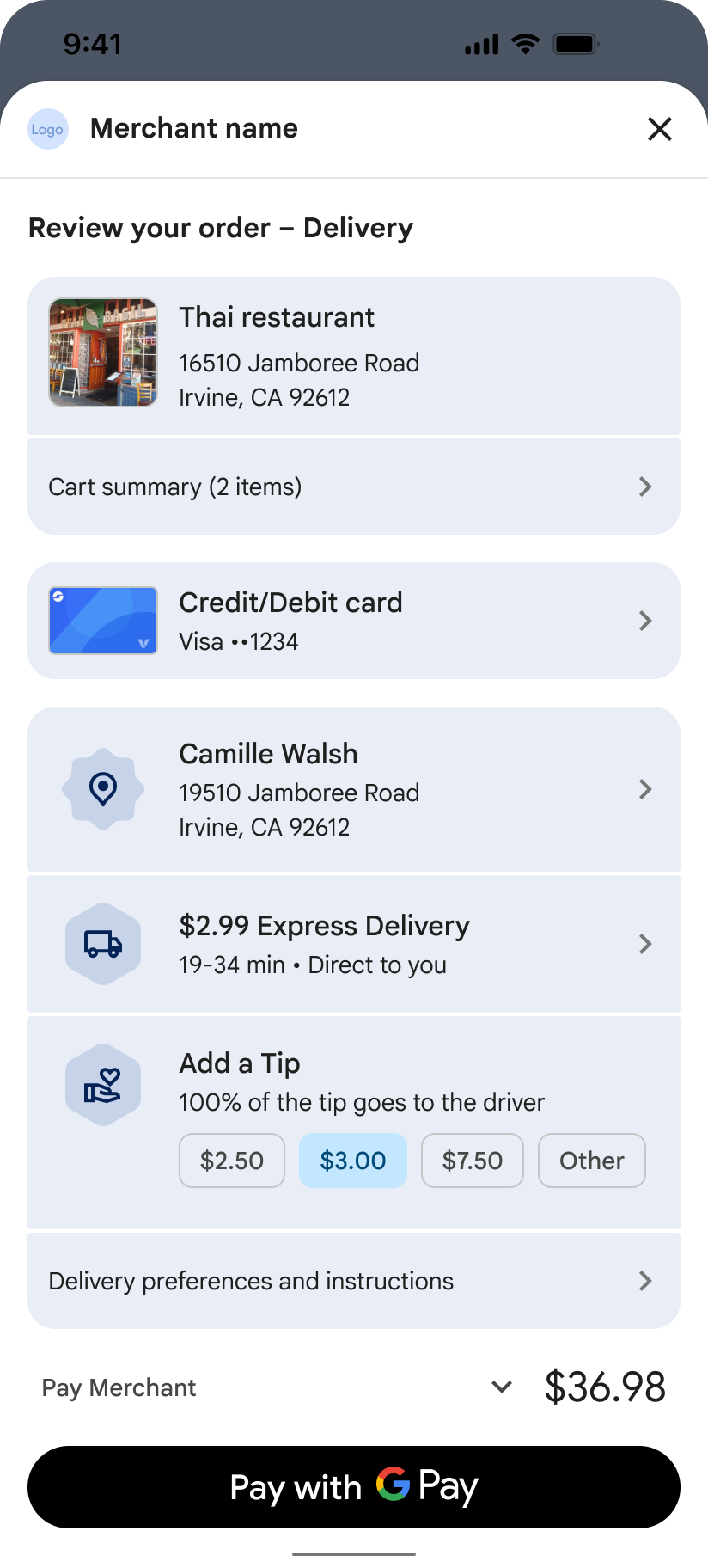
The Universal Commerce Protocol (UCP) is an open standard designed for the future of commerce like Food Ordering, empowering you to turn AI interactions into instant sales for both pickup and delivery orders. Adopt UCP to enable agentic actions on Google surfaces in the future.
Why implement UCP on Google?

Ready-made reach
Leverage UCP surface-agnostic designs and unlock access to users across AI surfaces like Google Maps to capture high intent customers during discovery.

Build user confidence at scale
Rely on a system designed for trust. UCP creates a transparent accountability trail between merchants, credential providers, and payment services, helping to ensure each transaction is secure, every time.

Maintain full control of your sales
You remain the Merchant of Record. Keep all of your customer data and relationships to offer personalized experiences like inline checkout and account linking that drive merchant orders and enhance conversations.
Learn more about Universal Commerce Protocol
Partner with us
Join the waitlist to become part of an ecosystem of industry leaders adopting the protocol to drive the next generation of commerce. Detailed onboarding and specs coming soon.
Join waitlistFrequently asked questions
What is the Universal Commerce Protocol (UCP)?
UCP is an open standard for agentic commerce that now unifies digital Food Ordering. It enables direct, instant purchases across Google surfaces, reducing friction and cart abandonment.
What can I expect when I integrate with UCP?
- Expanded reach: Connect with high-intent shoppers directly within Google's AI surfaces.
- Reduced checkout friction: Enable direct purchases within the interaction flow to keep users engaged.
- Control: You remain the Merchant of Record, maintaining full control over your customer relationships and data.
- Flexibility: Choose between different integration paths (Native and Embedded) to suit your brand and technical stack.
- Readiness for agentic experiences: Use core features like multi-item carts and account linking designed to support upcoming agentic capabilities.
- Compatibility across the ecosystem: Benefit from a protocol that is interoperable with major industry standards (Agent Payments Protocol (AP2), Agent2Agent (A2A) and Model Context Protocol (MCP)) and built to handle the full end-to-end shopping journey.
Will I lose control of my customer data?
No. You remain the Merchant of Record for all transactions. You retain full ownership of your customer relationships, data, and the post-purchase experience. Our standard security and privacy practices apply to the interaction, but you own the transaction.
What makes UCP different?
- Modular and extensible: UCP is designed to be modular and extensible to support rich commerce experiences using capabilities and extensions.
- Fast and easy to implement: UCP allows merchants the choice to select the set of capabilities & extensions they want to support and the communication medium that best suits their development needs such as APIs, MCP or A2A.
- Co-designed with industry leaders: UCP is open source and is designed directly by a collaboration of industry leaders, to support the diverse needs of a rich commerce ecosystem.
- Secure and seamless payments: UCP supports secure payments using tokenization and allows merchants to use existing payment integrations using payment handlers.
Is it compatible with my tech stack?
UCP is fully compatible with protocols such as AP2, A2A, and MCP. It supports transport REST API and MCP binding. We provide adapters to ensure compliance if you are using other protocols.
UCP primitives map 1:1 to standard retail operations such as checkout. UCP was designed in collaboration with industry leaders to ensure a low-lift integration that aligns with your existing business logic.
We have also deployed native SDKs for better language bindings, allowing you to integrate UCP faster within your existing development environment.