# Active voice vs. passive voice
> [!NOTE]
> **Estimated Time:** 15 minutes
The vast majority of sentences in technical writing should be
in active voice. This unit teaches you how to do the following:
- Distinguish passive voice from active voice.
- Convert passive voice to active voice because active voice is usually clearer.
First, watch this video, just to get the ball
rolling^[1](https://developers.google.com/tech-writing/one/active-voice#Footnote1)^:
[Video](https://www.youtube.com/watch?v=nG6DhoFt938)
## Distinguish active voice from passive voice in simple sentences
In an active voice sentence, an actor acts on a target. That is,
an active voice sentence follows this formula:
> Active Voice Sentence = actor + verb + target
A passive voice sentence reverses the formula. That is, a passive
voice sentence typically follows the following formula:
> Passive Voice Sentence = target + verb + actor
### Active voice example
For example, here's a short, active voice sentence:
> The cat sat on the mat.
- Actor: The cat
- Verb: sat
- Target: the mat
### Passive voice examples
By contrast, here's that same sentence in passive voice:
> The mat was sat on by the cat.
- Target: The mat
- Passive verb: was sat
- Actor: the cat
Some passive voice sentences omit an actor. For example:
> The mat was sat on.
- Actor: *unknown*
- Passive verb: was sat
- Target: the mat
Who or what sat on the mat? A cat? A dog? A T-Rex? Readers can only guess.
Good sentences in technical documentation identify who is doing what to whom.
## Recognize passive verbs
Passive verbs typically have the following formula:
passive verb = form of be + past participle verb
Although the preceding formula looks daunting, it is actually pretty simple:
- A **form of *be*** in a passive verb is typically one of the following words:
- is/are
- was/were
- A **past participle verb** is typically a plain verb plus the suffix *ed*. For example, the following are past participle verbs:
- interpreted
- generated
- formed
Unfortunately, some past participle verbs are irregular; that is, the past
participle form doesn't end with the suffix *ed*. For example:
- sat
- known
- frozen
Putting the form of *be* and the past participle together yields passive
verbs, such as the following:
- was interpreted
- is generated
- was formed
- is frozen
If the phrase contains an actor, a preposition ordinarily follows the
passive verb. (That preposition is often a key clue to help you spot
passive voice.) The following examples combine the passive verb and
the preposition:
- was interpreted as
- is generated by
- was formed by
- is frozen by
### Imperative verbs are typically active
It is easy to mistakenly classify sentences starting with an imperative
verb as passive. An **imperative verb** is a command. Many items in
numbered lists start with imperative verbs. For example, *Open* and
*Set* in the following list are both imperative verbs:
1. Open the configuration file.
2. Set the `Frombus` variable to `False`.
Sentences that start with an imperative verb are typically in active voice,
even though they don't explicitly mention an actor. Instead, sentences
that start with an imperative verb *imply* an actor. The implied actor
is **you**.
### Exercise
Mark each of the following sentences as either **Passive** or **Active**:
1. `MutableInput` provides read-only access.
2. Read-only access is provided by `MutableInput`.
3. Performance was measured.
4. Python was invented by Guido van Rossum in the twentieth century.
5. David Korn discovered the KornShell quite by accident.
6. This information is used by the policy enforcement team.
7. Click the Submit button.
8. The orbit was calculated by Katherine Johnson.
#### Click the icon to see the answer.
1. **Active**. MutableInput provides read-only access.
2. **Passive**. Read-only access is provided by MutableInput.
3. **Passive**. Performance was measured.
4. **Passive**. Python was invented by Guido van Rossum in the twentieth century.
5. **Active**. David Korn discovered the KornShell quite by accident.
6. **Passive**. This information is used by the policy enforcement team.
7. **Active** . Click the Submit button. (*Click* is an imperative verb.)
8. **Passive**. The orbit was calculated by Katherine Johnson.
*** ** * ** ***
## Distinguish active voice from passive voice in more complex sentences
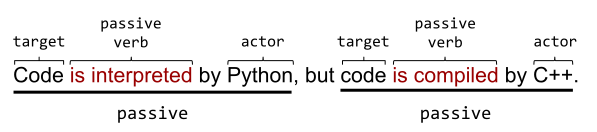
Many sentences contain multiple verbs, some of which are active and
some of which are passive. For example, the following sentence
contains two verbs, both of which are in passive voice:
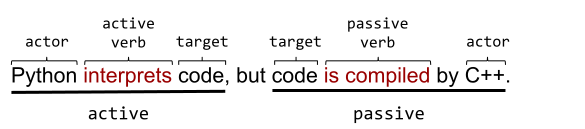
Here is that same sentence, partially converted to active voice:
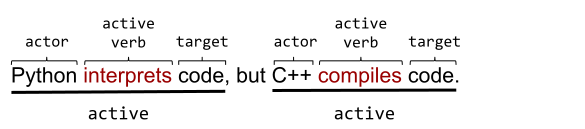
And here is that same sentence, now fully converted to active voice:
### Exercise
Each of the following sentences contains two verbs.
Categorize each of the verbs in the following sentences as either
active or passive. For example, if the first verb is active and
the second is passive, write **Active, Passive**.
1. The QA team loves ice cream, but the writers prefer sorbet.
2. Performance metrics are required by the team, though I prefer wild guesses.
3. When software engineers attempt something new and innovative, a reward should be given.
#### Click the icon to see the answer.
1. **Active, Active.** The QA team loves ice cream, but the writers prefer sorbet.
2. **Passive, Active.** Performance metrics are required by the team, though I prefer wild guesses.
3. **Active, Passive.** When software engineers attempt something new and innovative, a reward should be given.
## Prefer active voice to passive voice
Use the active voice most of the time. Use the passive voice sparingly.
Active voice provides the following advantages:
- Most readers mentally convert passive voice to active voice. Why subject your readers to extra processing time? By sticking to active voice, you enable readers to skip the preprocessor stage and go straight to compilation.
- Passive voice obfuscates your ideas, turning sentences on their head. Passive voice reports action indirectly.
- Some passive voice sentences omit an actor altogether, which forces the reader to guess the actor's identity.
- Active voice is generally shorter than passive voice.
Be bold---be active.
### Scientific research reports (optional material)
Passive voice runs rampant through certain scientific research reports.
In those research reports, experimenters and their equipment often
disappear, leading to passive sentences that start off as follows:
- It has been suggested that...
- Data was taken...
- Statistics were calculated...
- Results were evaluated.
Do we know who is doing what to whom? No. Does the passive voice
somehow make the information more objective? No.
Many scientific journals have embraced active voice. We encourage
the remainder to join the quest for clarity.
### Exercise
Rewrite the following passive voice sentences as active voice. Only part of
certain sentences are in passive voice; ensure that all parts end up as active
voice:
1. The flags weren't parsed by the Mungifier.
2. A wrapper is generated by the Op registration process.
3. Only one experiment per layer is selected by the Frombus system.
4. Quality metrics are identified by asterisks; ampersands identify bad metrics.
#### Click the icon to see the answer.
1. The Mungifier didn't parse the flags.
2. The Op registration process generates a wrapper.
3. The Frombus system selects only one experiment per layer.
4. Asterisks identify quality metrics; ampersands identify bad metrics.
**Next unit:** [Clear sentences](https://developers.google.com/tech-writing/one/clear-sentences)
^1. "Get the ball rolling" is an idiom that
means "to get something started." [↩](https://developers.google.com/tech-writing/one/active-voice#ref1 "Jump back to footnote 1 in the text.")^