# Component: Concept
## Element: [Concept](https://developers.google.com/public-data/docs/schema/dspl6#id37) / info
| Namespace | http://schemas.google.com/dspl/2010 |
| Annotations | Textual information, such as the name and description of the concept. |
| Diagram | 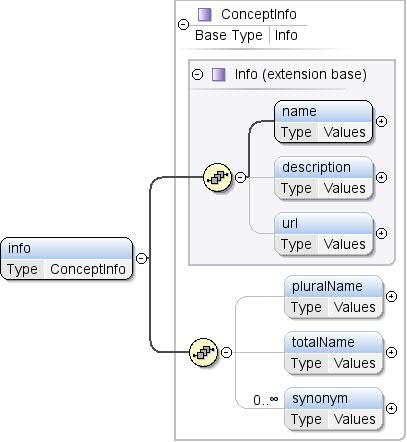 |
| Type | [ConceptInfo](https://developers.google.com/public-data/docs/schema/dspl13#id39) |
| Type hierarchy | - [Info](https://developers.google.com/public-data/docs/schema/dspl4#id6) - [ConceptInfo](https://developers.google.com/public-data/docs/schema/dspl13#id39) |
| Properties | | content: | complex | |---|---| |
| Model | [name](https://developers.google.com/public-data/docs/schema/dspl4#id7) , [description{0,1}](https://developers.google.com/public-data/docs/schema/dspl4#id14) , [url{0,1}](https://developers.google.com/public-data/docs/schema/dspl4#id15) , [pluralName{0,1}](https://developers.google.com/public-data/docs/schema/dspl13#id40) , [totalName{0,1}](https://developers.google.com/public-data/docs/schema/dspl13#id41) , [synonym\*](https://developers.google.com/public-data/docs/schema/dspl13#id42) |
| Children | [description](https://developers.google.com/public-data/docs/schema/dspl4#id14), [name](https://developers.google.com/public-data/docs/schema/dspl4#id7), [pluralName](https://developers.google.com/public-data/docs/schema/dspl13#id40), [synonym](https://developers.google.com/public-data/docs/schema/dspl13#id42), [totalName](https://developers.google.com/public-data/docs/schema/dspl13#id41), [url](https://developers.google.com/public-data/docs/schema/dspl4#id15) |
| Instance | ``` {1,1} {0,1} {0,1} ``` |
| Source | ``` Textual information, such as the name and description of the concept. ``` |
|---|---|
## Element: [Concept](https://developers.google.com/public-data/docs/schema/dspl6#id37) / topic
| Namespace | http://schemas.google.com/dspl/2010 |
| Annotations | A topic the concept is associated with. |
| Diagram | 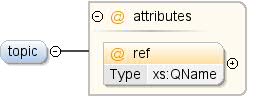 |
| Properties | | content: | complex | | minOccurs: | 0 | | maxOccurs: | unbounded | |---|---| |
| Attributes | | QName | Type | Fixed | Default | Use | Annotation | | [ref](https://developers.google.com/public-data/docs/schema/dspl6#id44) | xs:QName | | | optional | The unique identifier of the topic this concept is associated with. The referenced topic may be defined in the same dataset or externally, i.e., in another dataset. A reference to an external topic must be of the form "prefix:other_topic_id", where "prefix" is the prefix used for the namespace of the external dataset (see XML namespaces). | |---|---|---|---|---|---| |
| Source | ``` A topic the concept is associated with. The unique identifier of the topic this concept is associated with. The referenced topic may be defined in the same dataset or externally, i.e., in another dataset. A reference to an external topic must be of the form "prefix:other_topic_id", where "prefix" is the prefix used for the namespace of the external dataset (see XML namespaces). ``` |
|---|---|
## Element: [Concept](https://developers.google.com/public-data/docs/schema/dspl6#id37) / type
| Namespace | http://schemas.google.com/dspl/2010 |
| Annotations | The data type of the concept. A concept must provide a type declaration or extend another concept. In the case where it's extending a concept, it may also provide a type declaration. The type of the extended concept must be less restrictive than the type of the concept extending it. "Less restrictive than" (LRT) is a partial order defined as follows: string LRT float float LRT integer string LRT date string LRT boolean |
| Diagram |  |
| Properties | | content: | complex | | minOccurs: | 0 | |---|---| |
| Attributes | | QName | Type | Fixed | Default | Use | Annotation | | [ref](https://developers.google.com/public-data/docs/schema/dspl6#id46) | [DataType](https://developers.google.com/public-data/docs/schema/dspl18#id22) | | | required | | |---|---|---|---|---|---| |
| Source | ``` The data type of the concept. A concept must provide a type declaration or extend another concept. In the case where it's extending a concept, it may also provide a type declaration. The type of the extended concept must be less restrictive than the type of the concept extending it. "Less restrictive than" (LRT) is a partial order defined as follows: string LRT float float LRT integer string LRT date string LRT boolean ``` |
|---|---|
## Element: [Concept](https://developers.google.com/public-data/docs/schema/dspl6#id37) / attribute
| Namespace | http://schemas.google.com/dspl/2010 |
| Annotations | An attribute of the concept. Attributes represent additional information about the concept (e.g., GDP is a percentage). |
| Diagram |  |
| Type | [Attribute](https://developers.google.com/public-data/docs/schema/dspl14#id18) |
| Properties | | content: | complex | | minOccurs: | 0 | | maxOccurs: | unbounded | |---|---| |
| Model | [info{0,1}](https://developers.google.com/public-data/docs/schema/dspl14#id19) , [type{0,1}](https://developers.google.com/public-data/docs/schema/dspl14#id20) , ([value\*](https://developers.google.com/public-data/docs/schema/dspl0#id10) \| [conceptValue{0,1}](https://developers.google.com/public-data/docs/schema/dspl0#id12)) |
| Children | [conceptValue](https://developers.google.com/public-data/docs/schema/dspl0#id12), [info](https://developers.google.com/public-data/docs/schema/dspl14#id19), [type](https://developers.google.com/public-data/docs/schema/dspl14#id20), [value](https://developers.google.com/public-data/docs/schema/dspl0#id10) |
| Instance | ``` {0,1} {0,1} ``` |
| Attributes | | QName | Type | Fixed | Default | Use | Annotation | | [concept](https://developers.google.com/public-data/docs/schema/dspl14#id26) | xs:QName | | | optional | A reference to a concept that corresponds to the values of the attribute. If the attribute specifies a type, then the type must match the type of the referenced concept. A reference to an external concept must be of the form "prefix:other_concept_id", where "prefix" is the prefix used for the namespace of the external dataset (see XML namespaces). | | [id](https://developers.google.com/public-data/docs/schema/dspl14#id24) | [LocalId](https://developers.google.com/public-data/docs/schema/dspl17#id25) | | | optional | The id of the concept attribute. This identifier must be unique within the concept (across attributes and properties). The id may be omitted if the concept attribute is specified. In that case, an id is implicity created with value the local name of the referenced concept. For instance \ is equivalent to \ | |---|---|---|---|---|---| |
| Source | ``` An attribute of the concept. Attributes represent additional information about the concept (e.g., GDP is a percentage). ``` |
|---|---|
## Element: [Concept](https://developers.google.com/public-data/docs/schema/dspl6#id37) / property
| Namespace | http://schemas.google.com/dspl/2010 |
| Annotations | A property of the concept. Properties represent additional information about instances of the concept (e.g., a concept "city" may have a property "country"). |
| Diagram |  |
| Type | [ConceptProperty](https://developers.google.com/public-data/docs/schema/dspl8#id49) |
| Properties | | content: | complex | | minOccurs: | 0 | | maxOccurs: | unbounded | |---|---| |
| Model | [info{0,1}](https://developers.google.com/public-data/docs/schema/dspl8#id50) , [type{0,1}](https://developers.google.com/public-data/docs/schema/dspl8#id51) |
| Children | [info](https://developers.google.com/public-data/docs/schema/dspl8#id50), [type](https://developers.google.com/public-data/docs/schema/dspl8#id51) |
| Instance | ``` {0,1} {0,1} ``` |
| Attributes | | QName | Type | Fixed | Default | Use | Annotation | | [concept](https://developers.google.com/public-data/docs/schema/dspl8#id54) | xs:QName | | | optional | A reference to a concept that corresponds to the values of the property. If the property specifies a type, then the type must match the type of the referenced concept. A reference to an external concept must be of the form "prefix:other_concept_id", where "prefix" is the prefix used for the namespace of the external dataset (see XML namespaces). | | [id](https://developers.google.com/public-data/docs/schema/dspl8#id53) | [LocalId](https://developers.google.com/public-data/docs/schema/dspl17#id25) | | | optional | The id of the concept property. This identifier must be unique within the concept (across attributes and properties). The id may be omitted if the concept property is specified. In that case, an id is implicitly created with value the local name of the referenced concept. For instance \ is equivalent to \ | | [isMapping](https://developers.google.com/public-data/docs/schema/dspl8#id56) | xs:boolean | | false | optional | If true, then this property must reference a concept, and this property denotes a mapping (1-to-1) relationship between this concept and the referenced concept. Each instance of the referenced concept is referenced by at most one instance of this concept. | | [isParent](https://developers.google.com/public-data/docs/schema/dspl8#id55) | xs:boolean | | false | optional | If true, then this property must reference a concept, and this property denotes a hierarchical relationship between this concept and the referenced concept (e.g., the continent of a country). | |---|---|---|---|---|---| |
| Source | ``` A property of the concept. Properties represent additional information about instances of the concept (e.g., a concept "city" may have a property "country"). ``` |
|---|---|
## Element: [Concept](https://developers.google.com/public-data/docs/schema/dspl6#id37) / defaultValue
| Namespace | http://schemas.google.com/dspl/2010 |
| Annotations | A default value for the concept, to be used by applications when they need to pick one of the possible values of the concept. |
| Diagram |  |
| Type | [Values](https://developers.google.com/public-data/docs/schema/dspl3#id8) |
| Properties | | content: | complex | | minOccurs: | 0 | |---|---| |
| Model | [value\*](https://developers.google.com/public-data/docs/schema/dspl0#id10) \| [conceptValue{0,1}](https://developers.google.com/public-data/docs/schema/dspl0#id12) |
| Children | [conceptValue](https://developers.google.com/public-data/docs/schema/dspl0#id12), [value](https://developers.google.com/public-data/docs/schema/dspl0#id10) |
| Instance | ``` {0,unbounded} {0,1} ``` |
| Source | ``` A default value for the concept, to be used by applications when they need to pick one of the possible values of the concept. ``` |
|---|---|
## Element: [Concept](https://developers.google.com/public-data/docs/schema/dspl6#id37) / table
| Namespace | http://schemas.google.com/dspl/2010 |
| Annotations | A reference to a table that contains all the possible values for the concept and its non-constant properties. |
| Diagram |  |
| Type | [ConceptTableMapping](https://developers.google.com/public-data/docs/schema/dspl5#id59) |
| Properties | | content: | complex | | minOccurs: | 0 | |---|---| |
| Model | [mapConcept{0,1}](https://developers.google.com/public-data/docs/schema/dspl5#id60) , [mapProperty\*](https://developers.google.com/public-data/docs/schema/dspl5#id62) |
| Children | [mapConcept](https://developers.google.com/public-data/docs/schema/dspl5#id60), [mapProperty](https://developers.google.com/public-data/docs/schema/dspl5#id62) |
| Instance | ``` ``` |
| Attributes | | QName | Type | Fixed | Default | Use | Annotation | | [ref](https://developers.google.com/public-data/docs/schema/dspl5#id65) | [LocalId](https://developers.google.com/public-data/docs/schema/dspl17#id25) | | | required | The id of the table that contains data for the concept. | |---|---|---|---|---|---| |
| Source | ``` A reference to a table that contains all the possible values for the concept and its non-constant properties. ``` |
|---|---|
## Complex Type: Concept
| Namespace | http://schemas.google.com/dspl/2010 |
| Annotations | A concept is a definition of a type of data that appears in the dataset (e.g., "GDP" or "County"). A concept may be associated with an enumeration of all its possible values or not. A concept defined in some dataset may be referenced in other datasets. |
| Diagram |  |
| Used by | | Element | [dspl/concepts/concept](https://developers.google.com/public-data/docs/schema/dspl9#id36) | |---|---| |
| Model | [info](https://developers.google.com/public-data/docs/schema/dspl6#id38) , [topic\*](https://developers.google.com/public-data/docs/schema/dspl6#id43) , [type{0,1}](https://developers.google.com/public-data/docs/schema/dspl6#id45) , [attribute\*](https://developers.google.com/public-data/docs/schema/dspl6#id47) , [property\*](https://developers.google.com/public-data/docs/schema/dspl6#id48) , [defaultValue{0,1}](https://developers.google.com/public-data/docs/schema/dspl6#id57) , [table{0,1}](https://developers.google.com/public-data/docs/schema/dspl6#id58) |
| Children | [attribute](https://developers.google.com/public-data/docs/schema/dspl6#id47), [defaultValue](https://developers.google.com/public-data/docs/schema/dspl6#id57), [info](https://developers.google.com/public-data/docs/schema/dspl6#id38), [property](https://developers.google.com/public-data/docs/schema/dspl6#id48), [table](https://developers.google.com/public-data/docs/schema/dspl6#id58), [topic](https://developers.google.com/public-data/docs/schema/dspl6#id43), [type](https://developers.google.com/public-data/docs/schema/dspl6#id45) |
| Attributes | | QName | Type | Fixed | Default | Use | Annotation | | [extends](https://developers.google.com/public-data/docs/schema/dspl6#id67) | xs:QName | | | optional | The unique identifier of a concept that this concept extends. The referenced concept may be defined in the same dataset or externally, i.e., in another dataset. A reference to an external concept must be of the form "prefix:other_concept_id", where "prefix" is the prefix used for the namespace of the external dataset (see XML namespaces). | | [id](https://developers.google.com/public-data/docs/schema/dspl6#id66) | [Id](https://developers.google.com/public-data/docs/schema/dspl19#id33) | | | required | The unique identifier of the concept, which must be globally unique within the dataset. | |---|---|---|---|---|---| |
| Source | ``` A concept is a definition of a type of data that appears in the dataset (e.g., "GDP" or "County"). A concept may be associated with an enumeration of all its possible values or not. A concept defined in some dataset may be referenced in other datasets. Textual information, such as the name and description of the concept. A topic the concept is associated with. The unique identifier of the topic this concept is associated with. The referenced topic may be defined in the same dataset or externally, i.e., in another dataset. A reference to an external topic must be of the form "prefix:other_topic_id", where "prefix" is the prefix used for the namespace of the external dataset (see XML namespaces). The data type of the concept. A concept must provide a type declaration or extend another concept. In the case where it's extending a concept, it may also provide a type declaration. The type of the extended concept must be less restrictive than the type of the concept extending it. "Less restrictive than" (LRT) is a partial order defined as follows: string LRT float float LRT integer string LRT date string LRT boolean An attribute of the concept. Attributes represent additional information about the concept (e.g., GDP is a percentage). A property of the concept. Properties represent additional information about instances of the concept (e.g., a concept "city" may have a property "country"). A default value for the concept, to be used by applications when they need to pick one of the possible values of the concept. A reference to a table that contains all the possible values for the concept and its non-constant properties. The unique identifier of the concept, which must be globally unique within the dataset. The unique identifier of a concept that this concept extends. The referenced concept may be defined in the same dataset or externally, i.e., in another dataset. A reference to an external concept must be of the form "prefix:other_concept_id", where "prefix" is the prefix used for the namespace of the external dataset (see XML namespaces). ``` |
|---|---|
## Attribute: [Concept](https://developers.google.com/public-data/docs/schema/dspl6#id37) / [topic](https://developers.google.com/public-data/docs/schema/dspl6#id43) / @ref
| Namespace | No namespace |
| Annotations | The unique identifier of the topic this concept is associated with. The referenced topic may be defined in the same dataset or externally, i.e., in another dataset. A reference to an external topic must be of the form "prefix:other_topic_id", where "prefix" is the prefix used for the namespace of the external dataset (see XML namespaces). |
| Type | xs:QName |
| Properties | | content: | simple | |---|---| |
| Used by | | Element | [Concept/topic](https://developers.google.com/public-data/docs/schema/dspl6#id43) | |---|---| |
| Source | ``` The unique identifier of the topic this concept is associated with. The referenced topic may be defined in the same dataset or externally, i.e., in another dataset. A reference to an external topic must be of the form "prefix:other_topic_id", where "prefix" is the prefix used for the namespace of the external dataset (see XML namespaces). ``` |
|---|---|
## Attribute: [Concept](https://developers.google.com/public-data/docs/schema/dspl6#id37) / [type](https://developers.google.com/public-data/docs/schema/dspl6#id45) / @ref
| Namespace | No namespace |
| Type | [DataType](https://developers.google.com/public-data/docs/schema/dspl18#id22) |
| Properties | | use: | required | |---|---| |
| Facets | | enumeration | string | | | enumeration | float | | | enumeration | integer | | | enumeration | boolean | | | enumeration | date | | | enumeration | concept | | |---|---|---| |
| Used by | | Element | [Concept/type](https://developers.google.com/public-data/docs/schema/dspl6#id45) | |---|---| |
| Source | ``` ``` |
|---|---|
## Attribute: [Concept](https://developers.google.com/public-data/docs/schema/dspl6#id37) / @id
| Namespace | No namespace |
| Annotations | The unique identifier of the concept, which must be globally unique within the dataset. |
| Type | [Id](https://developers.google.com/public-data/docs/schema/dspl19#id33) |
| Properties | | use: | required | |---|---| |
| Facets | | maxLength | 64 | | |---|---|---| |
| Used by | | Complex Type | [Concept](https://developers.google.com/public-data/docs/schema/dspl6#id37) | |---|---| |
| Source | ``` The unique identifier of the concept, which must be globally unique within the dataset. ``` |
|---|---|
## Attribute: [Concept](https://developers.google.com/public-data/docs/schema/dspl6#id37) / @extends
| Namespace | No namespace |
| Annotations | The unique identifier of a concept that this concept extends. The referenced concept may be defined in the same dataset or externally, i.e., in another dataset. A reference to an external concept must be of the form "prefix:other_concept_id", where "prefix" is the prefix used for the namespace of the external dataset (see XML namespaces). |
| Type | xs:QName |
| Properties | | use: | optional | |---|---| |
| Used by | | Complex Type | [Concept](https://developers.google.com/public-data/docs/schema/dspl6#id37) | |---|---| |
| Source | ``` The unique identifier of a concept that this concept extends. The referenced concept may be defined in the same dataset or externally, i.e., in another dataset. A reference to an external concept must be of the form "prefix:other_concept_id", where "prefix" is the prefix used for the namespace of the external dataset (see XML namespaces). ``` |
|---|---|
Created using the
[oXygen XML Editor](http://www.oxygenxml.com).