Sandbox for playing with Sparse JAX and the sparse compiler on CPU.
See [colab](https://colab.corp.google.com/drive/1Grsj-eOqI90goMfpAqx21ErWvLQLWlF1#scrollTo=EEpQYtd-BrD0). Currently, it is only available to googlers.
*** ** * ** ***
This colab can be executed on Brain/DeepMind CPU runtime.
We need to use XLA-NEXT:CPU for fast sparse ops: the next cell shows how to set it up, and it allows to import sparse_jit either from P4 HEAD (the default) or from a CitC workspace (this only picks up Python related changes though).
**You must restart the runtime before re-running the cell below to pick up changes**:
- **soft restart**: go to Runtime, Restart Runtime
- **hard restart**: go to Connect to a Borg Runtime, Stop Runtime, Start New
### Setup
import functools
import jax
from jax.experimental import sparse # this gives you sparse JAX
import jax.numpy as jnp
import os
from colabtools import adhoc_import
CITC_CLIENT = ""
CITC_USER = ""
CL_NUMBER = "HEAD"
# Use XLA-NEXT for fast sparse ops
# --xla_cpu_use_xla_runtime enables XLA-NEXT which has fast sparse ops
# --xla_cpu_enable_mlir_tiling_and_fusion=false needed to workaround a few bugs
os.environ['XLA_FLAGS'] = '--xla_cpu_use_xla_runtime --xla_cpu_enable_mlir_tiling_and_fusion=false'
```
Hello sparse world
BCOO(float32[1000], nse=6)
Computed 91.0
```
### Profile matmul vs sparsity
import matplotlib.pyplot as plt
import timeit
REPEATS = 1
LOOPS = 10
SECONDS_TO_MICROS = 1_000 * 1_000
# Try reversing this shape to see how the relative difference in compute time
# between dense and sparse matmul changes.
DENSE_SHAPE = (8, 10_000)
#DENSE_SHAPE = (10_000, 8)
N_DENSE_ENTRIES = DENSE_SHAPE[0] * DENSE_SHAPE[1]
def matmul(m1, m2):
return jnp.matmul(m1, m2)
matmul_jit = jax.jit(matmul)
sparse_matmul_jit = sparse_jit(matmul, output_format=None) # One of None, 'dense', 'sparse'
key = jax.random.PRNGKey(0)
key, subkey = jax.random.split(key)
n_entries_sparse = []
t_us_dense = []
t_us_sparse_bcoo = []
t_us_sparse_bcsr = []
# This runs more data points in the sparse region.
# for i in range(11):
# fraction_non_zero = 10**-(0.5*(10-i))
# This runs data points uniformly.
for i in range(10):
fraction_non_zero = i / 10.0
m = (
jax.random.bernoulli(
key=subkey,
shape=DENSE_SHAPE,
p=fraction_non_zero,
)
*
jax.random.normal(
key=subkey,
shape=DENSE_SHAPE,
)
)
mT = m.T
# Note that the jax.experimental.sparse.BCOO.fromdense() method produces
# a sorted COO as currently always expected by the code generated by the
# sparse compiler. The operation sm.T, on the other hand, uses the
# jax.sparse implementation which does not result in sorted COO, unless
# we explicitly sparse_jit that operation too first. So, in general, for
# the time being, make sure that all operations are handled by sparse_jit,
# or otherwise only rely on the from_dense() method for BCOO construction.
sm = jax.experimental.sparse.BCOO.fromdense(m)
smT = jax.experimental.sparse.BCOO.fromdense(mT)
s2m = jax.experimental.sparse.BCSR.fromdense(m)
s2mT = jax.experimental.sparse.BCSR.fromdense(mT)
print(f'[{i:2}] Fraction of non-zero entries: {fraction_non_zero:.5f}')
# Dense
try:
op = lambda: matmul_jit(m, mT).block_until_ready()
dense_matmul_result = op() # Warmup
t = timeit.repeat(
op,
repeat=REPEATS,
number=LOOPS,
)
t_us_dense.append(SECONDS_TO_MICROS * max(t) / LOOPS)
print(f' Dense ARRAY matmul completed in {int(t_us_dense[-1]):8,}us')
del op
del t
except BaseException as e:
print(f' Dense matmul failed with error: {e}')
# Sparse BCOO
try:
n_entries_sparse.append(sm.nse)
op = lambda: sparse_matmul_jit(sm, smT).block_until_ready()
sparse_matmul_result = op() # Warmup
# Verify that dense and sparse path compute the same result.
# Note that the result returned by sparse_matmul_jit is dense.
assert jnp.allclose(dense_matmul_result, sparse_matmul_result)
t = timeit.repeat(
op,
repeat=REPEATS,
number=LOOPS,
)
t_us_sparse_bcoo.append(SECONDS_TO_MICROS * max(t) / LOOPS)
print(f' Sparse BCOO matmul completed in {int(t_us_sparse_bcoo[-1]):8,}us')
del op
del t
except BaseException as e:
print(f' Sparse BCOO matmul failed with error: {e}')
t_us_sparse_bcoo.append(0)
# Sparse BCSR
try:
op = lambda: sparse_matmul_jit(s2m, s2mT).block_until_ready()
sparse_matmul_result = op() # Warmup
# Verify that dense and sparse path compute the same result.
# Note that the result returned by sparse_matmul_jit is dense.
assert jnp.allclose(dense_matmul_result, sparse_matmul_result)
t = timeit.repeat(
op,
repeat=REPEATS,
number=LOOPS,
)
t_us_sparse_bcsr.append(SECONDS_TO_MICROS * max(t) / LOOPS)
print(f' Sparse BCSR matmul completed in {int(t_us_sparse_bcsr[-1]):8,}us')
del op
del t
except BaseException as e:
print(f' Sparse BCSR matmul failed with error: {e}')
t_us_sparse_bcsr.append(0)
print()
density = [n_entries_sparse[i] / N_DENSE_ENTRIES for i in range(len(n_entries_sparse))]
plt.figure(figsize=(10,7))
plt.plot(density, t_us_dense, 'o-')
plt.plot(density, t_us_sparse_bcoo, 'o-')
plt.plot(density, t_us_sparse_bcsr, 'o-')
plt.title(f'{DENSE_SHAPE} x {tuple(reversed(DENSE_SHAPE))} matmul time in microseconds vs density ({jax.devices()[0].platform}).');
plt.legend(['Dense matmul', 'Sparse matmul (BCOO)', 'Sparse matmul (BCSR)']);
plt.xlabel('Fraction of non-zero entries');
plt.ylabel('microseconds');
plt.yscale('log');
```
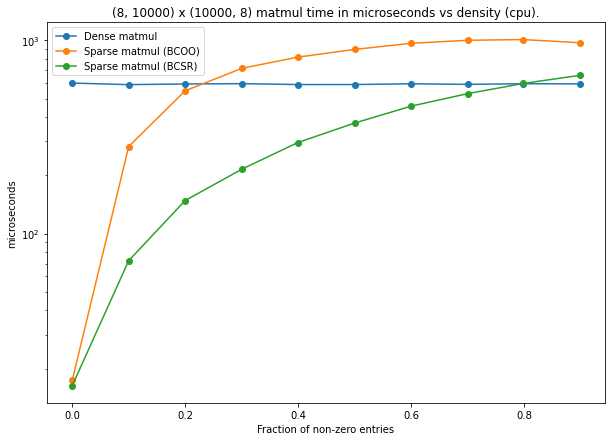
[ 0] Fraction of non-zero entries: 0.00000
Dense ARRAY matmul completed in 601us
Sparse BCOO matmul completed in 17us
Sparse BCSR matmul completed in 16us
[ 1] Fraction of non-zero entries: 0.10000
Dense ARRAY matmul completed in 590us
Sparse BCOO matmul completed in 282us
Sparse BCSR matmul completed in 72us
[ 2] Fraction of non-zero entries: 0.20000
Dense ARRAY matmul completed in 594us
Sparse BCOO matmul completed in 548us
Sparse BCSR matmul completed in 148us
[ 3] Fraction of non-zero entries: 0.30000
Dense ARRAY matmul completed in 597us
Sparse BCOO matmul completed in 717us
Sparse BCSR matmul completed in 215us
[ 4] Fraction of non-zero entries: 0.40000
Dense ARRAY matmul completed in 590us
Sparse BCOO matmul completed in 818us
Sparse BCSR matmul completed in 295us
[ 5] Fraction of non-zero entries: 0.50000
Dense ARRAY matmul completed in 590us
Sparse BCOO matmul completed in 898us
Sparse BCSR matmul completed in 374us
[ 6] Fraction of non-zero entries: 0.60000
Dense ARRAY matmul completed in 596us
Sparse BCOO matmul completed in 965us
Sparse BCSR matmul completed in 457us
[ 7] Fraction of non-zero entries: 0.70000
Dense ARRAY matmul completed in 591us
Sparse BCOO matmul completed in 1,001us
Sparse BCSR matmul completed in 530us
[ 8] Fraction of non-zero entries: 0.80000
Dense ARRAY matmul completed in 596us
Sparse BCOO matmul completed in 1,009us
Sparse BCSR matmul completed in 598us
[ 9] Fraction of non-zero entries: 0.90000
Dense ARRAY matmul completed in 595us
Sparse BCOO matmul completed in 972us
Sparse BCSR matmul completed in 658us
```
### Replicate matmul results from previous cell using nn.Dense model
import flax
from flax import linen as nn
import matplotlib.pyplot as plt
import timeit
REPEATS = 1
LOOPS = 10
SECONDS_TO_MICROS = 1_000 * 1_000
# Try reversing this shape to see how the relative difference in compute time
# between dense and sparse matmul changes.
DENSE_SHAPE = (8, 10_000)
# DENSE_SHAPE = (10_000, 8)
N_DENSE_ENTRIES = DENSE_SHAPE[0] * DENSE_SHAPE[1]
def matmul(m1, m2):
return jnp.matmul(m1, m2)
matmul_jit = jax.jit(matmul)
sparse_matmul_jit = sparse_jit(matmul)
key = jax.random.PRNGKey(0)
key, subkey = jax.random.split(key)
n_entries_sparse = []
t_us_dense = []
t_us_sparse = []
for i in range(11):
fraction_non_zero = 10**-(0.5*(10-i))
m = (
jax.random.bernoulli(
key=subkey,
shape=DENSE_SHAPE,
p=fraction_non_zero,
)
*
jax.random.normal(
key=subkey,
shape=DENSE_SHAPE,
)
)
mT = m.T
print(f'[{i:2}] Fraction of non-zero entries: {fraction_non_zero:.5f}')
model = nn.Sequential(
[
nn.Dense(features=DENSE_SHAPE[0], use_bias=False),
]
)
params = model.init(
{
'params': subkey,
},
m,
)
# Replace randomly initialized params with mT
params = jax.tree_util.tree_map(
lambda p: mT,
params
)
model_fn = functools.partial(model.apply)
# Now the model is equivalent to the matrix multiplication from the previous
# section.
assert jnp.allclose(matmul_jit(m, mT), model_fn(params, m))
# Dense
try:
dense_model_fn_jit = jax.jit(model_fn)
op = lambda: dense_model_fn_jit(params, m).block_until_ready()
dense_op_result = op() # Warmup
t = timeit.repeat(
op,
repeat=REPEATS,
number=LOOPS,
)
t_us_dense.append(SECONDS_TO_MICROS * min(t) / LOOPS)
print(f' Dense model completed in {int(t_us_dense[-1]):8,}us')
del op
del t
except BaseException as e:
print(f' Dense model failed with error: {e}')
# Sparse
try:
sm = jax.experimental.sparse.BCOO.fromdense(m)
sparse_params = jax.tree_map(
lambda x: jax.experimental.sparse.BCOO.fromdense(x),
params,
)
sparse_model_fn_jit = sparse_jit(model_fn)
op = lambda: sparse_model_fn_jit(sparse_params, sm).block_until_ready()
sparse_op_result = op() # Warmup
# Note that the result returned by sparse_matmul_jit is a dense matrix at
# the moment.
assert jnp.allclose(dense_op_result, sparse_op_result)
t = timeit.repeat(
op,
repeat=REPEATS,
number=LOOPS,
)
t_us_sparse.append(SECONDS_TO_MICROS * min(t) / LOOPS)
n_entries_sparse.append(sm.nse)
print(f' Sparse model completed in {int(t_us_sparse[-1]):8,}us')
del op
del t
except BaseException as e:
print(f' Sparse model failed with error: {e}')
print()
density = [n_entries_sparse[i] / N_DENSE_ENTRIES for i in range(len(n_entries_sparse))]
plt.figure(figsize=(10,7))
plt.plot(density, t_us_dense, 'o-')
plt.plot(density, t_us_sparse, 'o-')
plt.title(f'{DENSE_SHAPE} x {tuple(reversed(DENSE_SHAPE))} matmul time in microseconds vs density ({jax.devices()[0].platform}).');
plt.legend(['Dense model', 'Sparse model (BCOO)']);
plt.xlabel('Fraction of non-zero entries');
plt.ylabel('microseconds');
plt.yscale('log');
```
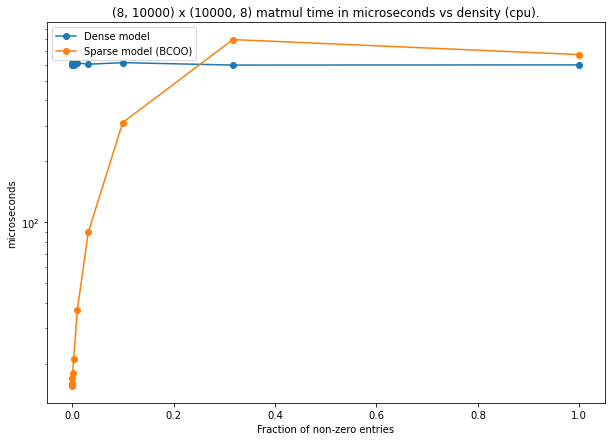
[ 0] Fraction of non-zero entries: 0.00001
Dense model completed in 601us
Sparse model completed in 17us
[ 1] Fraction of non-zero entries: 0.00003
Dense model completed in 601us
Sparse model completed in 15us
[ 2] Fraction of non-zero entries: 0.00010
Dense model completed in 608us
Sparse model completed in 15us
[ 3] Fraction of non-zero entries: 0.00032
Dense model completed in 598us
Sparse model completed in 16us
[ 4] Fraction of non-zero entries: 0.00100
Dense model completed in 597us
Sparse model completed in 18us
[ 5] Fraction of non-zero entries: 0.00316
Dense model completed in 593us
Sparse model completed in 21us
[ 6] Fraction of non-zero entries: 0.01000
Dense model completed in 612us
Sparse model completed in 37us
[ 7] Fraction of non-zero entries: 0.03162
Dense model completed in 602us
Sparse model completed in 89us
[ 8] Fraction of non-zero entries: 0.10000
Dense model completed in 613us
Sparse model completed in 310us
[ 9] Fraction of non-zero entries: 0.31623
Dense model completed in 596us
Sparse model completed in 796us
[10] Fraction of non-zero entries: 1.00000
Dense model completed in 597us
Sparse model completed in 671us
```
### Sparse Jax Specifics