# Random Forest
This is an Ox.
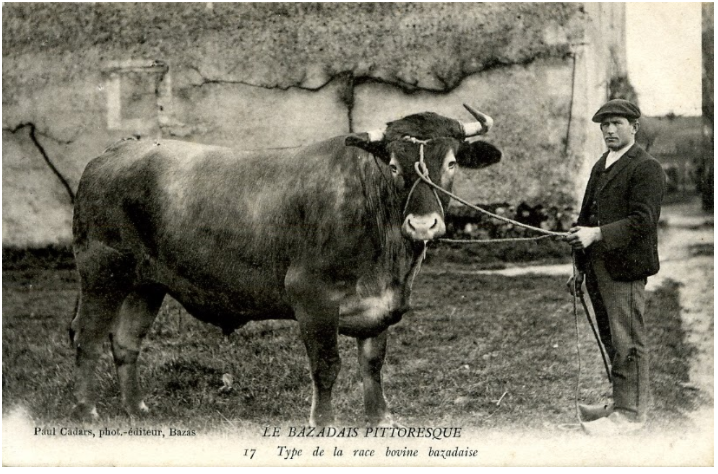
**Figure 19. An ox.**
In 1906, a [weight judging competition was held in
England](https://www.nature.com/articles/075450a0.pdf).
787 participants guessed the weight of an ox. The median *error* of individual
guesses was 37 lb (an error of 3.1%). However, the overall median of the
guesses was only 9 lb away from the real weight of the ox (1198 lb), which was
an error of only 0.7%.
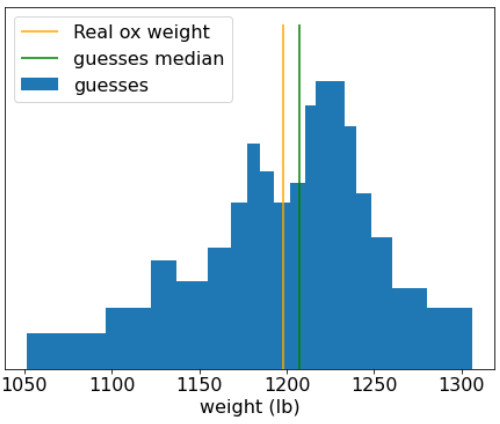
**Figure 20. Histogram of individual weight guesses.**
This anecdote illustrates the
[Wisdom of the crowd](https://developers.google.com/machine-learning/glossary#wisdom_of_the_crowd): *In
certain situations, collective opinion provides very good judgment.*
Mathematically, the wisdom of the crowd can be modeled with the
[Central limit theorem](https://wikipedia.org/wiki/Central_limit_theorem):
Informally, the squared error between a value and the average of N noisy
estimates of this value tends to zero with a 1/N factor.
However, if the variables are not independent, the variance is greater.
In machine learning, an
**[ensemble](https://developers.google.com/machine-learning/glossary#ensemble)** is a collection of models
whose predictions are averaged (or aggregated in some way). If the ensemble
models are different enough without being too bad individually, the quality of
the ensemble is generally better than the quality of each of the individual
models. An ensemble requires more training and inference time than a single
model. After all, you have to perform training and inference on multiple models
instead of a single model.
Informally, for an ensemble to work best, the individual models should be
independent. As an illustration, an ensemble composed of 10 of the exact same
models (that is, not independent at all) won't be better than the individual
model. On the other hand, forcing models to be independent could mean making
them worse. Effective ensembling requires finding the balance between model
independence and the quality of its sub-models.