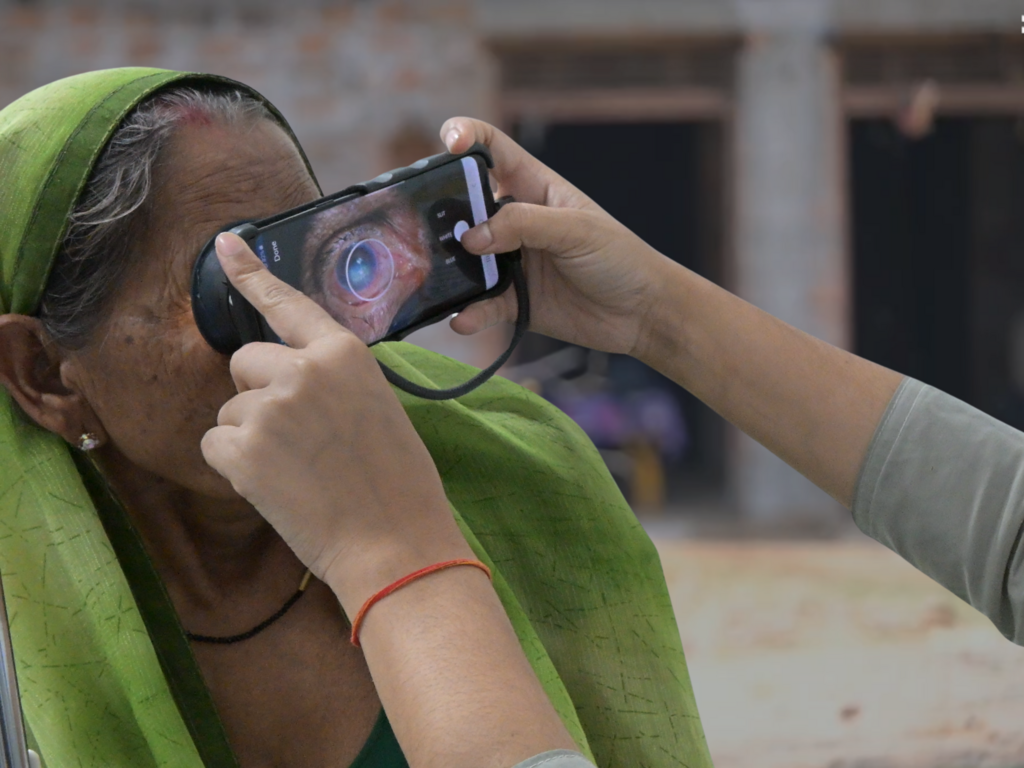
Globally, more than 1 billion people live with preventable blindness, yet they remain underserved due to a critical shortage of ophthalmologists and the difficulty of accessing urban eye care systems for rural patients. In many low resource environments, community health workers are the frontline of care, but they often lack specialized ophthalmic training or tools.
While AI has been implemented for back-of-the-eye diseases like diabetic retinopathy, the majority of vision loss occurs due to front-of-the-eye pathology, primarily due to cataracts. AI development for these conditions has historically lagged due to a lack of standardized imaging and high quality, representative datasets.
The Solution: smartphone-based screening with Seeker™
Visilant developed a multimodal AI solution leveraging MedGemma to empower frontline health workers to screen for the leading causes of visual impairment, including cataract, refractive error, corneal infection, pterygium, and corneal opacity. Using Seeker™, Visilant’s smartphone-based eye imaging system, health workers capture external eye images, measure visual acuity, and record patient-reported symptoms.
Visilant’s custom system, based on a fine-tuned MedGemma model, analyzes this multimodal data to identify clinical findings and generate triage reports. The system includes an expert-in-the-loop framework and automated guardrails designed to meet clinical safety standards while extending diagnostic reach to the most remote and underserved communities.
How open models from HAI-DEF helped
Previously, the Visilant pipeline relied on multiple Convolutional Neural Networks (CNNs) focused on distinct anatomical regions. This often led to "crosstalk," where a corneal disease might be incorrectly flagged as a positive cataract.
Visilant fine-tuned MedGemma 1.5 4B on a specialized dataset of 200,000 eye images and domain-specific knowledge. This model provides significantly better generalizability than the previous system, demonstrating robust performance across different smartphones and anatomical presentations. Furthermore, Seeker™ enforces critical clinical safety guardrails, such as flagging symptoms like eye redness (potential infection) or identifying cases where a patient’s reported vision loss does not correlate with physical findings. Seeker™ achieves 95+% accuracy for screening.
Real-world impact and adoption
"MedGemma is particularly useful for our use case, helping us move beyond narrow image classifiers toward a more clinically useful system that can interpret multimodal eye care data and support accurate triage in real-world settings."
— Jordan Schuff, Executive Director of Visilant
In partnership with premier, mission-aligned institutions, including the Aravind Eye Hospital, Dr. Shroff’s Charity Eye Hospital, and Sadguru Netra Chikitsalaya, Visilant has screened more than 50,000 patients across India to-date. Now, by introducing AI-supported screening workflows built with MedGemma, deployed with physician oversight, Visilant aims to scale impact by supporting frontline health workers in screening treatable eye disease that otherwise may have gone undetected.
Next steps
Visilant is currently initiating a prospective Randomized Controlled Trial to evaluate its AI-enabled screening platform, which incorporates fine-tuned MedGemma, against gold-standard clinical examinations. These results will form the foundation for regulatory clearance and large-scale integration into national public health systems in India.