Google's original Coral platform, with its 2 TOPS-per-watt EdgeTPU, set a new
standard for AI efficiency in IoT devices. However, the strict power and thermal
limits of always-on wearables demand an even more efficient class of
accelerator.
Coral NPU builds on insights from the original Coral device to create a
low-power
accelerator for power-constrained devices like wearables and ambient sensors. It
targets an exceptionally low 10 mW power envelope while delivering powerful
performance.
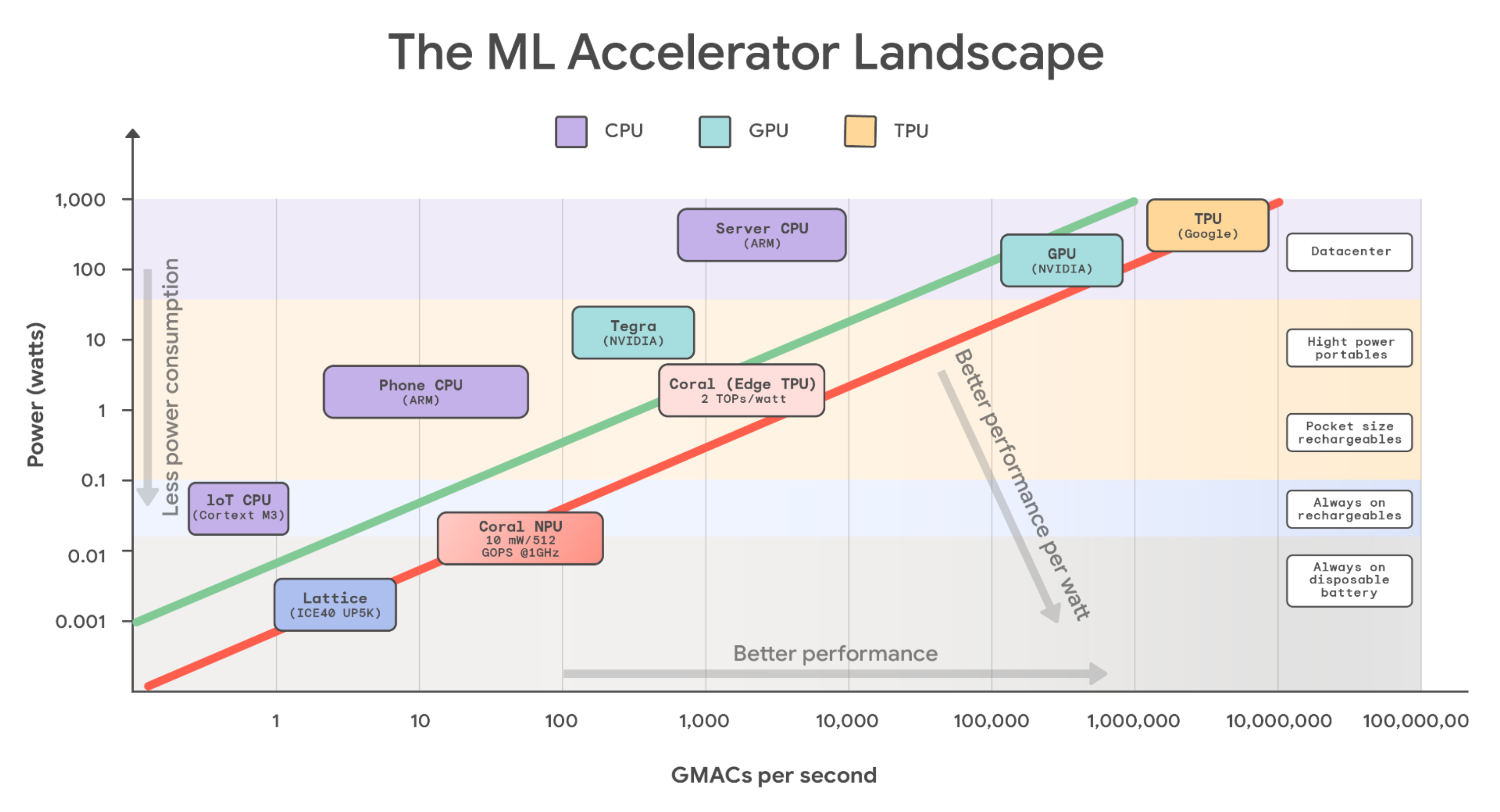
The diagram illustrates that the performance of AI/ML accelerators, measured in
giga multiply-accumulate operations per-second (GMACs), spans a vast range. This
ranges from a few GMACs at the low end to over 10 million GMACs (equivalent to
20,000 TOPS) at the high end. Here's a breakdown of the current landscape:
- **Low-power, battery-operated devices**: At the lower end of the performance
and power spectrum, ultra-low-power FPGAs like the Lattice iCE40UP5K and
microcontrollers based on ARM Cortex-M3 offer performance in the range of a
few GMACs and are ideal for battery-powered devices.
- **Mobile and rechargeable devices**: Moving up the scale, mobile phone CPUs,
often based on ARM architecture, deliver performance in the dozens of GMACs
range. These are commonly found in rechargeable mobile devices.
- **IoT and edge devices**: Further up, we have System-on-Chips (SoCs) that
operate in the thousands of GMACs (a few TOPs). This category includes
Nvidia's Tegra SoC and Google's EdgeTPU ASIC, which offers 4 TOPs. These are
typical in IoT devices that are either battery-powered or have a dedicated
power supply.
- **High-performance computing**: At the highest end, CPUs, GPUs, and TPUs are
used for dedicated AI/ML acceleration in PCs, servers, and cloud
infrastructure.
## Flexible and configurable
The Coral NPU's highly configurable architecture allows silicon partners to
develop a diverse portfolio of low-power AI accelerators from a single IP. The
baseline design targets 512 GOPs/10 mW for wearables, but the design can be
scaled to create higher performance NPU's for specific use cases.
This flexibility provides vendors the ability to create differentiated products
for various markets by tailoring performance and power. This strategy builds a
robust hardware ecosystem and accelerates the next wave of innovation in edge
AI.
*** ** * ** ***