Coral is a full-stack platform designed to empower hardware designers and ML
developers to build the next generation of private and efficient Edge AI
experiences. By combining an AI-first hardware architecture with a unified
developer experience, Coral targets ultra-low power, always-on edge AI
applications using ambient sensing. It is designed to enable all day
AI-experiences on wearable devices minimizing battery usage.
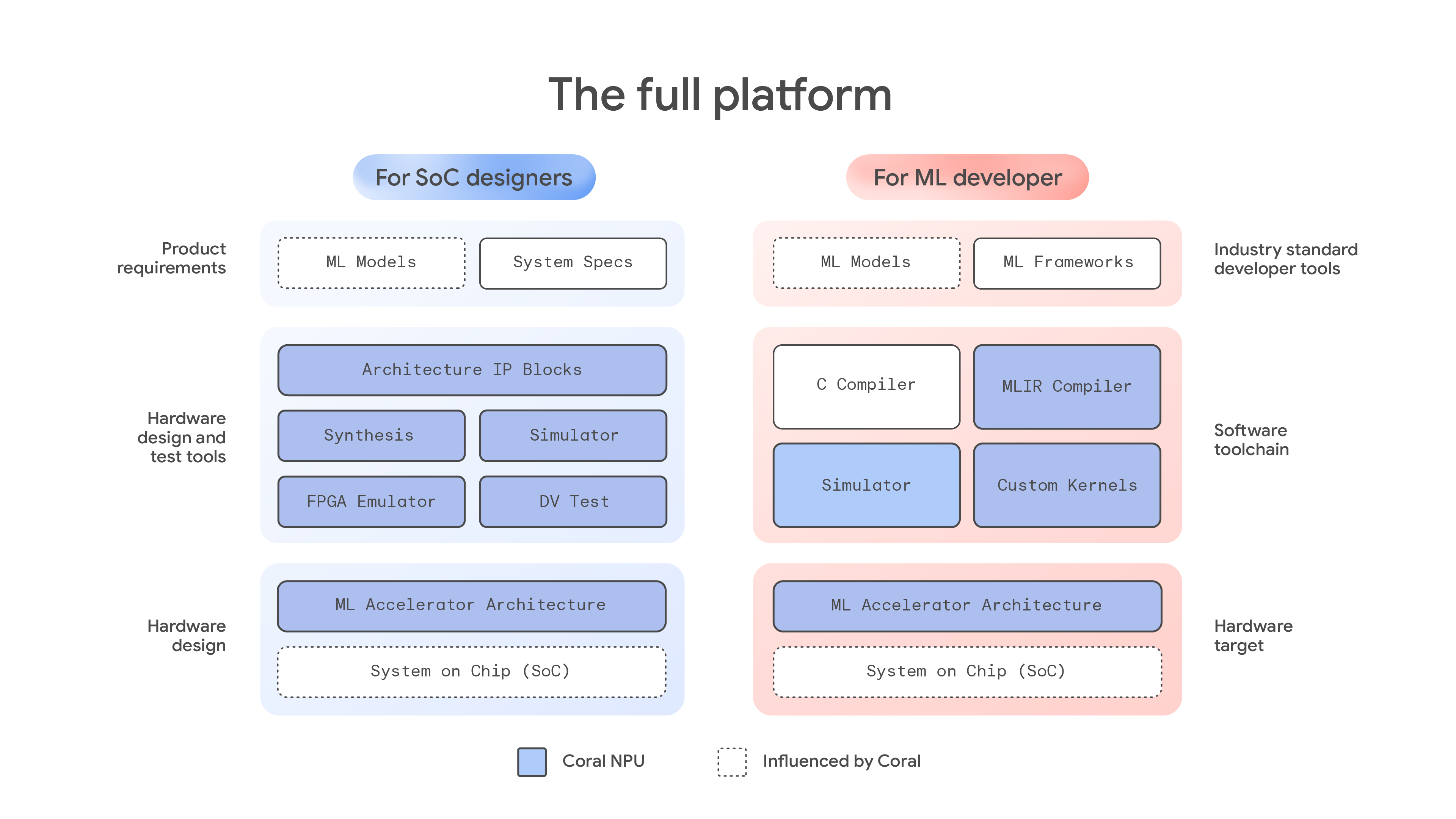
For hardware developers who design SoC or discrete AI accelerator chips, Coral
NPU provides these resources:
- **Architecture IP blocks**: the core and the components described in the
architecture overview provide the foundation for the NPU processor design,
using the RISC-V standard.
- **Synthesis tool**: converts hardware description language (HDL) into a
technology-specific, gate-level netlist. This is analogous to a software
compiler, which translates human-readable source code into
machine-executable binaries. It also performs complex optimizations to
meet the designer's goals for performance, power consumption, and chip
area, collectively known as PPA.
- **Simulator**: creates a virtual model of the RTL to test, verify, and
validate its functionality and performance. This allows rapid iterations and
helps identify issues early in the development cycle, before committing to
expensive physical prototypes.
- **FPGA emulator**: verifies that the design meets functional requirements by
imitating hardware behavior. It provides a high-speed, high-capacity and
hardware-accelerated platform for testing, validating, and debugging the
design before committing to silicon.
- **Design verification (DV) tests**: confirms that the design functions
exactly as intended by its specifications. This is essential for
preventing costly and time-consuming errors before committing to
silicon.
See the [hardware developer
guide](https://developers.google.com/coral/guides/hardware/get-started) for more details.
For software developers who design AI/ML models, Coral NPU provides these
resources:
- **C language compiler**: a standard C compiler for programs written in C.
This compiler is not unique for Coral NPU, as any open source standard C
compiler can be used.
- **MLIR compiler**: Multi-Level Intermediate Representation (MLIR) based
compiler acts as a flexible, modular "compiler toolkit" for bridging
high-level software abstractions with diverse hardware targets. Instead
of compiling directly from a high-level programming language like Python or
C++ to low-level machine code, MLIR enables a series of intermediate steps
that allow for domain-specific optimizations.
- **Simulator**: provides a controlled, virtual environment for training,
testing, and validating AI models. It helps developers evaluate how a model
will interact and perform with the Coral NPU hardware components. Allows
for rapid iterations, for debugging and stress tests.
- **Custom kernels**: are low-level, hardware-specific functions written
to perform specialized and highly optimized computations. Standard
machine learning frameworks offer a wide range of prebuilt operations,
but custom kernels are essential for pushing performance beyond these
generic libraries and implementing novel AI functionality. Developers
should consider using custom kernels for maximum performance, memory and
power optimization, specialized data types and sparsity, and to program the
Coral NPU based NPU design to execute new and experimental operations.
See the [software developer
guide](https://developers.google.com/coral/guides/software/get-started) for more details.
*** ** * ** ***