
Coral NPU is a machine learning (ML) accelerator core designed for
energy-efficient AI at the edge. Based on the open hardware RISC-V ISA, it is
available as validated open-source IP, for commercial silicon integration.
Coral NPU's open-source strategy aims to create a standard architecture to
accelerate the edge AI ecosystem and is based on the prior work of Google
Research in Coral.ai. First released in 2023 as a component of the [Open Se
Cura](https://opensecura.googlesource.com/manifest/+/refs/heads/master/README.md)
research project, it is now a dedicated initiative to drive this vision forward.
## The problem Coral NPU solves
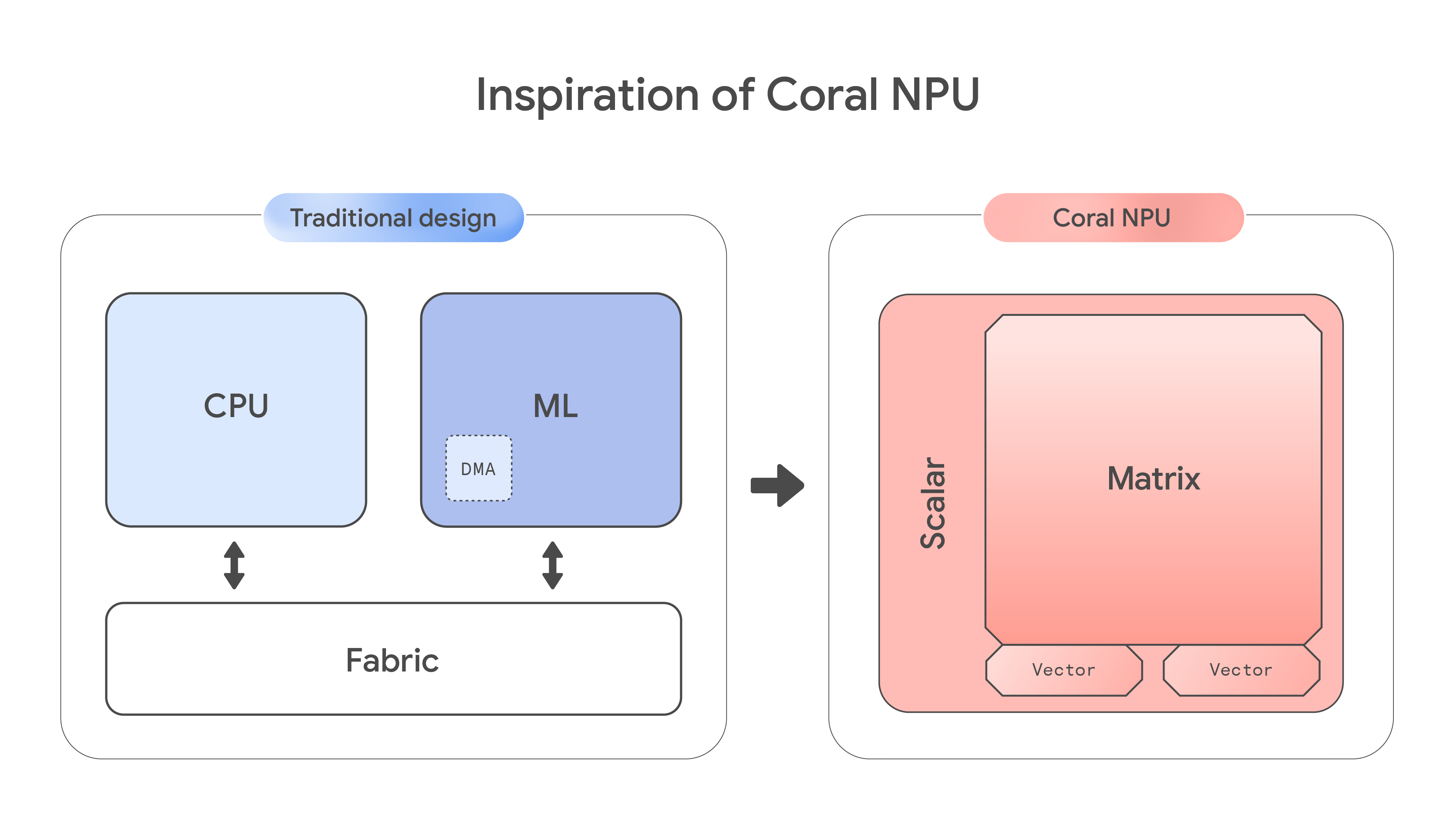
Coral NPU directly addresses the significant fragmentation in the edge AI device
ecosystem. Developers currently face a steep learning curve and major
programming complexity because programming models differ between separate
general-purpose (CPU) and ML compute blocks. These ML blocks often rely on
command buffers generated by specialized, proprietary compilers. This fragmented
approach makes it difficult to combine the strengths of each compute unit and
forces developers to manage multiple proprietary and opaque toolchains for
bespoke architectures.
Coral NPU is built on the RISC-V ISA standard, extending the C programming
environment with native tensor processing capabilities. It supports multiple
machine learning frameworks including: JAX, PyTorch, and LiteRT
(TensorFlow Lite) using open standards-based tools like Multi-Level Intermediate
Representation (MLIR), from the Low Level Virtual Machine (LLVM) project for
compiler infrastructure.
This integration of native ML acceleration primitives with a general purpose
computing ISA, delivers high ML performance without the usual system complexity,
cost, and data movement associated with separate, proprietary CPU/NPU designs.
## Key differentiators
Coral NPU's design is driven by several key principles:
- **ML-First Architecture**: Coral NPU reverses the traditional processor
design. Instead of starting with basic scalar computing, then adding vector
(SIMD) and matrix capabilities, Coral NPU is built with matrix
multiplication capabilities first and then integrates vector and scalar
functions. This tight integration of scalar/vector/matrix in a single
instruction set optimizes the architecture for AI workloads from its
foundation.
- **Dedicated ML Engine**: At the center of the design is a quantized outer
product multiply-accumulate (MAC) engine, purpose-built for the fundamental
calculations of neural networks. This specialized core processes 8-bit
operations into 32-bit results with extreme efficiency.
- **Integrated Vector (SIMD) Unit**: The vector execution engine implements
the
RISC-V Vector instruction set (RVV) v1.0, using a 32 x 128-bit vector
register file where a single instruction
triggers multiple operations, significantly boosting efficiency.
- **Simple, C-Programmable Scalar Core** : A lightweight RISC-V (RV32IMF)
frontend acts as a simple controller, managing and feeding the powerful
matrix and vector backends. This core is designed for a
["run-to-completion"](https://en.wikipedia.org/wiki/Run-to-completion_scheduling)
model, meaning it doesn't require a complex operating system or frequent
interrupts, contributing to its ultra-low power consumption.
- **Efficient Memory Management**: Coral NPU uses a single layer of small,
fast RAM (8KB for instructions, 32KB for data) to keep data close to the
processing units, minimizing power and latency.
- **Unified Developer Experience** : The platform is C-programmable and
designed for easy integration with modern ML compilers like [LiteRT Micro](https://ai.google.dev/edge/litert/microcontrollers/overview)
and [IREE](https://iree.dev/). This allows a unified,
MLIR-based toolchain
to support models using major frameworks including TensorFlow, JAX, and
PyTorch.
## Performance and efficiency highlights
Coral NPU's design delivers a highly efficient balance of power, performance,
and size, making it ideal for ambient applications and scalable to multicore
setups.
- **Performance**: Targets 512 GOP/S (Giga Operations Per Second) with 256 MACs per cycle.
- **Power Objective**: Ultra-low consumption, targeting \~6mW at 1GHz, using 22nm technology.
## Target applications
Coral NPU is designed to enable ultra-low-power, always-on edge AI applications,
particularly focused on ambient sensing systems. Its primary goal is to enable
all day AI-experiences on wearable devices minimizing battery usage.
### Potential use cases
- **Contextual Awareness**: Detecting user activity (e.g., walking, running),
proximity, or environment (e.g., indoors/outdoors, on-the-go) to enable
"do-not-disturb" modes or other context-aware features.
- **Audio Processing**: Voice and speech detection, keyword spotting, live
translation, transcription, and audio-based accessibility features.
- **Image Processing**: Person and object detection, facial recognition,
gesture recognition, and low-power visual search.
- **User Interaction**: Enabling control via hand gestures, audio cues, or
other sensor-driven inputs.
### Ideal device categories
Coral NPU's combination of high efficiency and low power makes it ideal for a
wide range of hardware:
- Hearables and smart earbuds
- Smart glasses and AR headsets
- Smartwatches and fitness trackers
- Smart home and ambient IoT devices
- Mobile phones (for ultra-low-power coprocessing)
- Automotive and in-vehicle systems
## Roadmap
The initial Coral NPU release includes our RISC-V compliant scalar core and
vector execution unit. Future releases will introduce our RISC-V matrix
execution unit that will provide a complete, end-to-end, open-source stack for
a fully RISC-V compliant NPU. See [Platform roadmap](https://developers.google.com/coral/guides/roadmap.md.txt)
for more details.
*** ** * ** ***