All of the information here is taken from *The RISC-V Instruction Set Manual* ,
[Zvt Family of Vector Matrix Extensions
(v0.3)](https://lists.riscv.org/g/tech-vme/attachment/411/0/zvt-20260831.pdf).
Copyright 2026 by RISC-V International.
The RISC-V^®^ Instruction Set Architecture (ISA) specifications are
owned by RISC-V International and licensed under the Creative Commons
Attribution 4.0 International License (CC-BY 4.0).
## Overview
The RISC-V **Zvt** matrix extensions add a new architectural state to each hart
in the form of square matrix tiles. New instructions perform tall-skinny by
short-wide matrix multiplications, in other words outer products or wide-outer
products. These instructions source their operands from vector registers and
accumulate their results into the square matrix tiles. Each matrix tile row or
column must fit within a single vector register group (VLEN\*8 bits).
The inputs' data width is specified by SEW, while the accumulators' data width
is given by TEW = SEW \* TWIDEN, where TWIDEN can be 1, 2, or 4, depending on the
instruction.
The matrix computational instructions perform the operation
`C[M,N] += A[K,M]^T * B[K,N]`
where C is stored in the tile state. Each of the input matrices A and B is held
in a set of vector registers, where each row of the matrix is held in a separate
vector register group and the number of rows is given by K. The inner dimension
K can be a maximum (KMAX) of 1, 2, or 4, depending on the data type of A and B.
Other instructions are provided to move rows and columns of the matrix arrays
--- moving them either to or from the vector registers or memory.
The **Zvtbase** extension provides the new architectural state along with the
new
configuration, move, load, store, and context-manipulation instructions. In the
base, the move, load, and store instructions support a tile EEW (TEW) of 32;
other TEWs are reserved for these instructions. TEW = 32 is chosen because it is
the most common accumulator bit-width.
The ISA fixes the number of TEW=32 tiles to four (mt0, mt4, mt8, mt12) to
support all cases at reasonable performance. The matrix state needs to hold at
least one accumulator as well as transposes of one or both inputs to support
efficient execution of all matrix operations.
The ISA is optimized for the case where TEW=32, as this is the most common
accumulator size. When TEW=32, the tiles have dimensions TE x TE elements, where
TE is a parameter of the implementation. TE is constrained to be a power of 2,
such that VLEN/4 \>= TE \>= 4. The upper bound is set by the requirement that a
tile row or column must fit within a single vector register group (VLEN\*8 bits).
The configuration instructions, described below, support writing of TE-agnostic
code.
The parameter ETE describes the tile dimensions as a function of TEW:
ETE = TEW \< 64 ? TE : TE/2
The **Zvt** matrix functionality is also referred to as Vector Matrix Extensions
(VME).
> [!NOTE]
> **Note:** The accumulator array dimensions (TE) may be determined dynamically with the `msettn` instruction, to enable writing TE-agnostic software.
## Matrix type (mtype) CSR
Similar to the Vector Type register (`vtype`), which is used dynamically govern
vector configuration, the Zvt matrix extension adds a Matrix Type register named
`mtype`. This register is unprivileged and read-only. It contains the following
fields:
| Bits | Field Definition |
|---|---|
| XLEN--1:24 | *reserved* |
| 23:10 | tm\[13:0\] --- Matrix dimension M, saturated to a maximum value |
| 9:8 | *reserved* |
| 7:5 | tk\[2:0\] --- Matrix dimension K, bounded up to KMAX (for example, 3) |
| 4:2 | *reserved* |
| 1:0 | mtwiden\[1:0\] |
- tm can hold values from 0--TE, inclusive.
- tk can hold values from 0--4, inclusive.
- If mtwiden=0, the matrix unit is not configured.
This configuration controls the active dimensions and operational parameters of
the matrix execution pipeline. Note that the vector configuration register `vl`
controls the matrix dimension N, dynamically tracking the active vector length
up to VLMAX.
## Matrix-multiply operations
The general form of the matrix-multiply operation is:
`C[tm,tn] += A[tk,tm]^T * B[tk,tn]`
where the inputs A and B are each sourced from a vector register group, while
the accumulator C is held in a matrix tile. A, B, and C are all specified
using register specifier fields in the instruction encoding.
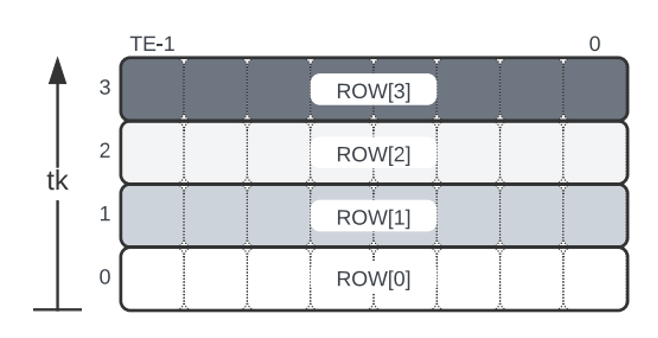
*A or B Matrix Operand*
The values of tm, tn, and tk are obtained from CSRs. tm and tk are fields in the
`mtype` register. tn is derived from `vl`; it is equal to min(vl,ETE). The new
configuration instructions described below allow the values of tm, tn, and tk to
be set in an implementation-agnostic manner from the application matrix
dimensions.
Each vector register group input has tk rows, where each row is held separately
in one or more vector registers, with the total number of vector registers
constrained to fit in one eight-register group. Each row fits within a vector
register group (i.e. an aligned power-of-2 number of vector registers) and the
collection of rows also fits in a (potentially larger) vector register group.
The value of tk sets the dimension of the dot products performed for each
accumulator element and the maximum value of tk (KMAX) depends on the element
widths, with a maximum value of 4.
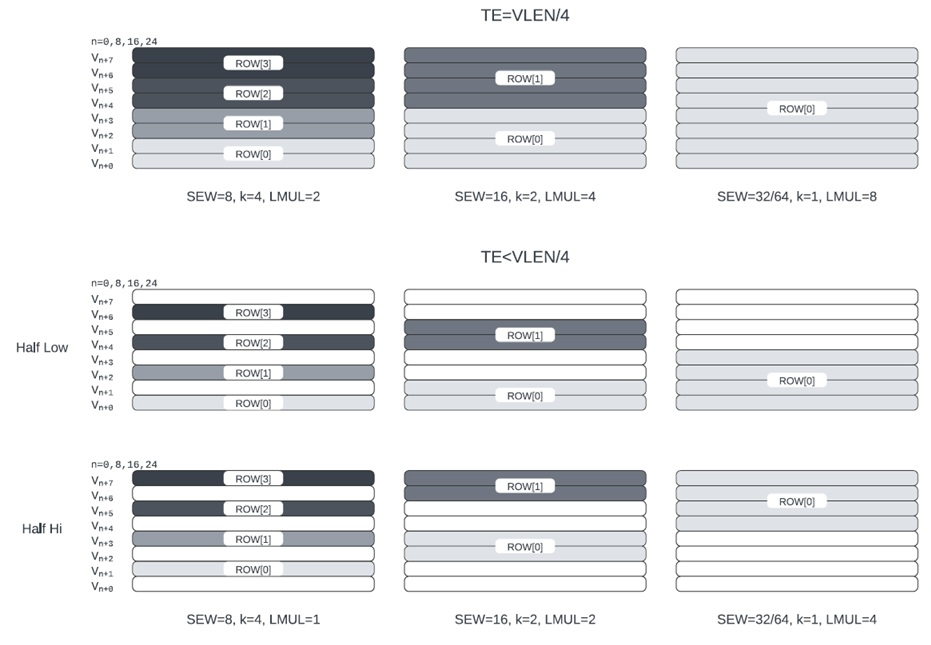
*Matrix Operand Layout in Vector Register Group*
This format allows existing vector unit-stride loads to be used to load each row
of an input from a memory matrix held in row-major format.
Successive rows are separated by (8/KMAX) vector registers. For example, for
vector register group specifier `v8`, and assuming KMAX=4 and LMUL=2, then `v8`
-- `v9` holds one matrix row, `v10` -- `v11` holds the next row, `v12`
-- `v13` the next, and `v14` -- `v15` the last. But when KMAX=4 and
LMUL=1, then `v8`, `v10`, `v12`, and `v14` hold the successive rows of the
matrix: the separation between rows is the same, but the odd-numbered vector
registers are skipped.
Vector register specifiers must be divisible by LMUL. For example, when KMAX=4
and LMUL=2, `v8` is valid but `v9` is not. But when KMAX=4 and LMUL=1, both are
valid: the former represents the even-numbered registers `v8` -- `v14`,
whereas the latter represents the odd-numbered registers `v9` -- `v15`.
Vector register specifiers, when taken modulo 8, must be less than 8/KMAX. For
example, when KMAX=4, `v10` is invalid.
## Matrix configuration instructions
The matrix configuration instructions are summarized in the following table:
| Instruction | Description |
|---|---|
| `msetmtype rs1,rs2` | Write the `mtype` and `vtype` CSRs to the values in the `rs1` and `rs2` registers. |
| `msetmtypei` | Similar to `msetmtype` except: 1) the new `mtype` CSR value is supplied by a zero-extended immediate, 2) the `vtype.vsew` field value is supplied by a zero-extended immediate, and 3) all other `vtype` fields are zeroed. |
| `msettn rd,rs1` | Set tn/vl to the value in `rs1`, constrained by the current matrix configuration; sets matrix dimension N. Operates similarly to `vsetvl`, updating `vl` from `rs1` and writing the new `vl` to `rd`. (See note below.\*) |
| `msettm rd,rs1` | Set tm to the value in `rs1`, constrained by the current matrix configuration -- sets tm to be the lesser of `rs1`, LMULxEVE, and ETE. Sets matrix dimension M. (See note below.\*) |
| `msettk rd,rs1` | Set tk to the value in `rs1`, constrained by the current matrix configuration -- sets tk to the lesser of `rs1` and KMAX. Sets matrix dimension K. (See note below.\*) |
\* For `msettm` and `msettk`, the new field value is written back to the
destination register `rd`. The `msettn` instruction uses the standard `vsetvl`
datapath to write the updated `vl` to `rd`.
Application matrices have varied sizes. The matrix configuration instructions
allow a single binary matrix-multiply routine to work for any size application
matrix-multiply on any sized matrix-multiply hardware implementation.
The actual size of a matrix-multiply operation is determined by values in two
CSRs: tk and tm are fields in the `mtype` register; tn is derived from the
`vl` register. These CSRs are set using configuration instructions.
The existing `vset[i]vl[i]` instructions write zero to the `mtype` CSR.
The `msetmtype` instruction writes the `mtype` and `vtype` CSRs to the values in
the `rs1` and `rs2` registers. First, vl is written with 0, and `mtype` is
written with the value in rs1. Then, `vtype` is written with the value in rs2,
as though by a `vsetvl` instruction. Finally, if `mtype.mtwiden` != 0, then vma
and vta are set to 1, vill is set if the resulting TEW is unsupported, and
`vlmul` is set.
The `msetmtypei` instruction is defined similarly, except the new
`mtype.mtwiden`,
`vtype.vsew`, and `vtype.altfmt` fields are supplied by immediates.
These instructions are included in the Zvtbase extension.
### msettn instruction
This instruction sets tn or vl to the value in `rs1`, constrained by the current
matrix configuration. If the matrix unit is not configured,
in other words mtwiden=0, the
instruction writes `vl` as if by a `vsetvl` instruction using the current vtype
setting. The new value of tn/vl is also written to the scalar destination
register `rd`.
The `msettn` instruction operates as follows:
if mtype.mtwiden == 0:
rd = vl = rs1 (following vsetvl semantics)
else:
rd = vl = min(rs1, LMUL*EVE, ETE)
The `msetmtype` and `msettn` instructions are intended to be used by
context-switching routines. Because their semantics degenerate to those of
`vsetvl` when the matrix unit is not configured, the usual `vsetvl` can be
replaced with `msetmtype` and `msettn`; there is no need to use a dynamic branch
to select between the two schemes.
### msettm and msettk instructions
These instructions set tm or tk to the value in `rs1`, constrained by the
current matrix configuration. If the matrix unit has not been configured
(mtwiden=0), the new tm or tk value is 0. The new value of tm or tk is also
written to the scalar destination register `rd`.
`msettm rd, rs1 // rd = tm = min(rs1, LMUL*EVE, ETE)`
The `msettm` instruction sets tm to be the lesser of `rs1`, LMUL\*EVE, and ETE.
`msettk rd, rs1 // rd = tk = ((mtwiden == 0) ? 0 : min(rs1, KMAX))`
The `msettk` instruction sets tk to the lesser of `rs1` and KMAX.
> [!NOTE]
> **Note:** Unlike the `vsetvl` family of instructions, `msettn`, `msettm`, and `msettk` are not special-cased when `rd` and/or `rs1` is `x0`.
### Supported SEW, TWIDEN, and KMAX values
The inner dimension specified by tk is used to support dot-product operations on
narrower datatypes to increase efficiency. The ISA fixes maximum K values (KMAX)
of matrix-multiply instructions according to SEW and TWIDEN to simplify ISA
specification of these arithmetic operators.
Unlike other matrix accelerator architectures that support fusion of narrower
datatypes by flattening K into both the M and N dimensions, this approach allows
software to use standard matrix formats.
TEW=8
SEW TWIDEN KMAX
8 1 4 (4-element dot product)
TEW=16
SEW TWIDEN KMAX
8 2 4 (4-element dot product)
16 1 2 (2-element dot product)
TEW=32
SEW TWIDEN KMAX
8 4 4 (4-element dot product)
16 2 2 (2-element dot product)
32 1 1
## Tile subset specifier (TSS)
For operations that move rows or columns between the matrix tiles and vector
registers or memory, a scalar value is used to encode the set of tile elements
that are accessed and the pattern by which they are accessed.
| Bits | Field definition |
|---|---|
| XLEN--1:31 | *reserved* |
| 30:27 | tile specifier (0-15) |
| 26:24 | pattern (0=row, 1=col, \>1 reserved) |
| 23:0 | index within pattern (e.g. row/col index) |
When there are fewer than 16 tiles due to the specified TEW, the log2(16 /
NTiles) LSBs of the tile specifier field are ignored, such that this field
always refers to a valid tile. The 3-bit field for pattern only has
two encodings defined, row and column. The pattern field defines how the index
field is interpreted. For the defined row and column patterns, the
index field is treated as an unsigned integer providing a one-dimensional index
of the row or column. Row and column indices greater than or equal to ETE are
reserved.
## Load/store tile subset to memory
The `vtle` and `vtse` instructions transfer matrix tile subsets between the tile
state and memory. These instructions support TEW values corresponding to all
supported SEW settings (8..ELEN). Implementations must provide vector loads and
stores with EEWs corresponding to all supported SEW settings (8..ELEN). These
instructions are included in the Zvtbase extension.
// Load tile subset from memory, using TEW=EEW
vtle8 rs2, (rs1) // rs1 is memory address, rs2 is TSS
vtle16 rs2, (rs1) // rs1 is memory address, rs2 is TSS
vtle32 rs2, (rs1) // rs1 is memory address, rs2 is TSS
vtle64 rs2, (rs1) // rs1 is memory address, rs2 is TSS
// Store tile subset to memory, using TEW=EEW
vtse8 rs2, (rs1) // rs1 is memory address, rs2 is TSS
vtse16 rs2, (rs1) // rs1 is memory address, rs2 is TSS
vtse32 rs2, (rs1) // rs1 is memory address, rs2 is TSS
vtse64 rs2, (rs1) // rs1 is memory address, rs2 is TSS
The integer register specified by `rs1` holds the base address in memory. The
integer register specified by `rs2` holds the tile subset specifier. These
instructions do not support masks. EEW is statically encoded in the instruction.
These instructions always load and store the tile subset to a contiguous region
of memory. For the defined row and column patterns, the elements of
the row or column are stored in increasing index order in memory.
For these instructions, the body elements are those with indices in the range
`[vstart, min(vl, ETE) - 1]`, and the tail elements are those with
indices ≥ min(vl, ETE).
Since vl=tn holds the number of columns in the accumulator (the length of a
row), these instructions are oriented towards loading and storing accumulator
rows. When loading and storing accumulator columns, additional `msettn`
instructions may be needed to program vl=tn to hold the number of rows,
that is, the length of a column, instead.
## Move tile subset between tile state and vector registers
Tile subset operations transfer elements between a matrix tile and a vector
register group. These instructions support TEW values corresponding to all
supported SEW settings (8..ELEN). These instructions are included in the Zvtbase
extension.
// Move tile subset to vector register group, using TEW=SEW
vtmv.v.t vd, rs1
// vd is destination vector register, rs1 is TSS of source
// Move vector register group to tile subset, using TEW=SEW
vtmv.t.v rs1, vs2
// vs2 is source vector register, rs1 is TSS of destination
## Matrix arithmetic instructions
These instructions all have the form C += A\^T \* B, where C is held in a matrix
tile and A and B are supplied by vector register groups.
### Floating-point matmuls (OCP, BF16, IEEE)
vtfmm.tvv mtd, vs2, vs1
vtfmm.alt.tvv mtd, vs2, vs1
- `vtype` holds SEW and `altfmt`; `mtype` holds TWIDEN
- `vs2` specifies A vector register group
- `vs1` specifies B vector register group
- `mtd` is C destination tile specifier
### Integer matmuls
vtmmu.tvv mtd, vs2, vs1
vtmms.tvv mtd, vs2, vs1
These instructions use the values of tm, tn, and tk to determine what
computations to perform. If any of these values are zero, then no computation is
performed and no state is updated.
## Matrix tile-zero instruction
The `vtzero` instruction writes 0 to each element of the tm by tn submatrix of
the destination matrix tile. This instruction is included in the Zvtbase
extension.
`vtzero mtd`
## Context status
The `mtype` CSR is considered part of the vector context; access to this CSR is
controlled by the various VS fields. Additional MS context-status fields are
added to reduce the cost of saving and restoring the matrix tile state.
### Zvt context status in mstatus
A Zvt context status field, MS, is added to `mstatus[30:29]` and shadowed in
`sstatus[30:29]`. It is defined analogously to the floating-point context status
field, FS.
### Zvt context discard instruction
The `vtdiscard` instruction is provided to inform the runtime that the matrix
tile state is no longer useful and need not be saved.
*** ** * ** ***